 中文
中文


Home > News > India’s Biotech Shift: Breakthrough Disease Therapies May Launch Every Few Years, Says Eyestem’s Dr Jogin Desai
India’s Biotech Shift: Breakthrough Disease Therapies May Launch Every Few Years, Says Eyestem’s Dr Jogin Desai
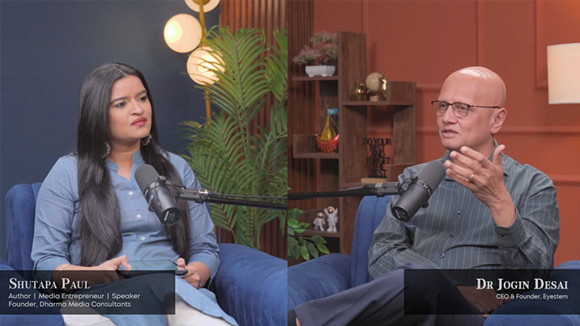
Bengaluru, 15 April 2026: As India’s biotechnology sector enters a high-growth phase, a key question is emerging: can it deliver breakthrough therapies globally? In the latest episode of the “What India Needs!” podcast, host Shutapa Paul spoke with Dr Jogin Desai, Founder and CEO of Eyestem, about this inflection point as the sector shifts from incremental progress to transformative, globally competitive medical solutions.
Rethinking Treatment Timelines
Setting the context, Paul noted, “Eyestem is among a handful of companies globally working on therapies that could potentially reverse blindness caused by dry age-related macular degeneration (AMD). If successful, this would not just be a scientific milestone, but also a life-changing breakthrough for millions.”
Building on this, Dr Desai pointed to a broader shift underway in biotechnology: “Our goal is to bring a new therapy for an incurable disease every two to three years once we reach commercialisation. Historically, new treatments have taken decades, but that cycle is now compressing dramatically.”
Apart from dry AMD, Eyestem is expanding its product pipeline across multiple incurable conditions. As Dr Desai explained, “One is retinitis pigmentosa, which primarily affects younger populations, with animal studies expected to begin next year. The second is idiopathic pulmonary fibrosis, where studies are set to commence next month in collaboration with partners in Singapore. The third is Parkinson’s disease, for which we are currently in the process of identifying the most suitable cell-based approach.”
He emphasised that the shift is not just about speed, but also about fundamentally redefining treatment outcomes. “We are not in the business of slowing diseases; we are working towards reversing them. There is credible science, along with active trials and a clear pathway emerging,” he said.
India’s Window of Opportunity
The conversation comes at a time when India’s biotech sector is witnessing strong policy backing. Union Budget 2026–27 introduced the Biopharma SHAKTI programme, a ₹10,000 crore initiative focused on strengthening biologics manufacturing, expanding clinical research infrastructure, and enhancing regulatory capacity.
Dr Desai noted that this momentum coincides with a unique global shift. “India is investing at a time when parts of the West are pulling back on research funding, creating a rare window of opportunity to build long-term leadership in deeptech and biotechnology,” he said.
However, he cautioned that India’s ability to capitalise on this moment will depend on structural changes in how innovation is funded. “In developed economies, private capital plays a far larger role in driving innovation. In India, the structure is still heavily government-led, and that limits the pace at which breakthrough science can scale,” he explained. At present, nearly 60–70 per cent of R&D in developed markets is driven by private capital, while in India, close to 70 per cent continues to be government-led.
Paul reinforced this concern, pointing out that India’s overall R&D expenditure, at approximately 0.6–0.7 per cent of the gross domestic product (GDP), remains significantly lower than that in countries such as the US, China, and Israel. “This gap raises important questions about long-term competitiveness, especially in sectors like biotechnology that rely heavily on sustained research investment,” she noted.
Dr Desai also pointed to growing deep science innovation across India, supported by institutions like C-CAMP, as a sign that globally relevant breakthroughs are beginning to emerge.
Translating Capability into Real-World Impact
Paul highlighted the broader challenge of translating scientific capability into actual impact. “We’ve built strong scientific capability over the years, but the real question is how much of that is translating into scalable, real-world solutions?” she asked.
Dr Desai pointed to regulatory delays as a key bottleneck. “If you raise capital for 18 months and spend six to nine months waiting for approvals, that is a significant portion of time lost. In markets like the US and China, decisions are often made in close to 30 days. Greater predictability in India would significantly improve innovation velocity and investor confidence,” he said.
With India’s bio-economy projected to reach $300 billion by 2030, Dr Desai emphasised that global leadership will require more than growth alone: “At a minimum, India should aim to create multiple blockbuster drugs for the world over the next decade. That is the level of ambition required if we want to move from being a manufacturing hub to an innovation leader.”
From Cost Arbitrage to Innovation Leadership
Eyestem’s work reflects the breakthrough innovation the sector is aiming for. The company is developing regenerative therapies for dry AMD, a leading cause of blindness globally. “If successful, this will be among 2-3 therapies in the world that reverses vision loss rather than just slowing it,” Dr Desai said.
“Globally, similar therapies are priced anywhere from $500,000 to over $2 million. Our goal is to bring this down to below $15,000, and potentially even lower, so that it is accessible at scale,” he added.
Paul noted that such breakthroughs could reshape not just healthcare outcomes, but also global perceptions of India’s innovation capabilities. “Some of the most exciting work today is happening in deeptech and biotech, but it often goes underreported because it is complex and long-gestation. That narrative needs to change,” she said.
Looking ahead, Dr Desai highlighted the convergence of artificial intelligence (AI) and biology as a key driver of transformation. “The combination of AI and biology can unlock new pathways in this sector, and at the same time, it will bring new risks, requiring strong guardrails from both companies and governments,” he said.
Watch Link:
YouTube: https://youtu.be/Pw1dX6TU0gM
Spotify: https://open.spotify.com/episode/6lpqa8IebrTLg6kMVWcFYv?si=xIq4VW3aSqyYNtFoP9XnXQ
About the “What India Needs!” Podcast
“What India Needs!” is a thought-provoking podcast dedicated to exploring key topics crucial to India’s development. Our mission is to delve into pressing issues, engage with experts and thought leaders, and uncover actionable solutions for a more sustainable and prosperous future. Join us as we navigate the complexities of India’s growth, from policy and governance to technology and innovation, fostering informed discussions that inspire change and drive progress. To know more, check out our channel: https://www.youtube.com/@Shutapa_Paul
About Shutapa Paul
The host of the “What India Needs!” podcast, Shutapa Paul, is an anchor, commentator, author, and media entrepreneur. After a successful career in journalism, she founded Dharma Media Consultants, an award-winning brand-building and communications company. Her deep knowledge and experience in the investing, startup, and impact ecosystem have earned her numerous accolades, including being listed in Businessworld’s 40 Under 40 (PR & Corp Comm), Social Samosa’s 40 Under 40, and Agency Reporter’s 40 Under 40. She is also the recipient of Businessworld’s Excel Communications Personality of the Year award and ranks among LinkedIn’s “Top Voices”. With Shutapa Paul at the helm, the “What India Needs!” podcast promises to be a vibrant platform for discussing impactful ideas and insights.
About Eyestem:
Headquartered in Bengaluru and Delaware, Eyestem Research is a clinical-stage biotechnology company, which was started by a founding team with several decades of experience in pharmaceutical product development, retinal surgery, and cell biology. It has won significant accolades with the most recent one being named the top innovator in India across all sectors in 2022 by the prestigious The Economic Times newspaper. It is also the recipient of several prestigious grants and awards from the Department of Biotechnology (DBT), Government of India, and has been feted at high-profile government events as one of the most successful and innovative biotechnology companies in the country.
About Dr Jogin Desai
Dr Desai is the Founder and CEO of Eyestem, a company aiming to democratise access to cell therapy through a scalable cell therapy platform. He brings more than 20 years of experience in growing and nurturing businesses to his newest venture. Prior to Eyestem, he was part of the global leadership team at Quintiles and headed up their cardiac safety business from 2001 to 2007. More recently, he was the CEO of Cenduit (www.cenduit.com), a randomisation joint venture between Quintiles (IQVIA) and ThermoFisher Scientific company with offices in North Carolina, Bangalore, Basel, and Philadelphia.
Related News
- Lipid Nanoparticles (LNPs) for Protein Delivery: Breaking Through Therapeutic Ba 9/20/2026
- PMSF Protease Inhibitor: The Indispensable Guardian of Proteins in Laboratory Re 9/19/2026
- Avantor Expands RIM Single-Use Portfolio Across APAC 9/18/2026
- Neutral Protease: Core Properties, Experimental Applications and High-Quality Pr 9/18/2026
- Prestained Protein Marker: A Comprehensive Guide for Western Blot and Protein El 9/17/2026
- PSEN1 Antibody: A Critical Tool for Deciphering Alzheimer's Disease Pathogenesis 9/16/2026
- SHP Substrate 1 Recombinant Protein: Molecular Design, Functional Mechanisms and 9/15/2026
- Research Progress on Hepatic Lectin H1 Protein 9/14/2026
- PIC Paired Antibodies: A Comprehensive Analysis of Principles, Preparation, and 9/11/2026
- CMS: Initial Prescriptions for Silevimig Injection, the World's First Bispecific 9/10/2026