 中文
中文


Home > News > CD163 Antibodies: Targeted Delivery Systems for Promoting Vascular Regeneration and Homeostasis Recovery Post-Spinal Cord Injury
CD163 Antibodies: Targeted Delivery Systems for Promoting Vascular Regeneration and Homeostasis Recovery Post-Spinal Cord Injury
- 1. Concept
Spinal cord injury (SCI), a severe central nervous system (CNS) trauma, triggers complex pathological cascades where vascular system damage and impaired repair are key barriers to neurological recovery. Post-injury disruption of the blood-spinal cord barrier (BSCB) causes microenvironmental imbalance, leading to progressive tissue ischemia and secondary injury. While endogenous angiogenic responses are activated, newly formed blood vessels often lack functionality, maturation, and barrier integrity—failing to restore effective tissue perfusion. CD163, a macrophage-specific surface marker primarily expressed on repair-oriented M2-type macrophages, plays a pivotal role in this context. These cells secrete transforming growth factor-β (TGF-β), which regulates angiogenesis and barrier stabilization but may also promote glial scar formation. CD163 antibodies, developed by ANT BIO PTE. LTD., enable precise identification and targeting of these macrophages, supporting the development of targeted delivery systems to enhance vascular regeneration and BSCB repair after SCI.
2. Research Frontiers
Cutting-edge research on CD163 and targeted delivery systems has unlocked innovative therapeutic strategies for SCI:
M2 Macrophage-Mediated Repair: CD163-positive M2 macrophages secrete TGF-β, which promotes vascular endothelial cell proliferation, migration, and lumen formation while enhancing intercellular junction protein expression to stabilize the BSCB. The challenge lies in separating TGF-β’s pro-angiogenic effects from its pro-fibrotic (glial scar-promoting) properties.
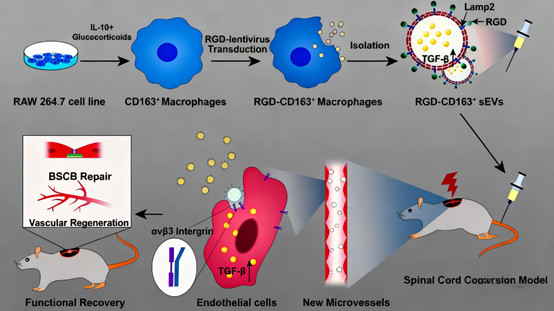
RGD-Modified Targeted Delivery Systems: Arginine-glycine-aspartic acid (RGD) peptide-modified extracellular vesicles (EVs) form a precision delivery platform. RGD binds specifically to integrin αvβ3 on neovascular endothelial cells, enabling targeted accumulation of EV-encapsulated bioactive molecules at SCI sites. EVs offer inherent advantages: biocompatibility, low immunogenicity, and sustained release of cargo.
Preclinical Efficacy Validation: In vivo studies confirm that intravenous injection of RGD-modified EVs (loaded with CD163-positive macrophage-derived factors) accumulates at SCI neovascular regions, significantly enhancing vascular network reconstruction and BSCB function. Treated animals show improved motor function and neural conduction, while in vitro experiments demonstrate enhanced endothelial cell tube formation, migration, and barrier integrity.
Therapeutic Innovation: This strategy achieves dual targeting (CD163-positive macrophages + αvβ3-expressing endothelial cells), spatial restriction of TGF-β action, and avoids synthetic carrier-related toxicities—representing a paradigm shift from non-specific to precision therapy for SCI.
3. Research Significance
CD163-targeted delivery systems hold profound implications for SCI treatment and translational medicine:
Addressing Unmet Clinical Needs: They tackle the core barrier to SCI recovery—vascular dysfunction and BSCB impairment—offering a targeted alternative to non-specific traditional therapies.
Precision Medicine Advancement: By isolating TGF-β’s beneficial effects from its adverse outcomes, the system maximizes therapeutic efficacy while minimizing glial scar formation, a major limitation of conventional treatments.
Broad Applicability: Beyond SCI, the platform can be adapted to deliver other therapeutic molecules for vascular-related CNS disorders or peripheral tissue repair, expanding its translational value.
Research Tool Value: High-quality CD163 antibodies enable accurate identification of M2 macrophages, advancing studies on macrophage polarization, tissue repair mechanisms, and tumor-associated macrophage biology.
4. Related Mechanisms, Research Methods, and Product Applications
Related Mechanisms
CD163-targeted delivery systems promote SCI recovery through coordinated biological pathways:
M2 Macrophage Recruitment and Activation: CD163-positive M2 macrophages secrete TGF-β, which activates downstream signaling in vascular endothelial cells to drive angiogenesis and BSCB stabilization.
Targeted Cargo Delivery: RGD-modified EVs bind integrin αvβ3 on neovascular endothelial cells, delivering encapsulated TGF-β or other bioactive molecules directly to injury sites—avoiding systemic off-target effects.
Barrier Function Restoration: TGF-β upregulates intercellular junction proteins (e.g., tight junctions) in endothelial cells, reducing BSCB permeability and restoring microenvironmental homeostasis.
Research Methods
CD163 antibodies and targeted delivery systems rely on advanced research techniques:
Macrophage Identification and Isolation: Flow cytometry and immunohistochemistry (IHC) using CD163 antibodies to purify and characterize M2-type macrophages.
Targeted Delivery System Construction: Genetic modification of cells to express RGD peptides, EV isolation and characterization, and cargo loading efficiency analysis.
In Vivo Efficacy Assessment: SCI animal models to evaluate vascular density, BSCB integrity (via permeability assays), motor function recovery (e.g., BBB locomotor scale), and histological analysis.
In Vitro Functional Assays: Endothelial cell tube formation, migration, and barrier integrity assays to validate the system’s direct effects on vascular cells.
Product Applications by ANT BIO PTE. LTD.
ANT BIO PTE. LTD., via its sub-brand STARTER (specializing in high-performance antibodies), offers a curated portfolio of CD163 antibodies with exceptional specificity, sensitivity, and batch consistency. These products are rigorously validated for IHC, flow cytometry, and functional assays, enabling diverse research applications:
SCI and Tissue Repair Research: Identification of M2 macrophages in injury sites to study their role in vascular regeneration and BSCB repair.
Macrophage Typing: Specific detection of M2-type macrophages for analyzing polarization in inflammatory diseases, infection, and tissue repair.
Tumor-Associated Macrophage (TAM) Studies: Detection of CD163-positive TAMs in solid tumors (breast, liver, colorectal cancer) to explore their links to angiogenesis, immune suppression, and tumor progression.
Hemoglobin Metabolism Research: Investigation of macrophage functions in erythrocyte clearance and iron metabolism recycling.
5. Brand Mission
At ANT BIO PTE. LTD., our mission is to empower global innovative pharmaceutical companies, research institutions, and life science researchers with high-quality, high-value biological reagents and comprehensive solutions. Leveraging state-of-the-art technology platforms—including recombinant rabbit monoclonal antibody, recombinant mouse monoclonal antibody, rapid mouse monoclonal antibody, and recombinant protein development systems (E.coli, CHO, HEK293, Insect Cells), as well as the One-Step ELISA Platform and PTM Pan-Modification Antibody Platform—we strive to accelerate scientific discovery and translational research. Our sub-brands (Absin for general reagents and kits, STARTER for antibodies, and UA for recombinant proteins) synergize to address diverse research needs, contributing to breakthroughs in neuroscience, oncology, inflammatory biology, and tissue repair. With certifications including EU 98/79/EC, ISO9001, and ISO13485, we uphold the highest standards of quality and reliability to support our mission of advancing human health through science.
6. Related Product List
| S0B8362 | Alexa Fluor® 647 Rat Anti-Mouse CD163 Antibody (S-R608) |
Host : Rat Conjugation : Alexa Fluor® 647 |
| S0B8328 | FITC Mouse Anti-Human CD163 Antibody (S-3028) |
Host : Mouse Conjugation : FITC |
| S0B8272 | Biotin Rabbit Anti-Human CD163 Antibody (S-222-171) |
Host : Rabbit Conjugation : Biotin |
| S0B5910 | Biotin Mouse Anti-Human CD163 Antibody (S-3028) |
Host : Mouse Conjugation : Biotin |
| S0B5791 | Mouse Anti-Human CD163 Antibody (S-3028) |
Host : Mouse Conjugation : Unconjugated |
| S0B5043 | Rat Anti-Mouse CD163 Antibody (S-R608) |
Host : Rat Conjugation : Unconjugated |
7. AI Disclaimer
This article is AI-compiled and interpreted based on the original work. All intellectual property (e.g., images, data) of the original publication shall belong to the journal and the research team. For any infringement, please contact us promptly and we will take immediate action.
ANT BIO PTE. LTD. – Empowering Scientific Breakthroughs
At ANTBIO, we are committed to advancing life science research through high-quality, reliable reagents and comprehensive solutions. Our specialized sub-brands (Absin, Starter, UA) cover a full spectrum of research needs, from general reagents and kits to antibodies and recombinant proteins. With a focus on innovation, quality, and customer-centricity, we strive to be your trusted partner in unlocking scientific mysteries and driving medical progress. Explore our product portfolio today and elevate your research to new heights.
Related News
- Prestained Protein Marker: A Comprehensive Guide for Western Blot and Protein El 9/17/2026
- PSEN1 Antibody: A Critical Tool for Deciphering Alzheimer's Disease Pathogenesis 9/16/2026
- SHP Substrate 1 Recombinant Protein: Molecular Design, Functional Mechanisms and 9/15/2026
- Research Progress on Hepatic Lectin H1 Protein 9/14/2026
- PIC Paired Antibodies: A Comprehensive Analysis of Principles, Preparation, and 9/11/2026
- CMS: Initial Prescriptions for Silevimig Injection, the World's First Bispecific 9/10/2026
- Precision in Practice: Why Skilled Manufacturing Remains Central to Titan Enterp 9/10/2026
- Adagene Achieves Milestone in Collaboration with Exelixis for Advancement of SAF 9/10/2026
- Avi-Tag Technology: High-Precision Biotinylation Labeling Facilitates Molecular 9/10/2026
- ANT BIO: The Remarkable Biotinylated Proteins 9/9/2026