 中文
中文


Home > News > Recombinant Rabbit Monoclonal Antibodies: Revolutionizing the Precision and Reliability of Pathological Diagnosis
Recombinant Rabbit Monoclonal Antibodies: Revolutionizing the Precision and Reliability of Pathological Diagnosis
- 1. Concept
Pathological diagnosis relying on immunohistochemical (IHC) techniques is highly dependent on the quality of antibody reagents. Recombinant rabbit monoclonal antibodies integrate the natural advantages of the rabbit immune system (precise epitope recognition, diverse antibody libraries, efficient affinity maturation) with the controllability of genetic engineering. By leveraging recombinant technology to clone and express antibody genes, these antibodies overcome the limitations of traditional murine monoclonal and polyclonal antibodies, delivering superior specificity, sensitivity, and batch consistency. They serve as a new generation of diagnostic tools, fundamentally enhancing the accuracy and reliability of pathological diagnosis.
2. Research Frontiers
2.1 Technical Bottlenecks of Traditional Antibody Technologies
Traditional antibody reagents face inherent limitations that constrain pathological diagnosis:
* Murine Monoclonal Antibodies: Restricted epitope recognition diversity, relatively low affinity, and risks of immunogenicity in clinical applications.
* Polyclonal Antibodies: Cross-reactivity from recognizing multiple epitopes leads to background staining and nonspecific signals.
* Hybridoma Technology Limitations: Gene loss, cell line drift, and batch-to-batch variations compromise result reproducibility.
* Species Immune System Differences: Murine immune systems struggle to recognize certain conserved or weakly immunogenic human antigens.
2.2 Unique Advantages of the Rabbit Immune System
The rabbit immune system’s evolutionary adaptations make it ideal for high-quality antibody generation:
* Precise Epitope Recognition: Capable of distinguishing structurally similar epitopes, minimizing cross-reaction risks.
* Enhanced Antibody Diversity: Complex V gene recombination mechanisms produce a more diverse antibody library, covering a broader range of antigens.
* Efficient Affinity Maturation: Robust somatic hypermutation optimizes antibody binding strength, resulting in higher affinity than murine antibodies.
2.3 How Recombinant Technology Improves Antibody Consistency
Recombinant technology addresses core pain points of traditional antibody production:
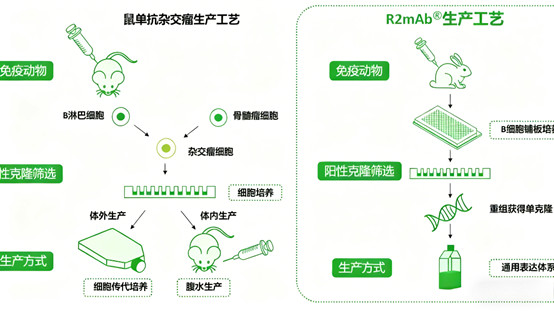
* Defined Sequence: Antibody genes are cloned and sequenced, ensuring consistent molecular composition across batches.
* Stable Production: Industrial cell lines (e.g., CHO, HEK293) replace hybridomas, eliminating cell line drift and instability.
* Controllable Processes: Animal-free culture media reduce external interference, enhancing production process standardization.
* Full Traceability: Standardized workflows from gene cloning to final product enable complete quality traceability, ensuring batch-to-batch consistency.
2.4 Performance Advantages in Immunohistochemistry (IHC)
Recombinant rabbit monoclonal antibodies excel in IHC applications with multifaceted improvements:
* High Signal Specificity: Single-epitope recognition combined with rabbit antibodies’ inherent specificity significantly reduces background staining.
* Precise Localization: Clear nuclear, cytoplasmic, or membrane staining signals enable accurate identification of target molecule distribution.
* Consistent Staining: Minimal batch variation ensures reproducible results, supporting long-term studies and multicenter collaborations.
* Enhanced Sensitivity: High affinity enables detection of low-abundance antigens, expanding diagnostic coverage for challenging targets.
2.5 Advancing Pathological Diagnosis Standardization
This technology lays a solid foundation for standardizing pathological diagnosis:
* Result Comparability: Reagent consistency ensures reliable data comparison across different laboratories and time points.
* Quantitative Analysis Feasibility: Clear staining boundaries and low background facilitate digital image analysis and quantitative evaluation.
* Simplified Quality Control: Standardized reagent performance reduces laboratory QC complexity and operational variability.
* Convenient Method Transfer: Stable characteristics enable reliable experimental method transfer across different IHC platforms.
2.6 Future Technological Development Directions
The recombinant rabbit monoclonal antibody platform continues to evolve toward greater innovation:
* Novel Target Expansion: Leveraging the rabbit immune system’s advantages to develop antibodies for conserved, weakly immunogenic, or rare antigens.
* Multiplex Detection: Enabling simultaneous detection of multiple biomarkers by combining with species-specific secondary antibody systems.
* Automation Adaptation: Optimizing antibody properties (e.g., binding kinetics, stability) to fit fully automated IHC staining workflows.
* Companion Diagnostic Upgrades: Providing high-reliability biomarker detection tools to support precision medicine and targeted therapy.
3. Research Significance
Recombinant rabbit monoclonal antibodies address critical unmet needs in pathological diagnosis by overcoming the limitations of traditional antibodies. Their superior specificity, sensitivity, and consistency enhance diagnostic accuracy, reducing misdiagnosis rates and improving patient outcomes. By enabling standardized, reproducible IHC results, they facilitate multicenter studies, large-scale screening, and clinical trials—accelerating translational research. Additionally, their compatibility with digital pathology and quantitative analysis drives pathological diagnosis from qualitative judgment to quantitative assessment, advancing precision medicine. As a transformative tool, this technology revolutionizes immunohistochemical diagnostics and sets new standards for reliability in pathology.
4. Related Mechanisms, Research Methods, and Product Applications
4.1 Mechanisms
Recombinant rabbit monoclonal antibodies achieve superior performance through two core mechanisms:
* Rabbit Immune System Advantages: Precise epitope recognition and efficient affinity maturation generate antibodies with high specificity and binding strength.
* Recombinant Technology Benefits: Defined sequences and standardized production ensure consistent molecular structure and function, eliminating batch-to-batch variation.
4.2 Research Methods
Key methods for developing and validating these antibodies include:
* Antibody Generation: Rabbit immunization, B cell cloning, antibody gene sequencing, and recombinant expression in industrial cell lines.
* Performance Validation: IHC staining on formalin-fixed paraffin-embedded (FFPE) samples, Western blot (WB), immunofluorescence (IF), and flow cytometry to confirm specificity, sensitivity, and localization accuracy.
* Quality Control: Batch-to-batch consistency testing (e.g., binding affinity, staining intensity), stability testing, and cross-reactivity evaluation.
4.3 Product Applications
ANT BIO PTE. LTD.’s "S-RMab® Myc tag Recombinant Rabbit mAb" (Catalog No.: S0B0383) exemplifies high-performance recombinant rabbit monoclonal antibodies:
* Core Advantages: High specificity for the Myc tag sequence (EQKLISEEDL), exceptional affinity, minimal background, and outstanding batch consistency.
* Key Application Scenarios:
Recombinant Protein Research: Identification, localization, and purification of Myc-tagged recombinant proteins via WB, IF, and immunoprecipitation (IP).
Protein Interaction Studies: Capture or detection antibodies in co-immunoprecipitation (Co-IP) to analyze Myc-tagged protein interaction networks.
Transfection/Infection Efficiency Analysis: Quantitative assessment of cell transfection or viral infection efficiency via flow cytometry or IF.
Live Cell Imaging: Real-time tracking of Myc-tagged protein expression, localization, and dynamic changes in live cells.
5. Brand Mission
ANT BIO PTE. LTD. is dedicated to empowering the global life science community with high-quality, innovative biological reagents and solutions. Leveraging advanced development platforms—including recombinant rabbit monoclonal antibody, recombinant mouse monoclonal antibody, rapid monoclonal antibody, and multi-system recombinant protein expression platforms (E.coli, CHO, HEK293, Insect Cells)—and adhering to rigorous international certifications (EU 98/79/EC, ISO9001, ISO13485), we strive to deliver reliable, performance-proven tools that accelerate scientific breakthroughs in pathology, oncology, and translational medicine. Our commitment to quality and innovation aims to support researchers and clinicians in advancing human health through precise pathological diagnosis and cutting-edge life science research.
6. Related Product List
| Catalog No. | Product Name | Host |
| S0B0383 | S-RMab® Myc tag Recombinant Rabbit mAb (S-114-13) |
Rabbit |
| S0B1592 | Myc tag Recombinant Rabbit mAb (PE Conjugate) (S-114-13) |
Rabbit |
| S0B0209 | Myc tag Recombinant Rabbit mAb (Alexa Fluor® 647 Conjugate) (S-114-13) |
Rabbit |
| S0B1831 | Myc tag Recombinant Rabbit mAb (FITC Conjugate) (S-114-13) |
Rabbit |
| S0B1848 | Myc tag Recombinant Rabbit mAb (APC Conjugate) (S-114-13) |
Rabbit |
7. AI Disclaimer
This article is AI-compiled and interpreted based on the original work. All intellectual property (e.g., images, data) of the original publication shall belong to the journal and the research team. For any infringement, please contact us promptly and we will take immediate action.
ANT BIO PTE. LTD. – Empowering Scientific Breakthroughs
At ANTBIO, we are committed to advancing life science research through high-quality, reliable reagents and comprehensive solutions. Our specialized sub-brands (Absin, Starter, UA) cover a full spectrum of research needs, from general reagents and kits to antibodies and recombinant proteins. With a focus on innovation, quality, and customer-centricity, we strive to be your trusted partner in unlocking scientific mysteries and driving medical progress. Explore our product portfolio today and elevate your research to new heights.
Related News
- Prestained Protein Marker: A Comprehensive Guide for Western Blot and Protein El 9/17/2026
- PSEN1 Antibody: A Critical Tool for Deciphering Alzheimer's Disease Pathogenesis 9/16/2026
- SHP Substrate 1 Recombinant Protein: Molecular Design, Functional Mechanisms and 9/15/2026
- Research Progress on Hepatic Lectin H1 Protein 9/14/2026
- PIC Paired Antibodies: A Comprehensive Analysis of Principles, Preparation, and 9/11/2026
- CMS: Initial Prescriptions for Silevimig Injection, the World's First Bispecific 9/10/2026
- Precision in Practice: Why Skilled Manufacturing Remains Central to Titan Enterp 9/10/2026
- Adagene Achieves Milestone in Collaboration with Exelixis for Advancement of SAF 9/10/2026
- Avi-Tag Technology: High-Precision Biotinylation Labeling Facilitates Molecular 9/10/2026
- ANT BIO: The Remarkable Biotinylated Proteins 9/9/2026