 中文
中文


Home > News > Mouse T Cell Activation Kits: Enabling Efficient Immune Activation Through the CD3/CD28 Dual-Signal System
Mouse T Cell Activation Kits: Enabling Efficient Immune Activation Through the CD3/CD28 Dual-Signal System
- 1. Literature Information
Research Focus: Exploration of the CD3/CD28 dual-signal mechanism in T cell activation, optimization of in vitro T cell activation technologies using antibody-conjugated magnetic beads, and their applications in cell therapy and immunology research.
Core Innovation: Development of a biomimetic artificial antigen-presenting system (CD3/CD28 antibody-conjugated magnetic beads) that replicates natural T cell activation conditions, addressing limitations of traditional methods and enhancing activation efficiency and cell function preservation.
2. Research Background
T lymphocyte activation is a tightly regulated process dependent on a dual-signal system, which is fundamental to adaptive immunity and cell therapy development. The first signal is initiated by the interaction between the T cell receptor (TCR)/CD3 complex and the MHC-antigen peptide complex on antigen-presenting cells (APCs), ensuring antigen-specific recognition. The second co-stimulatory signal, primarily mediated by CD28-B7 (CD80/CD86) binding, is essential for complete T cell activation—absence of this signal leads to T cell anergy rather than functional activation. Additionally, activated T cells require cytokines such as IL-2 and IL-15 to support proliferation, differentiation, and survival, avoiding activation-induced cell death. Traditional in vitro T cell activation methods (e.g., soluble antibodies) suffer from transient signaling, insufficient co-stimulation, and high risk of T cell exhaustion, limiting their utility in basic research and clinical applications like CAR-T/TCR-T therapy. There is an urgent need for a robust, standardized activation system that mimics physiological conditions.
3. Research Approaches
To develop an efficient T cell activation platform, the research team adopted a mechanism-driven and application-oriented strategy:
Mechanistic Validation: Investigating the dual-signal regulatory network of T cell activation, focusing on the synergy between TCR/CD3 signaling and CD28 co-stimulation.
Biomimetic Design: Engineering CD3/CD28 antibody-conjugated magnetic beads to replicate the spatial structure and signal persistence of natural immune synapses.
Efficacy Comparison: Evaluating activation efficiency, cell proliferation, cytokine secretion, and memory phenotype maintenance across different methods (soluble antibodies vs. magnetic bead system vs. traditional OKT3/IL-2 protocol).
Parameter Optimization: Systematically testing key variables including antibody ratio/density on magnetic beads, bead-to-cell ratio, activation duration, cytokine combinations, and magnetic bead removal timing.
Application Validation: Assessing the performance of the optimized system in cell therapy scenarios (CAR-T/TCR-T preparation) and compliance with GMP/regulatory requirements.
4. Research Outcomes
4.1 Mechanism of Magnetic Bead-Mediated T Cell Activation
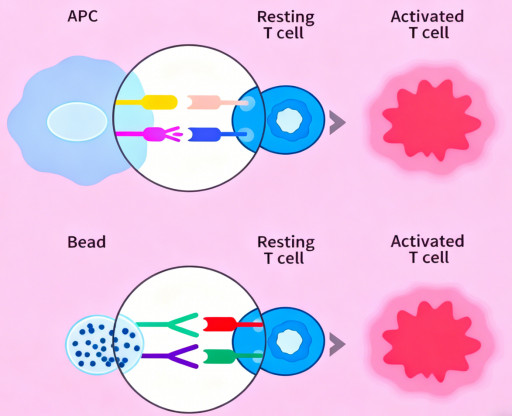
CD3/CD28 antibody-conjugated magnetic beads function as an artificial APC system, precisely mimicking natural activation:
First Signal Simulation: CD3 antibodies on magnetic beads bind the TCR/CD3 complex, triggering initial signal transduction cascades in T cells.
Co-Stimulatory Signal Substitution: CD28 antibodies provide the critical second signal, promoting cytokine gene expression and complete activation.
Structural Advantage: The fixed arrangement of antibodies on magnetic beads recapitulates immune synapse architecture, delivering sustained, stable signals—enhancing cytokine production by 10-100 times compared to soluble antibodies.
4.2 Superiority Over Traditional Activation Methods
Comparative studies demonstrated the magnetic bead system’s advantages:
Soluble Antibodies: Transient signaling, poor synergy, high reliance on exogenous IL-2, and increased T cell exhaustion.
Magnetic Bead System: Sustained dual-signal stimulation induces stronger proliferation, preserves memory T cell phenotypes (higher central memory T cell proportion), reduces terminal differentiation, and lowers exhaustion marker expression—outperforming the traditional OKT3/IL-2 protocol in functional persistence.
4.3 Key Applications in Cell Therapy
For adoptive cell therapies (CAR-T/TCR-T), the magnetic bead system offers critical benefits:
Youthful Cell State: Generates a higher proportion of central memory T cells, improving therapeutic persistence in vivo.
Enhanced Expansion: Sustained signals drive robust proliferation with reduced cytokine dependency.
Batch Consistency: Standardized protocols facilitate quality control for therapeutic product manufacturing.
Regulatory Compliance: Closed operational processes align with GMP standards, supporting clinical translation.
4.4 Optimized Technical Parameters
The study identified optimal conditions for maximum activation efficacy:
Antibody Ratio/Density: Balanced CD3/CD28 antibody coating on magnetic beads to ensure signal harmony.
Bead-to-Cell Ratio: Recommended 1:1 to 3:1, adjustable based on experimental design.
Activation Duration: 48-72 hours (prolonged activation increases exhaustion risk).
Cytokine Synergy: Timely addition of IL-2, IL-7, or IL-15 enhances activation outcomes.
Magnetic Bead Removal: Timely separation to avoid overstimulation.
4.5 Future Development Directions
T cell activation technology is evolving toward refinement and multifunctionality:
Intelligent Regulation: Smart materials responsive to microenvironmental cues for dynamic signal modulation.
Personalized Customization: Tailored activation strength for diverse disease and therapeutic scenarios.
Multifunctional Integration: Combining activation with gene editing and directed differentiation into a unified workflow.
Non-Invasive Removal: Improved magnetic bead separation to minimize cell damage.
Microphysiological Systems: Organ-on-chip technologies to replicate in vivo-like activation environments.
5. Product Empowerment by ANT BIO PTE. LTD.
ANT BIO PTE. LTD.’s UA brand, a specialist in recombinant proteins and cell therapy tools, delivers a game-changing solution with the "CellXViva Mouse T Cell Activation Kit" (Catalog No.: UA090032). This product is engineered to enable efficient, reliable in vitro mouse T cell activation, directly supporting the research outcomes highlighted above.
Key Roles of the Product in Research and Applications:
Mechanistic Research Support: The kit’s optimized CD3/CD28 co-stimulatory system provides a standardized platform to study T cell activation, proliferation, and differentiation mechanisms—ensuring reproducible data for immunology research.
Cell Therapy Development: As a core reagent for activating mouse-derived CAR-T, TCR-T, and tumor-infiltrating lymphocytes (TILs), the kit maintains high cell viability and functional integrity, critical for preclinical therapeutic development.
Drug Screening Utility: Facilitates evaluation of immunomodulatory drugs by providing a consistent T cell activation model to assess compound effects on T cell function.
Reliability and Consistency: Animal-free formulation minimizes exogenous interference, while stringent quality control ensures batch-to-batch consistency—supporting long-term research and industrial applications.
Compatible with flow cytometry, cytokine secretion assays, and functional validation methods, the kit is an indispensable tool for bridging basic immunology research and translational cell therapy.
6. Brand Mission
ANT BIO PTE. LTD. is committed to empowering global life science advancement through three specialized sub-brands: ABSIN (general reagents, ELISA kits), STARTER (antibodies), and UA (recombinant proteins, cell therapy tools). Leveraging advanced development platforms—including recombinant monoclonal antibody generation, rapid antibody development, recombinant protein expression (E.coli, CHO, HEK293, Insect Cells), One-Step ELISA, and PTM Pan-Modification Antibody platforms—we deliver high-quality, compliant products certified by EU 98/79/EC, ISO9001, and ISO13485. Our mission is to partner with biopharmaceutical companies, research institutions, and scientists worldwide, providing innovative reagents and solutions that accelerate discoveries in immunology, cell therapy, and precision medicine.
7. Related Product List
| UA090032 | Mouse T Cell Activation Kit/CellXViva Mouse T cell Activation Kit | Host : Mouse |
8. AI Disclaimer
This article is AI-compiled and interpreted based on the original work. All intellectual property (e.g., images, data) of the original publication shall belong to the journal and the research team. For any infringement, please contact us promptly and we will take immediate action.
ANT BIO PTE. LTD. – Empowering Scientific Breakthroughs
At ANTBIO, we are committed to advancing life science research through high-quality, reliable reagents and comprehensive solutions. Our specialized sub-brands (Absin, Starter, UA) cover a full spectrum of research needs, from general reagents and kits to antibodies and recombinant proteins. With a focus on innovation, quality, and customer-centricity, we strive to be your trusted partner in unlocking scientific mysteries and driving medical progress. Explore our product portfolio today and elevate your research to new heights.
Related News
- Prestained Protein Marker: A Comprehensive Guide for Western Blot and Protein El 9/17/2026
- PSEN1 Antibody: A Critical Tool for Deciphering Alzheimer's Disease Pathogenesis 9/16/2026
- SHP Substrate 1 Recombinant Protein: Molecular Design, Functional Mechanisms and 9/15/2026
- Research Progress on Hepatic Lectin H1 Protein 9/14/2026
- PIC Paired Antibodies: A Comprehensive Analysis of Principles, Preparation, and 9/11/2026
- CMS: Initial Prescriptions for Silevimig Injection, the World's First Bispecific 9/10/2026
- Precision in Practice: Why Skilled Manufacturing Remains Central to Titan Enterp 9/10/2026
- Adagene Achieves Milestone in Collaboration with Exelixis for Advancement of SAF 9/10/2026
- Avi-Tag Technology: High-Precision Biotinylation Labeling Facilitates Molecular 9/10/2026
- ANT BIO: The Remarkable Biotinylated Proteins 9/9/2026