 中文
中文


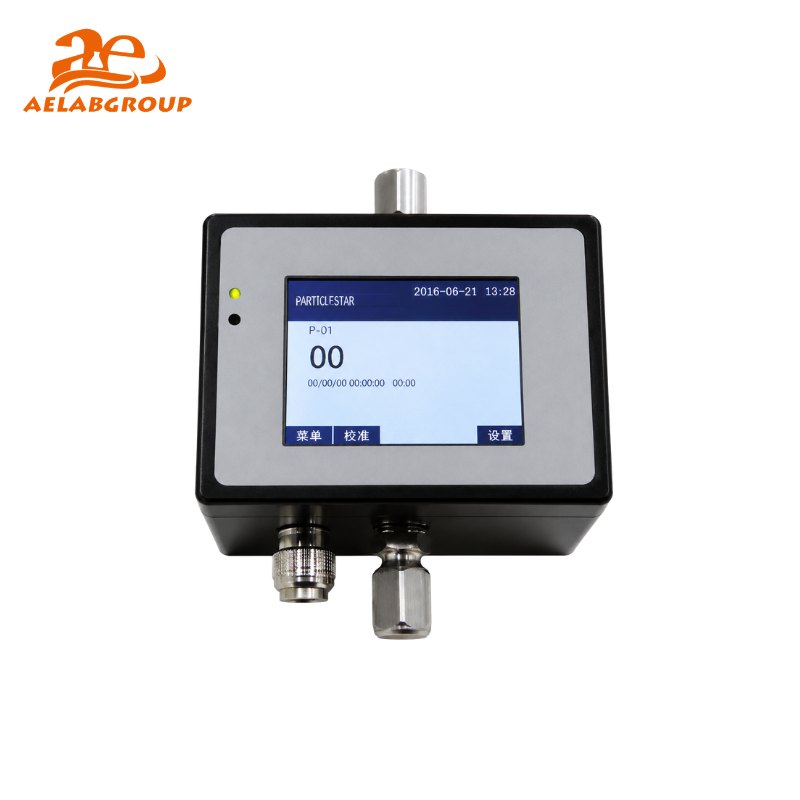
AELAB Light Blocking Method Particle Counter for Oil and Fluid Contamination Analysis

- Product Detail
- Company Profile
- Lubricating oil cleanliness analysis
- Hydraulic fluid contamination monitoring
- Turbine oil condition assessment
- Transformer and insulating oil testing
- Gear oil and transmission fluid analysis
- Aviation and industrial oil contamination control
- Petroleum product quality control
- Preventive and predictive maintenance programs
- Monitoring wear debris and external contamination
- Evaluation of filtration-system performance
- Incoming oil and lubricant inspection
- Research and development of industrial fluids
- Type of oil, fuel or industrial liquid
- Approximate sample viscosity
- Expected particle concentration or cleanliness level
- Required particle-size channels
- Required cleanliness code or reporting format
- Laboratory or field-testing requirement
- Estimated number of samples per day
- Required data output or communication method
- Power-supply requirement
- Destination country and delivery location
- Multiple particle-counter models for different oil and fluid-testing requirements
- Light-blocking particle-counting technology
- Portable, precision and high-precision configurations
- Solutions for petroleum laboratories and industrial maintenance programs
- Support for model comparison before quotation
- Technical consultation based on sample type and testing workflow
- International supply and export packaging support
- Power-supply and configuration support according to destination market
- Availability of technical documentation according to selected model
AELAB supplies light-blocking particle counters designed for particle contamination analysis in petroleum products, lubricating oils, hydraulic fluids, insulating oils and other industrial liquid samples.
The AELAB particle counter range includes portable, laboratory and high-precision configurations for routine oil cleanliness monitoring, quality control, equipment condition monitoring and contamination analysis.
Available product families include the LPC-P5, LPC-P2, LPC-P6, LPC-02, LPC-M and LPC-M2 series. Each model is intended for different testing environments, sample-handling requirements and measurement workflows.
Customers can select a suitable particle counter according to sample type, required particle-size channels, cleanliness reporting method, portability, testing frequency and laboratory operating conditions.
Compare portable, precision and high-precision light-blocking particle counters for petroleum and industrial fluid testing.
Light-Blocking Particle Counting Technology
A light-blocking particle counter measures particles suspended in a liquid sample as they pass through an optical detection area. When a particle moves through the light path, it temporarily reduces the amount of light reaching the detector.
The instrument processes this change in the optical signal to count particles and classify them according to particle-size ranges. The resulting data can be used to evaluate fluid cleanliness, detect abnormal contamination and support preventive maintenance programs.
Important: The correct model should be selected according to the liquid type, sample viscosity, expected contamination level, required reporting standard and laboratory procedure.
View the complete AELAB Particle Counter range and available product information
Typical Applications
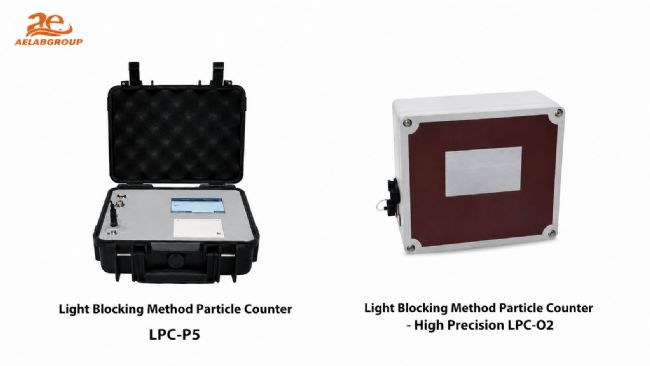
Industries Using Particle Counters
| Industry | Typical Testing Requirement |
|---|---|
| Petroleum and Lubricant Laboratories | Measurement of particle contamination in oils, lubricants and petroleum-derived fluids. |
| Power Generation | Monitoring turbine oils, transformer oils and lubrication systems used in power plants. |
| Hydraulic Equipment | Contamination monitoring to help protect pumps, valves, cylinders and hydraulic components. |
| Automotive and Transportation | Testing engine oils, gear oils, transmission fluids and other vehicle-related lubricants. |
| Aviation and Aerospace | Cleanliness evaluation of aviation hydraulic fluids, lubricants and precision fluid systems. |
| Industrial Manufacturing | Condition monitoring of machinery lubricants and production-fluid systems. |
| Independent Testing Laboratories | Third-party oil analysis, cleanliness reporting and contamination investigation. |
Why Particle Contamination Testing Is Important
Solid particles in oil and hydraulic fluids can contribute to abrasive wear, valve blockage, surface damage, reduced lubrication efficiency and premature component failure.
Regular particle-count testing helps maintenance and quality-control teams identify changes in fluid cleanliness before they develop into serious equipment problems.
Detect unexpected increases in fluid contamination.
Reduce the risk of wear and damage in sensitive components.
Assess whether filtration systems are operating effectively.
Support preventive and condition-based maintenance decisions.
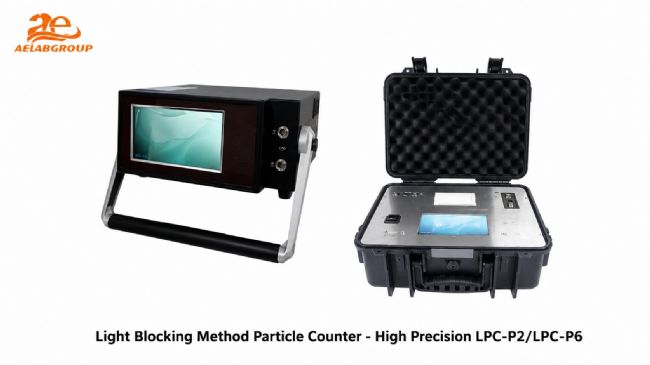
How to Select the Right Particle Counter
Selecting a particle counter should be based on the actual testing application rather than model name alone. The sample fluid, expected particle concentration, viscosity, required size channels and reporting method should all be considered.
| Selection Factor | Questions to Consider |
|---|---|
| Sample Type | Will the instrument test lubricating oil, hydraulic fluid, insulating oil, fuel or another industrial liquid? |
| Sample Viscosity | Is the sample sufficiently fluid for direct testing, or will special sample preparation be required? |
| Particle-Size Channels | Which particle-size ranges must be measured and reported? |
| Cleanliness Reporting | Which cleanliness code, particle-count format or internal reporting method is required? |
| Testing Location | Will testing be performed in a fixed laboratory or near industrial machinery and maintenance locations? |
| Measurement Frequency | How many samples must be tested per day, week or maintenance cycle? |
| Sample Preparation | Does the laboratory require sample agitation, degassing, dilution or other preparation before testing? |
| Data Management | Is result storage, printing, export or connection to an external data system required? |
| Calibration and Verification | What calibration, performance verification and quality-control procedures are required by the laboratory? |
Information Required for Model Recommendation
To receive an accurate model recommendation, provide the AELAB technical sales team with the following information:
Why Choose AELAB Particle Counters?
AELAB is a laboratory equipment brand and supplier based in Guangzhou, China. The company supplies analytical instruments, petroleum-testing equipment, environmental-testing systems, laboratory equipment and quality-control solutions for customers worldwide.
AELAB works with distributors, universities, research laboratories, testing organizations, industrial companies and quality-control departments requiring laboratory and process-testing equipment.
Official website: www.aelabgroup.com
Frequently Asked Questions
What does a light-blocking particle counter measure?
It measures and classifies particles suspended in a liquid sample by detecting changes in light intensity as particles pass through the optical measurement area.
Which liquids can be tested with an AELAB particle counter?
Depending on the selected model and sample procedure, particle counters may be used for lubricating oils, hydraulic fluids, insulating oils and other compatible industrial liquid samples.
What is the difference between a portable and laboratory particle counter?
Portable configurations are generally selected for flexible testing near maintenance or operating locations, while laboratory models are intended for controlled, routine sample analysis.
Can a particle counter identify the chemical composition of particles?
A standard light-blocking particle counter counts and classifies particles by detected size. It does not normally identify the chemical composition or material type of individual particles.
Why is sample preparation important?
Proper sample collection, mixing, container cleanliness and bubble control help reduce measurement errors and improve the repeatability of particle-count results.
Which AELAB particle counter model should I choose?
The suitable model depends on the sample type, viscosity, particle-size channels, testing location, reporting requirements and sample volume. Send these details to AELAB for model comparison.
Can AELAB provide a technical proposal and quotation?
Yes. AELAB can prepare a model recommendation, technical proposal and quotation based on the customer's testing application and purchasing requirements.
Send your sample type, approximate viscosity, required particle-size channels, cleanliness reporting method, testing location and daily sample quantity to the AELAB technical sales team.
The proposal can include suitable models, available configurations, technical information, optional accessories, delivery time, packaging and shipping details.
View AELAB Particle Counter Models
Email: info@aelabgroup.com
WhatsApp / WeChat: +86 158 0001 6110
Website: www.aelabgroup.com
-
AELAB GUANGZHOU CO., LTD.
AELAB is a laboratory equipment and analytical instrument supplier based in Guangzhou, China. We provide laboratory instruments, quality control equipment, analytical systems, sample preparation equipment, and related laboratory solutions for distributors, industrial laboratories, universities, research organizations, and testing centers worldwide.
AELAB offers both our own-brand products and carefully selected instruments from established manufacturers. OEM and ODM services are available for selected AELAB products, including customized branding, appearance, configuration, power supply, accessories, packaging, and documentation according to customer requirements.
For laboratory projects, distributor orders, government tenders, and complete laboratory setups, our team can provide a one-stop purchasing solution. We assist customers with product selection, technical comparison, quotation preparation, sourcing, quality inspection, export packaging, shipping coordination, and after-sales support.
Our technical team helps customers select suitable equipment based on their application, testing method, required specifications, budget, and local standards. Warranty and technical support are provided according to the product and project requirements.
AELAB operates under an established quality management system. Relevant company and product documentation may include SGS verification, ISO certification, CE, RoHS, FCC, or UL-related documentation, depending on the specific product model and configuration. Customers may contact us to confirm the available certificates before ordering.
Our equipment is widely used in industrial quality control, scientific research, universities, pharmaceutical laboratories, food and agricultural testing, environmental analysis, chemical laboratories, and other professional testing applications.
We are committed to developing long-term cooperation with distributors, laboratories, research institutions, and project contractors. If you are looking for a reliable laboratory equipment supplier with stable service and technical support, please contact AELAB.
Contact AELAB
Website:
https://aelabgroup.com
Email:
info@aelabgroup.com
WhatsApp / WeChat:
+86 15800016110
| Request Information |
| Other Products |
| Related Products |

| Recently viewed products |