 中文
中文


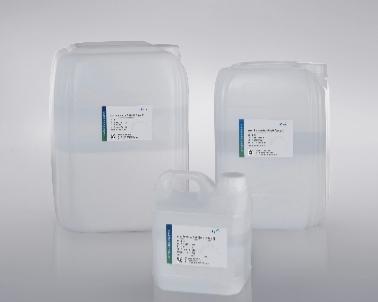
Butyl Hydrophobic Interaction Chromatography Resin

- Product Detail
- Company Profile
- 1.Details
Hydrophobic Interaction Chromatography (HIC) is a method for separating proteins based on differences in their surface hydrophobicity, utilizing reversible binding between proteins and the resin. HIC operates under mild conditions with high resolution, making it one of the most commonly used methods for biological macromolecule separation and purification. The Butyl HIC Resin uses highly cross-linked polyacrylate as the matrix and butyl groups as ligands. This product has high mechanical strength and excellent compatibility with bioactive macromolecules, particularly suitable for the separation and purification of proteins, peptides, polysaccharides, small nucleic acids, and plasmids.
2.Features
Product Properties
|
Properties |
CPB-30 |
CPB-60 |
GPB-30 |
GPB-60 |
|
Average Particle Size |
40μm±10μm |
70μm±20μm |
40μm±10μm |
70μm±20μm |
|
Pore Size |
100nm |
500nm |
||
|
Matrix |
Polyacrylate |
|||
|
Ligand |
Butyl |
|||
|
Maximum Pressure Limit |
1 MPa |
|||
|
pH Stability |
pH 3-13 |
|||
|
Storage |
2~30 ℃(20% Ethanol) |
|||
Chromatographic operation Procedure
Chromatographic operation typically includes steps such as equilibration, sample loading, washing, elution, and regeneration. The specific operating methods are as follows:
Equilibration: Equilibrate the column with 5-10 column volumes (CV) of equilibration buffer (e.g., 50 mM PB+1.0~2.0 M (NH4)2SO4, pH7.0; the specific buffer system should be selected and optimized based on the stability and hydrophobicity of the target protein) at a flow rate not exceeding the maximum pressure limit, until the conductivity and pH of the effluent remain constant (consistent with the equilibration buffer).
Sample Loading: The sample loading buffer should be as consistent as possible with the equilibration buffer; solid samples can be dissolved and prepared in equilibration buffer; dilute samples can be dialyzed with equilibration buffer or supplemented with the corresponding amount of Solution composition; concentrated sample solutions can be diluted with equilibration buffer. To avoid clogging the chromatography column, sample solutions should be centrifuged or microfiltered (0.45 μm). The loading volume should be calculated based on the binding capacity and the target protein content in the sample solution.
Washing: After loading, continue washing with equilibration buffer until the UV absorbance drops to baseline.
Elution: Elute with elution buffer (e.g., 50 mM PB, pH7.0). Elution methods include pH gradient elution, linear gradient elution, or step gradient elution.
Regeneration: After each cycle, clean the column with Low ionic strength solution to Remove proteins with strong hydrophobic binding. Then rinse column with 3CV of water, followed by equilibration with 5CV of equilibrium buffer.
Cleaning In Place (CIP): After 5-10 uses (the specific number depends on the type and source of raw materials and experimental requirements), the column requires Cleaning In Place, which can refer to the table below
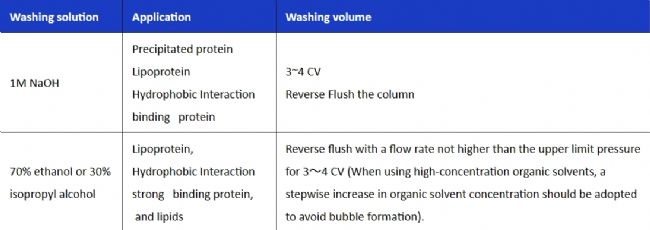
Rinse immediately with 3CV of water after CIP completion, followed by 5CV of equilibration buffer.
Storage: Store in 20% ethanol at 2-30°C; The unpacked resins can be flushed with 20% ethanol and then stored at 2-30°C.
Other Considerations: When using and storing the column, avoid letting it run dry or become poorly sealed to prevent air bubbles from entering.
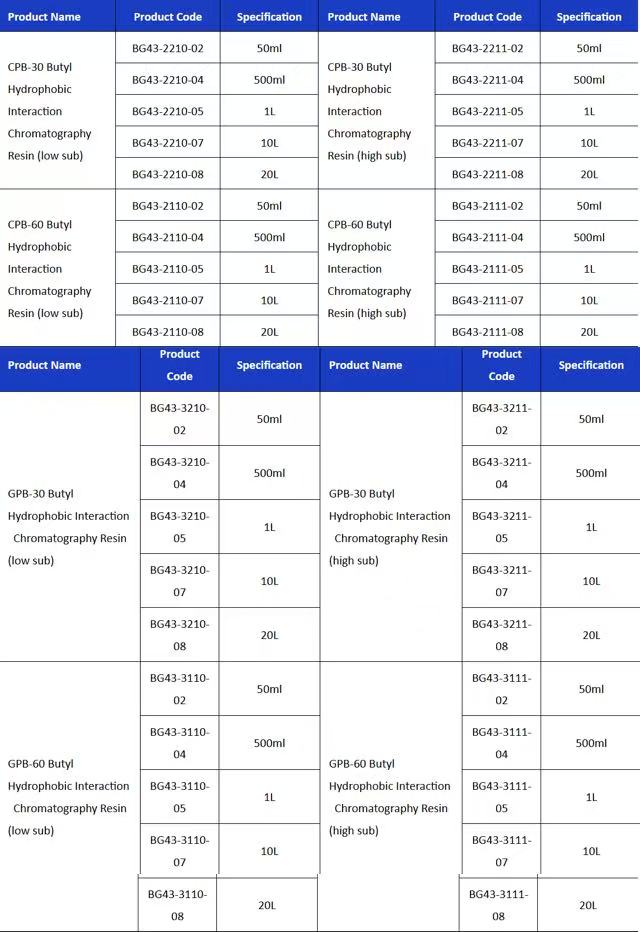
3.Specification
-
Duoning Biotech is a leading one-stop bioprocess solutions provider from China, committed to offering products and services required for the discovery, development and commercialization production of biologics, including reagents, consumables, instruments, equipment, and services. Leveraging our integrated bioprocess system, we empower our customers to achieve effective, reliable, lower-cost and higher-quality biologics manufacturing processes.
| Request Information |
| Other Products |
| Related Products |
| Recently viewed products |