 中文
中文


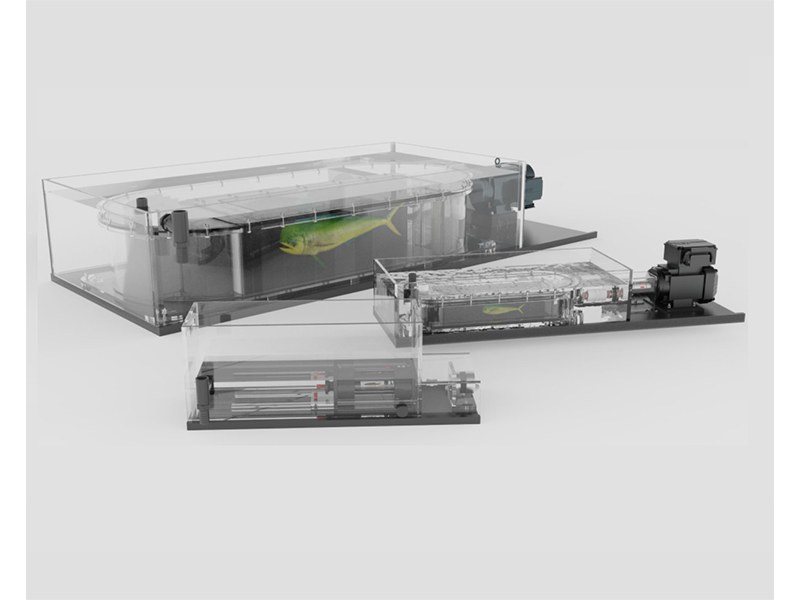
Forced-swimming Respiratory Metabolic Measurement System for Aquatic Organisms

- Product Detail
- Company Profile
Product Description (Forced-swimming Respiratory Metabolic Measurement System)
The aquatic organisms' forced swimming respiratory metabolism measurement system is used for the swimming ability test of aquatic organisms, exercise respiratory metabolism (respiratory oxygen consumption) measurement, resting metabolism measurement, and other functions. It is an important research instrument for carrying out the ecology of fish and other aquatic organisms, water environment toxicology, aquaculture, fish physiological ecological behavior, aquatic animal development ecology, and other aspects.
The metabolic chamber has multiple specifications and is suitable for different sizes of fish, from zebrafish swimming fish to large fish. Chamber sizes range from 170ml to 800L.
Applied disciplines: Marine Biology, Pharmacology, Animal Behavior, Eco-hydraulic Engineering, Dam Fish Research, Metabolism, Medicine, Aquatic Breeding, Molecular Biology.
Product Features
A swimming respiratory measurement system designed for aquatic organisms
Measure respiratory metabolism during a forced movement state (forced swimming)
Fully automatic-control
In-depth analysis, statistics, and data export
High-throughput experiments can be conducted, and different sizes of swimming tunnels are available
Fresh water and seawater are both applicable
Measurement and analysis of the real-time oxygen consumption rate
The system provides a test function for fish swimming ability. It adjusts the impeller speed through the voltage input of the motor control box to create a swimming area at different flow rates. The design has the advantages of flexible control for efficient experiments and a highly restored natural flow field.
Using a down-view camera, one can observe the behavioral movement mechanisms of aquatic organisms in different environmental states. This can help the experimenter conduct in-depth analyses of research directions, including feeding, biological, and social interaction research, swimming rules, behaviour trajectory, avoidance ability, etc.
System Diagram

Technical Parameters
Subject Weight Range: 2g~3000g, covering the experimental requirements for all specifications from zebrafish to adult fish
Controlled speed: 5 ~ 165 cm/s
Measuring area size: different specifications can be selected
It can be connected to the oxygen sensor or oxygen electrode;
Dissolved oxygen range: 0-475% dissolved oxygen saturation
Soluble oxygen resolution: + / -0.475% a.s.
Response time: less than 30 seconds
Measurement range of the flow meter: 0.01 ~ 3 m/s
Accuracy of the flow meter: + / -1.5%
The respiratory metabolism measurement system for aquatic organisms mainly measures oxygen consumption in fish, aquatic invertebrates, fish eggs and embryos, and even plankton. It is widely used in the ecology of aquatic life, water environment toxicology, aquaculture, fish behavior physiological ecology, aquatic animal development ecology, and aquariums.
The respiratory metabolic measurement system for aquatic organisms adopts an “intermittent” respiratory measurement method, which combines the advantages of an “open” method with long measurement time with a simple “closed” method. This method overcomes the disadvantages of poor time resolution in “open” mode and poor continuous measurement in “closed” mode.
Features
The intermittent” respiratory measurement method combines the advantages of “the open” respiratory measurement method with a long measurement time and a simple “closed” respiratory measurement method, overcoming the disadvantages of poor time resolution in “the open” mode and poor continuous measurement in “the closed” mode.
Dissolved oxygen measurement: Fluorescent fibre oxygen measurement technology, high measurement accuracy, strong stability, no oxygen consumption;
The respiratory measurement chamber has a static respiratory chamber and a dynamic respiratory chamber/swimming chamber, which are used to measure the standard metabolism (SMR) and the activity metabolism (AMR) at different swimming speeds, respectively;
Fully automatic control, recording, and analysis of data, simple and easy to use; the control of the submersible pump and the acquisition of oxygen signal is through Bluetooth. Remote wireless transmission can effectively avoid the complicated cabling connection and the working noise caused by the submersible pump.
The respiratory chamber is highly customized in either shape or size according to the type of aquatic animal.

Water environment control module: This module includes a temperature monitoring control module and a dissolved oxygen monitoring control module. Can individually regulate CO2 / pH.
a. The temperature monitoring and control module includes the temperature sensor, submersible pump, stainless steel cooling pipe, etc. Temperature sensor Pt1000 measurement range -50℃ ~180℃, accuracy ± 0.15℃;
b. The oxygen monitoring and control module includes the fluorescent fibre oxygen sensor, solenoid valve, air stone, etc. The module controls the solenoid valve to add oxygen or nitrogen to control the water in hyperoxia or hypoxia.
c. CO2 / pH monitoring and control module includes controller host, pH meter and probe, solenoid valve, air stone CapCTRL control software, etc. By monitoring the pH value, the CO2 content in water is indirectly determined, and control water's pH and CO2 content is adjusted and monitored in real time. The pH measurement range is 0~14, and the resolution is 0.01.

References
-
TOW-Int, as a high-tech enterprise focusing on the research and development, production and sales of animal experimental equipment and cell research instruments, has always been committed to providing customers with cutting-edge, efficient and stable scientific research solutions.The company is committed to breaking technical barriers, and providing accurate solutions for global customers.
Tow-Int offers a wide range of products, including:
1. Metabolic science experimental equipment,
2. Respiratory study equipment,
3. Laboratory animal hyperbaric and hypobaric chamber,
4. Incubators for cellular study,
5. Animal inhalation and exposure systems.
We are opening for global collaborations, if you want to become our distribution partner, please kindly contact us for more information.
| Request Information |
| Other Products |
| Related Products |

| Recently viewed products |