 中文
中文


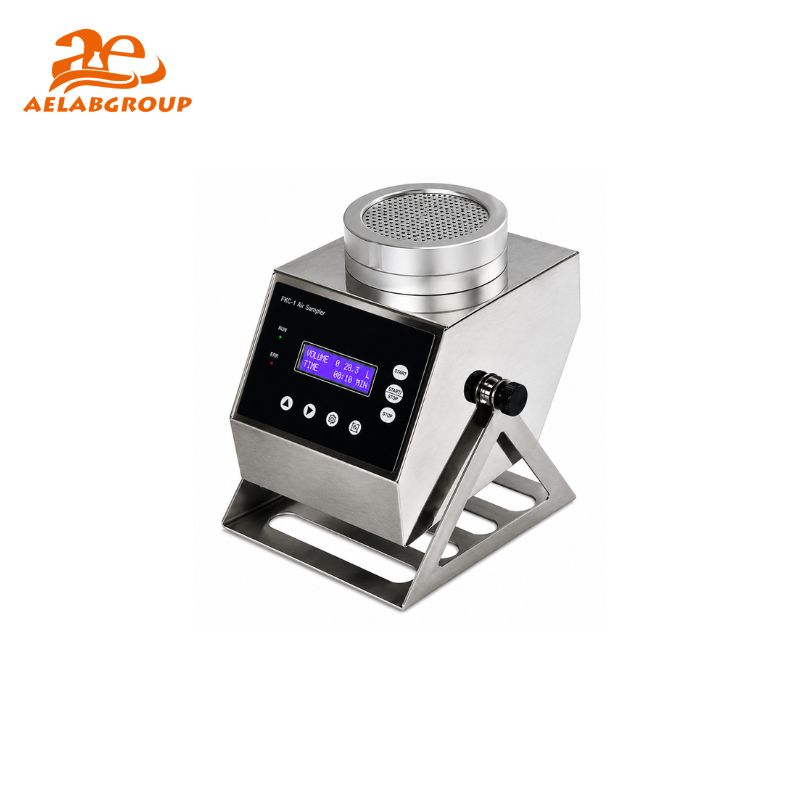
AELAB Air Samplers for Microbial Air Monitoring

- Product Detail
- Company Profile
- Define the sampling location, sampling volume and culture medium according to the facility monitoring plan.
- Clean and disinfect the sampler exterior and sampling head using a material-compatible procedure.
- Install the prepared agar plate without touching the culture surface.
- Position the instrument at the specified location and height without obstructing the air inlet.
- Set the required air volume and begin the sampling cycle.
- Remove and identify the culture plate after sampling.
- Incubate the plate using conditions appropriate for the target microorganisms and laboratory method.
- Count the colonies, record the sampled volume and calculate or report the result according to the laboratory procedure.
- Verify airflow performance according to the laboratory calibration schedule.
- Inspect the perforated sampling head for blockage, contamination or physical damage.
- Disinfect the sampling head and exposed surfaces before and after use.
- Avoid touching the agar surface while installing or removing culture plates.
- Keep the battery adequately charged before multi-location sampling work.
- Record the sampling location, date, time, air volume and operator information.
- Store the instrument in a clean and dry environment when it is not in use.
- Use culture dishes and media compatible with the selected model and microbiological method.
- Follow the product manual and the facility’s environmental-monitoring procedure.
- Models for cleanroom and portable microbial air-sampling applications
- Controlled air-volume collection for quantitative monitoring workflows
- Impactor-style collection onto microbiological culture media
- Rechargeable options for movement between sampling locations
- Solutions for pharmaceutical, healthcare, food and research environments
- Model-selection assistance based on the actual monitoring application
- Technical specification and quotation support for distributors and laboratories
- International supply, export packaging and shipping support
AELAB supplies portable and cleanroom air samplers designed for collecting viable airborne microorganisms in controlled production areas, laboratories, healthcare facilities, food-processing environments and research facilities.
These instruments actively draw a defined quantity of air through a perforated sampling head and deposit airborne microorganisms onto culture media. After incubation, colonies can be counted to evaluate the viable microbial concentration of the monitored environment.
The AELAB air sampler range includes compact microbial air sampling systems for routine environmental monitoring, cleanroom contamination control, pharmaceutical production, hospital hygiene assessment and food-industry microbiological inspection.
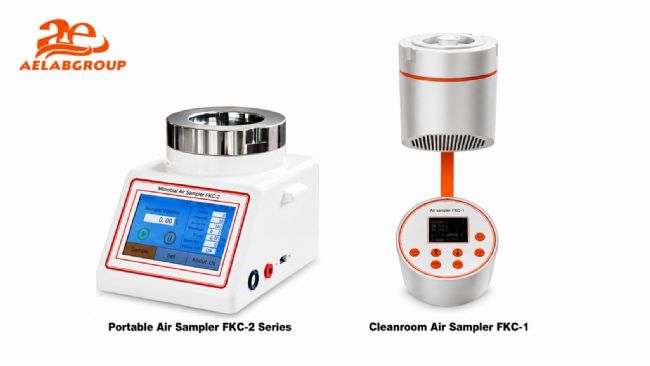
Compare portable and cleanroom microbial air samplers according to sampling range, portability, operating environment and data-recording requirements.
How Does a Microbial Air Sampler Work?
A microbial air sampler uses an internal pump to draw air through a sampling head containing multiple precision openings. Airborne microorganisms and microorganism-carrying particles are directed toward the surface of an agar plate positioned inside the sampler.
After the selected air volume has been collected, the culture plate is removed and incubated under appropriate microbiological conditions. The resulting colonies are counted and the microbial concentration can be reported according to the sampled air volume.
1. Set Sampling Volume
Select the required quantity of air according to the monitoring procedure.
2. Collect Air
The sampler draws air through the perforated impactor head.
3. Capture Microorganisms
Viable airborne particles are deposited onto the culture medium.
4. Incubate and Count
The plate is incubated and visible microbial colonies are evaluated.
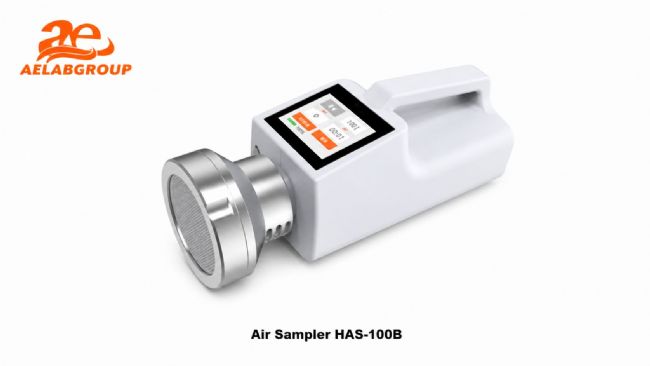
Air Sampler Applications
| Application Area | Typical Monitoring Purpose |
|---|---|
| Pharmaceutical Cleanrooms | Routine viable air monitoring in controlled manufacturing and filling areas. |
| Hospitals and Healthcare | Microbial assessment of operating rooms, sterile areas and clinical environments. |
| Food and Beverage Facilities | Monitoring airborne bacteria, yeast and mold in processing and packaging zones. |
| Biotechnology Laboratories | Environmental monitoring around microbiological, culture and research workflows. |
| Cosmetics Manufacturing | Microbial contamination control in formulation, filling and production rooms. |
| Research Facilities | Collection and evaluation of viable airborne microorganisms during studies. |
| Controlled Storage Areas | Periodic verification of microbiological conditions in controlled environments. |
Microbial Air Sampler vs. Particle Counter
A microbial air sampler and an airborne particle counter may both be used in cleanrooms, but they measure different contamination parameters and should not be treated as interchangeable instruments.
| Comparison | Microbial Air Sampler | Particle Counter |
|---|---|---|
| Primary Purpose | Collection of viable airborne microorganisms. | Measurement of non-viable airborne particles. |
| Sampling Result | A physical culture plate for incubation and colony counting. | Immediate numerical particle concentration data. |
| Typical Output | Microbial colony concentration based on sampled air volume. | Particle counts by selected particle-size channels. |
| Common Use | Viable environmental monitoring and microbiological contamination control. | Cleanroom classification and non-viable particle monitoring. |
How to Select an Air Sampler
The correct air sampler should be selected according to the monitoring environment, required sampling volume, culture-plate format, portability, battery operation and documentation needs.
| Selection Factor | Questions to Consider |
|---|---|
| Monitoring Environment | Will the sampler be used in a pharmaceutical cleanroom, hospital, food plant, laboratory or general controlled area? |
| Sampling Volume | What air volume is required by the laboratory procedure or environmental-monitoring plan? |
| Sampling Flow | Does the method require a defined flow rate for quantitative microbial air collection? |
| Culture Plate Size | Which Petri-dish diameter and agar-medium format are used in the laboratory? |
| Portability | Will the unit remain at one sampling point or be transported between multiple rooms? |
| Battery Runtime | How many sampling points must be completed before the instrument can be recharged? |
| Cleaning and Disinfection | Can the sampling head and external surfaces be cleaned according to the facility procedure? |
| Data Storage | Is internal storage of previous sampling records needed for documentation and traceability? |
| Operating Conditions | Are the temperature, humidity and pressure conditions suitable for the selected model? |
Recommended Microbial Air-Sampling Workflow
Operation and Maintenance Recommendations
AELAB is a laboratory equipment and scientific instrument supplier based in Guangzhou, China. The company supplies laboratory, analytical, environmental, pharmaceutical and quality-control equipment to distributors, universities, laboratories, research organizations and industrial customers.
AELAB can provide product information, model comparison, technical specifications, optional configurations, quotation support, export packaging and international shipment arrangements.
Official website: www.aelabgroup.com
Frequently Asked Questions
What does a microbial air sampler measure?
It collects viable airborne microorganisms onto culture media. After incubation, the resulting microbial colonies can be counted and evaluated according to the sampled air volume.
Is an air sampler the same as an airborne particle counter?
No. A microbial air sampler collects viable microorganisms for incubation, while a particle counter directly measures non-viable airborne particles according to particle size.
Which AELAB model is designed for cleanroom monitoring?
The FKC-1 is presented by AELAB as a cleanroom microbial air sampler for viable monitoring in controlled environments.
Which model is suitable for portable sampling?
The FKC-2 has a compact rechargeable design and is intended for portable microbial air sampling across laboratories, cleanrooms and other monitoring locations.
Does the air sampler identify the microorganism directly?
No. The sampler collects viable microorganisms onto culture media. Incubation, colony counting and any subsequent identification are performed through the laboratory’s microbiological workflow.
What information should be provided before requesting a quotation?
Send the intended application, monitoring environment, required sampling volume, preferred culture-plate size, number of sampling points, power requirements and destination country.
Tell the AELAB technical sales team where the sampler will be used, the required sampling volume, culture-plate format, monitoring frequency and data-recording requirements. A suitable model can then be recommended according to the actual application.
The quotation may include available models, technical specifications, supplied accessories, optional items, delivery time, export packaging and shipping information.
Email: info@aelabgroup.com
WhatsApp / WeChat: +86 158 0001 6110
Website: www.aelabgroup.com
-
AELAB GUANGZHOU CO., LTD.
AELAB is a laboratory equipment and analytical instrument supplier based in Guangzhou, China. We provide laboratory instruments, quality control equipment, analytical systems, sample preparation equipment, and related laboratory solutions for distributors, industrial laboratories, universities, research organizations, and testing centers worldwide.
AELAB offers both our own-brand products and carefully selected instruments from established manufacturers. OEM and ODM services are available for selected AELAB products, including customized branding, appearance, configuration, power supply, accessories, packaging, and documentation according to customer requirements.
For laboratory projects, distributor orders, government tenders, and complete laboratory setups, our team can provide a one-stop purchasing solution. We assist customers with product selection, technical comparison, quotation preparation, sourcing, quality inspection, export packaging, shipping coordination, and after-sales support.
Our technical team helps customers select suitable equipment based on their application, testing method, required specifications, budget, and local standards. Warranty and technical support are provided according to the product and project requirements.
AELAB operates under an established quality management system. Relevant company and product documentation may include SGS verification, ISO certification, CE, RoHS, FCC, or UL-related documentation, depending on the specific product model and configuration. Customers may contact us to confirm the available certificates before ordering.
Our equipment is widely used in industrial quality control, scientific research, universities, pharmaceutical laboratories, food and agricultural testing, environmental analysis, chemical laboratories, and other professional testing applications.
We are committed to developing long-term cooperation with distributors, laboratories, research institutions, and project contractors. If you are looking for a reliable laboratory equipment supplier with stable service and technical support, please contact AELAB.
Contact AELAB
Website:
https://aelabgroup.com
Email:
info@aelabgroup.com
WhatsApp / WeChat:
+86 15800016110
| Request Information |
| Other Products |


| Recently viewed products |