Introduction:
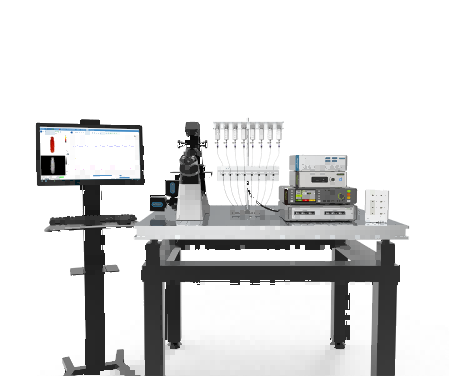
This system loads calcium (or other ion) fluorescent dyes into target cells. The calcium fluorescent dye enters the cell and binds to intracellular calcium ions, changing its signal in accordance with variations in calcium concentration. Using optical filters and an optical imaging system, the system records these signal changes. It is also capable of geometric measurement of single cells: while synchronously detecting cellular calcium signals, it records physical cell contraction changes, converts them into digital signals, and transmits them to a computer for data recording, storage, and analysis.
System Detection Parameters:
·Calcium Signals
Intracellular calcium transient duration (CTD10–90), dispersion of calcium transient duration (CTD10–90), time to peak and recovery time, amplitude, intracellular calcium conduction, visualization video of intracellular calcium activity, as well as functions including sarcoplasmic reticulum/endoplasmic reticulum calcium store, RyR, SERCA, and NCX.
·Contraction Signals
Cell length, contraction and relaxation time, contraction time and rate, relaxation time and rate, cell relaxation or contraction length, excitation–contraction coupling time (EC Coupling Time), etc.
·Action Potential Signals
Action potential conduction time, conduction direction, conduction velocity, conduction dispersion, depolarization velocity, time to depolarization peak, action potential duration (APD10–90), dispersion of action potential duration (APD10–90), visualization video, etc.
Applicable Research Fields:
·Research on calcium ion changes and contraction differences in various cell types, such as cardiomyocytes, smooth muscle cells, skeletal muscle cells, macrophages, chondrocytes, etc.
·Research on abnormal calcium regulation caused by different diseases or gene mutations and subsequent effects on contractile function, corresponding to functional changes in cellular calcium-handling proteins including CaV1.2, RyR₂, and SERCA.
·Drug screening for cardiovascular and cerebrovascular diseases, evaluating drug effects on intracellular calcium ions.
·Functional evaluation of organoids, supporting drug safety assessment, pathological model construction, and related research.
·Neuroscience research, monitoring calcium ion changes in neurons, investigating neuronal excitability, synaptic transmission, as well as connection patterns and functional properties of neural circuits.
Applicable Samples:
Cardiomyocytes, smooth muscle cells, skeletal muscle cells, macrophages, chondrocytes, cell layers, organoids, tissue slices, small‑size samples, and other specimens ranging from 0.1 mm to 3 mm.
System Features:
·High Performance
High‑speed camera with high sampling rate and quantum efficiency up to 95%, enabling high‑resolution observation of the spatiotemporal distribution of calcium in single cells.
·High‑Throughput Detection
Simultaneous acquisition and analysis of signals from more than 10 cells, with high speed and high throughput.
·Intelligent Operation
Capable of saving experimental protocols and synchronously controlling stimulation, LED, camera, and other equipment.
bio-equip.cn
 中文
中文