|
How Does Clausenamide Alleviate Parkinson's Disease Neuroinjury via Regulating the PKCα-ALOX5 Axis?
hits:25 Date:05/30/26
1. Concept of Parkinson's Disease and Neuroinjury Mechanisms
Parkinson's disease (PD) is a chronic neurodegenerative disorder characterized by progressive motor dysfunction, primarily caused by the loss of dopaminergic neurons in the midbrain substantia nigra pars compacta. Core pathological drivers include iron overload and abnormal lipid peroxidation—excessive iron and lipid peroxidation products induce oxidative stress, accelerating dopaminergic neuron degeneration. Current clinical treatments only relieve symptoms, failing to halt neuronal loss. Thus, targeting lipid peroxidation with natural plant-derived active components (e.g., clausenamide) has emerged as a promising therapeutic direction, leveraging their multi-target effects and safety profiles.
2. Research Frontiers
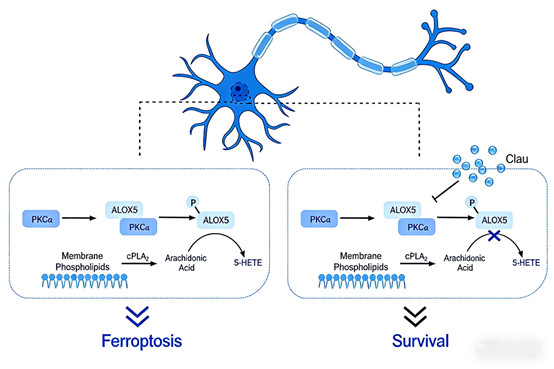
Research focuses on unraveling the PKCα-ALOX5 signaling axis as a key mediator of PD neuroinjury and clausenamide’s intervention mechanism. Key frontiers include defining how PKCα (a serine/threonine kinase) acts as a lipid peroxidation sensor, phosphorylates ALOX5 (arachidonate 5-lipoxygenase) at Ser663 to promote its nuclear translocation, and forms a positive feedback loop exacerbating lipid peroxidation. PKCα recombinant rabbit monoclonal antibodies enable precise detection of PKCα expression, phosphorylation, and interaction with ALOX5. Additionally, optimizing clausenamide’s pharmacokinetics (e.g., blood-brain barrier permeability) and developing PKCα-specific modulators are active translational research areas.
3. Research Significance
Elucidating clausenamide’s regulation of the PKCα-ALOX5 axis provides a novel therapeutic strategy for PD. This axis is a central mediator of lipid peroxidation-induced neuroinjury—disrupting it with clausenamide alleviates dopaminergic neuron loss and improves motor function. PKCα antibodies are indispensable for validating this mechanism, evaluating drug efficacy, and identifying potential biomarkers. Clausenamide’s natural origin and targeted action offer a safe alternative to conventional treatments, addressing unmet clinical needs for disease-modifying therapies. This research also expands understanding of lipid peroxidation in neurodegeneration, with implications for other disorders like Alzheimer’s disease.
4. Related Mechanisms, Research Methods, and Product Applications
4.1 PKCα’s Role in Lipid Peroxidation Damage
PKCα drives PD-related neuroinjury through a specific mechanism:
* Acts as a lipid peroxidation sensor—ferroptosis inducer erastin upregulates PKCα in dopaminergic neurons.
* Directly interacts with ALOX5, phosphorylating its Ser663 site to promote nuclear translocation and activation.
* Activated ALOX5 metabolizes arachidonic acid into toxic 5-HETE, exacerbating lipid peroxidation.
* Forms a PKCα-ALOX5 positive feedback loop, amplifying oxidative stress and neuronal degeneration.
4.2 Clausenamide’s Neuroprotective Mechanism
Clausenamide exerts protection by targeting the PKCα-ALOX5 axis:
* Competitively binds ALOX5’s Ser663 site, blocking PKCα-mediated phosphorylation.
* Inhibits ALOX5 nuclear translocation and activation, reducing 5-HETE production and lipid peroxidation.
* Disrupts the PKCα-ALOX5 positive feedback loop, mitigating oxidative stress-induced neuronal loss.
* Improves dopaminergic neuron survival and motor function in PD models.
4.3 Application Value of PKCα Recombinant Rabbit Monoclonal Antibodies
These antibodies are critical for PD research and drug development:
* Mechanistic Studies: Used in Western blot to quantify PKCα expression/phosphorylation; immunofluorescence to visualize subcellular localization; co-immunoprecipitation to confirm PKCα-ALOX5 interaction.
* Drug Evaluation: Assess clausenamide’s effects on PKCα activity and localization, providing evidence for target engagement.
* Biomarker Development: Establish PKCα activity-based diagnostic methods for PD progression monitoring.
4.4 Product Applications in Advanced Research
ANT BIO PTE. LTD.’s PKCα antibody supports diverse research scenarios:
* Neurodegenerative Disease Research: Study PKCα’s role in PD, Alzheimer’s, and synaptic plasticity.
* Tumor Biology: Analyze abnormal PKCα activation in breast/colorectal cancer, exploring its role in proliferation and metastasis.
* Cardiovascular Research: Investigate PKCα’s function in myocardial contraction, vascular regulation, and hypertension/heart failure mechanisms.
* Cell Signaling: Explore PKCα activation by EGF/PDGF and its regulation of cell cycle progression.
5. Brand Mission
ANT BIO PTE. LTD. is dedicated to empowering global neuroscience, oncology, and cardiovascular research through innovative, high-quality reagents. We strive to develop cutting-edge antibodies, proteins, kits, and tools that enable researchers to unravel disease mechanisms and advance targeted therapeutics. Our mission is to accelerate scientific discovery, facilitate the development of disease-modifying treatments for PD and other disorders, and improve human health by providing reliable, reproducible, and high-performance research solutions. With a commitment to excellence, innovation, and customer-centricity, we aim to be a trusted partner for researchers advancing the frontiers of precision medicine.
6. Related Product List
| Product Code |
Product Name |
Host |
| S0B0494 |
PKC alpha Recombinant Rabbit Monoclonal Antibody
(S-624-36) |
Rabbit |
Core Advantages of ANT BIO PTE. LTD.’s PKCα Antibody
High Specificity and Activation Detection: Precisely recognizes PKCα and its activation-associated phosphorylation sites, enabling monitoring of dynamic regulation and membrane translocation.
Exceptional Stability and Consistency: Strict quality control ensures minimal batch-to-batch variation and reliable performance across WB, IF, and IHC, supporting reproducible signaling research.
7. AI Disclaimer
This article is AI-compiled and interpreted based on the original work. All intellectual property (e.g., images, data) of the original publication shall belong to the journal and the research team. For any infringement, please contact us promptly and we will take immediate action.
ANT BIO PTE. LTD. – Empowering Scientific Breakthroughs
At ANTBIO, we are committed to advancing life science research through high-quality, reliable reagents and comprehensive solutions. Our specialized sub-brands (Absin, Starter, UA) cover a full spectrum of research needs, from general reagents and kits to antibodies and recombinant proteins. With a focus on innovation, quality, and customer-centricity, we strive to be your trusted partner in unlocking scientific mysteries and driving medical progress. Explore our product portfolio today and elevate your research to new heights.
|
 中文
中文