 中文
中文


Home > News > How Does Rab10 (Thr73) Regulate Membrane Trafficking and Signaling of the M4 Muscarinic Receptor?
How Does Rab10 (Thr73) Regulate Membrane Trafficking and Signaling of the M4 Muscarinic Receptor?
- 1. Concept of Rab10, GPCRs, and M4 Muscarinic Receptor
G protein-coupled receptors (GPCRs) are a major family of transmembrane receptors that regulate diverse physiological processes and serve as key drug targets. Membrane trafficking precisely controls GPCR expression, localization, and signaling, with Rab GTPases acting as central coordinators of this network. The M4 muscarinic acetylcholine receptor (M4 mAChR), a Class A GPCR, plays critical roles in the central nervous system—its dysfunction is linked to Alzheimer's disease and schizophrenia. Rab10, a member of the Rab GTPase family, functions as a "molecular brake" in M4 receptor endosomal trafficking and resensitization post-activation. Phosphorylation at Thr73 is a key regulatory modification of Rab10, and specific antibodies targeting this site enable in-depth analysis of its active state and functional roles.
2. Research Frontiers
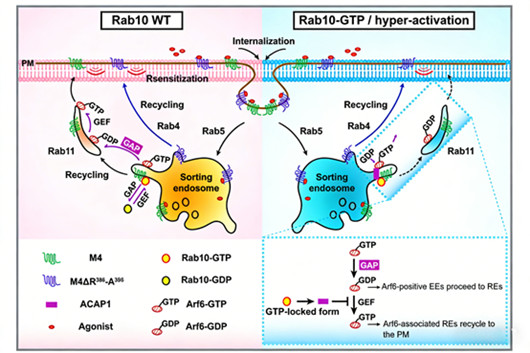
Research on Rab10’s regulation of M4 receptors focuses on unraveling the molecular mechanisms of membrane trafficking and signaling crosstalk. Key frontiers include defining how Rab10-GTP traps M4 receptors in early endosomes, the Rab10-GTP/ACAP1/Arf6 signaling cascade, and the impact of Rab10 Thr73 phosphorylation on its activity. Recent advances use Rab10 (Thr73) phosphorylation antibodies to explore upstream regulatory kinases (e.g., LRRK2) and validate Rab10 as a therapeutic target for neuropsychiatric disorders. Additionally, understanding how Rab10-mediated trafficking modulates M4 receptor signaling resensitization provides new insights into GPCR functional regulation, guiding drug development for GPCR-related diseases.
3. Research Significance
Elucidating Rab10’s role in M4 receptor regulation is critical for understanding GPCR trafficking mechanisms and developing treatments for neuropsychiatric disorders. Rab10’s "molecular brake" function modulates M4 receptor recycling and signaling resensitization, providing a novel layer of GPCR regulation. Thr73 phosphorylation, catalyzed by LRRK2 (a Parkinson’s disease-associated kinase), links Rab10 to neurodegenerative disease pathology. Rab10 (Thr73) antibodies serve as indispensable tools for validating these mechanisms, identifying biomarkers, and evaluating drug efficacy—bridging basic cell biology and clinical translation. This research also expands knowledge of Rab GTPase function in membrane trafficking, with broader implications for other GPCRs and cellular processes.
4. Related Mechanisms, Research Methods, and Product Applications
4.1 Rab10-GTP Blocks M4 Receptor Recycling
Rab10-GTP inhibits M4 receptor recycling through two key mechanisms:
1. Trapping in Early Endosomes: Constitutively active Rab10 Q68L (GTP-bound) or enhanced endogenous Rab10-GTP (via AS160 knockdown) retains internalized M4 receptors in Rab5-positive early endosomes, preventing entry into Rab4/Rab11 recycling pathways.
2. Direct Protein Interaction: Rab10-GTP binds the third intracellular loop (ICL3) of M4 (R386-A393 sequence). Deleting this sequence abrogates Rab10’s inhibitory effect, allowing M4 to rapidly recycle via Rab4.
4.2 Rab10-GTP/ACAP1/Arf6 Signaling Cascade
Rab10 executes its "braking" function through a downstream cascade:
1. Recruitment of ACAP1: Rab10-GTP binds ACAP1 (a GTPase-activating protein for Arf6) and recruits it to endosomal membranes.
2. Arf6 Inactivation: ACAP1 accelerates Arf6-GTP hydrolysis, converting it to the inactive GDP-bound state.
3. Blockade of Recycling: Activated Arf6 (GTP-bound) promotes receptor trafficking from endosomes to the plasma membrane. Inhibiting Arf6 via ACAP1 blocks M4 recycling—reversed by ACAP1 R448Q (GAP-deficient) or Arf6 Q67L (constitutively active).
4.3 Impact on M4 Receptor Signaling
Rab10-regulated trafficking modulates M4 signaling output:
1. Disrupting the Rab10/ACAP1/Arf6 cascade inhibits M4 receptor signal resensitization (measured via live-cell calcium imaging of Gi-mediated calcium release).
2. This effect is dependent on Rab10-M4 binding—M4 mutants lacking the R386-A393 sequence show unimpaired resensitization, confirming Rab10 acts via trafficking regulation, not direct signaling interference.
4.4 Application Value of Rab10 (Thr73) Phosphorylation Antibodies
Rab10 (Thr73) antibodies are critical for diverse research areas:
Mechanistic Studies: Detect Thr73 phosphorylation under physiological/pathological conditions to identify upstream regulators (e.g., LRRK2) of Rab10 activity.
Functional Correlation: Link Thr73 phosphorylation to M4 receptor localization, recycling efficiency, and signal resensitization, validating phosphorylation as a key regulatory switch.
Disease and Drug Development: Serve as a biomarker for LRRK2 activity in Parkinson’s disease and evaluate LRRK2 inhibitor efficacy in preclinical/clinical studies.
Insulin Signaling Research: Explore Thr73 phosphorylation’s role in GLUT4 glucose transporter trafficking under insulin stimulation.
4.5 Product Applications in Advanced Research
ANT BIO PTE. LTD.’s Rab10 (Thr73) antibody supports key research scenarios:
Neurodegenerative Disease Research: Detect elevated Thr73 phosphorylation in LRRK2 mutant cells/models/patient samples, elucidating Parkinson’s disease mechanisms.
Membrane Trafficking Studies: Investigate phosphorylated Rab10’s role in endocytosis, secretion, and organelle homeostasis (Golgi, endosomes).
GPCR Regulation: Analyze Rab10 phosphorylation’s impact on M4 and other GPCR trafficking/signaling.
Drug Efficacy Evaluation: Assess LRRK2 inhibitor effects on Rab10 Thr73 phosphorylation as a pharmacodynamic biomarker.
5. Brand Mission
ANT BIO PTE. LTD. is dedicated to empowering global life science research and drug development through innovative, high-quality reagents. We strive to develop cutting-edge antibodies, proteins, kits, and tools that enable researchers to unravel the mechanisms of membrane trafficking, GPCR regulation, and neurodegenerative diseases. Our mission is to accelerate scientific discovery, facilitate the development of novel therapeutics for neuropsychiatric and metabolic disorders, and improve human health by providing reliable, reproducible, and high-performance research solutions. With a commitment to excellence, innovation, and customer-centricity, we aim to be a trusted partner for researchers advancing the frontiers of cell biology and precision medicine.
6. Related Product List
| Product Code | Product Name | Host |
| S0B1326 | Phospho-RAB10 (Thr73) Recombinant Rabbit Monoclonal Antibody (S-1687-8) |
Rabbit |
Core Advantages of ANT BIO PTE. LTD.’s Rab10 (Thr73) Antibody
High Phosphorylation Site Specificity: Precisely recognizes Rab10 Thr73 phosphorylation—catalyzed by LRRK2—enhancing Rab10-effector binding and modulating membrane trafficking. A key tool for studying the LRRK2-Rab10 axis.
Exceptional Stability and Consistency: Strict quality control ensures minimal batch-to-batch variation and reliable performance across WB, IF, and other platforms, supporting reproducible signaling and trafficking research.
7. AI Disclaimer
This article is AI-compiled and interpreted based on the original work. All intellectual property (e.g., images, data) of the original publication shall belong to the journal and the research team. For any infringement, please contact us promptly and we will take immediate action.
ANT BIO PTE. LTD. – Empowering Scientific Breakthroughs
At ANTBIO, we are committed to advancing life science research through high-quality, reliable reagents and comprehensive solutions. Our specialized sub-brands (Absin, Starter, UA) cover a full spectrum of research needs, from general reagents and kits to antibodies and recombinant proteins. With a focus on innovation, quality, and customer-centricity, we strive to be your trusted partner in unlocking scientific mysteries and driving medical progress. Explore our product portfolio today and elevate your research to new heights.
Related News
- Lilac Biosciences and Soin Neuroscience Announce Publication of Clinical Review 7/24/2026
- Matexcel Launches Mid-Year Special Promotion to Support Materials Science Resear 7/24/2026
- Epidermal Growth Factor (EGF): A Revolutionary Molecule from Basic Biology to Re 7/24/2026
- How DPP-4 Research Becomes the National Natural Science Foundation’s "Golden Tra 7/23/2026
- Potent Payloads in ADCs: Enhancing Targeted Cancer Therapy through Payload Techn 7/22/2026
- Axiom Biosciences Announces Intention to Become the First U.S. Biotech to List o 7/22/2026
- Win an INTEGRA Biosciences PIPETBOY GENIUS Pipet Controller! 7/21/2026
- PTEN Companion Diagnostic Antibodies Direct Precision Cancer Therapy 7/21/2026
- Illumina Expands Billion Cell Atlas Program with New AI Drug Developers 7/20/2026
- PTEN Antibody Decodes Tumor Suppressor Inactivation and Precision Therapy 7/20/2026