|
Regulatory Mechanisms and Biological Functions of the PI3K Signaling Pathway
hits:18 Date:05/31/26
1. Concept of the PI3K Signaling Pathway
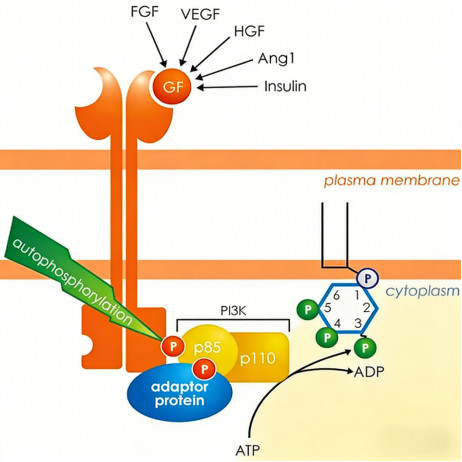
The phosphatidylinositol 3-kinase (PI3K) signaling pathway is a conserved intracellular regulatory network that mediates diverse biological processes in response to extracellular stimuli. Class I PI3K— the most extensively studied subclass—consists of a heterodimer of regulatory (e.g., p85) and catalytic (p110α/β/δ/γ) subunits. Activation begins with growth factors (FGF, VEGF, insulin) binding to receptor tyrosine kinases, triggering receptor autophosphorylation and recruitment of PI3K. The catalytic subunit phosphorylates phosphatidylinositol-4,5-bisphosphate (PIP2) to form phosphatidylinositol-3,4,5-trisphosphate (PIP3), a key second messenger that initiates downstream signaling cascades centered on the effector molecule AKT.
2. Research Frontiers
Current research on the PI3K pathway focuses on isoform-specific functions, spatiotemporal regulation, and translational applications. Key frontiers include dissecting the unique roles of p110β (critical in platelets, GPCR signaling, and PTEN-deficient tumors) versus other p110 isoforms, and exploring cross-talk with MAPK, AMPK, and other pathways. Advanced tools like PI3K p110β recombinant rabbit monoclonal antibodies enable precise detection of isoform expression, subcellular localization, and complex formation. Additionally, developing selective p110 isoform inhibitors and establishing pathway-specific biomarkers drive progress in treating tumors, metabolic diseases, and cardiovascular disorders.
3. Research Significance
Understanding PI3K pathway regulation is critical for unraveling cellular physiology and developing targeted therapies. The pathway governs glucose metabolism, cell survival, proliferation, and apoptosis—its dysregulation is linked to tumors (breast, prostate, colorectal cancer), type 2 diabetes, and cardiovascular/neurological diseases. PI3K p110β-specific antibodies serve as indispensable tools for identifying isoform-specific contributions to disease, validating drug targets, and monitoring treatment efficacy. Selective inhibition of p110β offers therapeutic potential for PTEN-deficient tumors and thrombotic disorders, highlighting the pathway’s translational relevance.
4. Related Mechanisms, Research Methods, and Product Applications
4.1 Pathway Activation and PIP3-Mediated Signaling
Activation Cascade: Growth factor-receptor binding induces receptor autophosphorylation, recruiting PI3K (p85-p110 heterodimer). p110 catalyzes PIP2 → PIP3 conversion.
Downstream Recruitment: PIP3 binds PH domains of AKT and PDK1, recruiting them to the plasma membrane. PDK1 phosphorylates AKT (Thr308), activating its kinase function.
4.2 AKT-Mediated Cellular Regulation
Activated AKT regulates multiple biological processes:
Metabolic Control: Phosphorylates AS160 (promotes GLUT4 membrane translocation) and GSK3β (enhances glycogen synthesis); activates mTORC1 (promotes protein translation).
Cell Survival and Apoptosis: Phosphorylates BAD (inhibits pro-apoptosis), IKKα (activates NF-κB survival genes), and FOXO1 (suppresses apoptotic gene expression); inhibits caspase-9 and promotes p53 degradation via MDM2.
4.3 Negative Regulation by PTEN
Phosphatase and tensin homolog (PTEN) is the key negative regulator:
Dephosphorylates PIP3 back to PIP2, attenuating AKT activation.
PIP2 (PTEN’s product) regulates calcium signaling, protein kinase C activity, ion channels, and cytoskeleton-membrane interactions, expanding PTEN’s functional scope.
4.4 Application of PI3K p110β Recombinant Rabbit Monoclonal Antibodies
These antibodies are versatile tools for research and drug development:
Mechanistic Studies: Used in co-immunoprecipitation (IP) to analyze p110β-p85 complex assembly; Western blot (WB) for quantitative expression analysis; immunofluorescence (IF) to visualize membrane recruitment.
Disease Research: Detect p110β expression/distribution in clinical samples to explore correlations with tumor progression and treatment response.
Drug Screening: Evaluate candidate compounds’ effects on p110β-specific signaling in high-throughput platforms.
4.5 Product Applications in Advanced Research
ANT BIO PTE. LTD.’s p110β antibodies support key research scenarios:
GPCR-Mediated Signaling: Investigate p110β activation by chemokines/lysophosphatidic acid via GPCRs, regulating cell chemotaxis and cytoskeletal reorganization.
Platelet Biology and Thrombosis: Study p110β’s role in platelet activation, aggregation, and thrombus formation under collagen/thrombin stimulation.
Tumor Research: Analyze p110β activation in PTEN-deficient tumors and evaluate p110β-specific inhibitors as therapeutic strategies.
Metabolic Regulation: Explore p110β’s non-redundant role in insulin signaling and glucose homeostasis.
5. Brand Mission
ANT BIO PTE. LTD. is dedicated to empowering global life science research and biopharmaceutical development through innovative, high-quality reagents. We strive to develop cutting-edge antibodies, proteins, kits, and tools that enable researchers to unravel the complexities of signaling pathways like PI3K and their role in disease. Our mission is to accelerate scientific discovery, facilitate the development of targeted therapeutics for tumors, metabolic diseases, and cardiovascular disorders, and improve human health by providing reliable, reproducible, and high-performance research solutions. With a commitment to excellence, innovation, and customer-centricity, we aim to be a trusted partner for researchers advancing the frontiers of precision medicine.
6. Related Product List
| Product Code |
Product Name |
Host |
| S0B1024 |
PI3 Kinase p110β Recombinant Rabbit Monoclonal Antibody (S-1193-115) |
Rabbit |
| S0B0904 |
PI3 Kinase p110β Recombinant Rabbit Monoclonal Antibody (S-1193-109) |
Rabbit |
Core Advantages of ANT BIO PTE. LTD.’s PI3K p110β Antibodies
High Specificity and Isoform Selectivity: Precisely recognize the p110β catalytic subunit with minimal cross-reactivity to p110α/δ/γ, ensuring accurate detection in complex samples.
Exceptional Stability and Consistency: Strict quality control ensures minimal batch-to-batch variation and reliable performance across WB, IP, and IF, supporting reproducible signaling pathway research.
7. AI Disclaimer
This article is AI-compiled and interpreted based on the original work. All intellectual property (e.g., images, data) of the original publication shall belong to the journal and the research team. For any infringement, please contact us promptly and we will take immediate action.
ANT BIO PTE. LTD. – Empowering Scientific Breakthroughs
At ANTBIO, we are committed to advancing life science research through high-quality, reliable reagents and comprehensive solutions. Our specialized sub-brands (Absin, Starter, UA) cover a full spectrum of research needs, from general reagents and kits to antibodies and recombinant proteins. With a focus on innovation, quality, and customer-centricity, we strive to be your trusted partner in unlocking scientific mysteries and driving medical progress. Explore our product portfolio today and elevate your research to new heights.
|
 中文
中文