|
The Key Role of Cyclin D1 Antibodies in Tumor Pathological Diagnosis
hits:307 Date:03/29/26
1. Literature Information
Research Focus: Exploration of Cyclin D1’s role in cell cycle regulation, its association with tumorigenesis, specific applications of Cyclin D1 antibodies in tumor pathological diagnosis, quality control standardization, and future research directions.
Core Innovation: Validation of Cyclin D1 as a pivotal oncoprotein and diagnostic marker—with Cyclin D1 antibodies serving as indispensable tools for mantle cell lymphoma diagnosis, differential diagnosis of solid tumors, and prognosis assessment—supported by standardized quality control systems.
2. Research Background
Cyclin D1, a 36kDa protein (295 amino acids) encoded by the gene on chromosome 11q13, is a core regulator of the cell cycle. It forms complexes with CDK4/6 to phosphorylate retinoblastoma protein, driving the G1-to-S phase transition. Under physiological conditions, its expression is cell-cycle dependent (peaking in G1) and tissue-specific. However, gene amplification, chromosomal translocations (e.g., t(11;14) in mantle cell lymphoma), or protein overexpression disrupts cell cycle control, promoting tumorigenesis. Cyclin D1 abnormalities are common in mantle cell lymphoma, breast cancer, colorectal cancer, and other malignancies. Cyclin D1 antibodies enable precise detection of this protein, addressing critical needs in tumor pathological diagnosis and personalized therapy.
3. Research Approaches
To establish Cyclin D1 antibodies as a core diagnostic tool, the research team adopted a mechanism-to-clinical strategy:
Mechanistic Validation: Investigating Cyclin D1’s role in cell cycle regulation (G1-to-S transition) and how abnormal expression drives tumorigenesis.
Clinical Application Analysis: Evaluating Cyclin D1 antibodies in diagnosing mantle cell lymphoma, solid tumors, and differentiating tumor subtypes.
Quality Control Standardization: Developing positive/negative control systems (e.g., tonsil tissue) and standardized interpretation guidelines for staining localization/intensity.
Future Direction Exploration: Investigating Cyclin D1’s interaction networks, drug resistance associations, and advanced detection technologies.
4. Research Outcomes
4.1 Cyclin D1’s Role in Cell Cycle Regulation
Molecular Mechanism: Cyclin D1 forms functional complexes with CDK4/6, phosphorylating retinoblastoma protein to release E2F transcription factors—driving G1-to-S phase transition.
Physiological Expression: Periodic expression (peaks in G1, declines in S phase) with strict tissue specificity (confined to epithelial proliferative zones, endothelial cells, fibroblasts).
4.2 Abnormal Cyclin D1 Expression in Tumorigenesis
Genetic Alterations: Gene amplification, chromosomal translocations (t(11;14) in mantle cell lymphoma, t(11;11) in parathyroid adenomas) lead to sustained overexpression.
Tumor Associations: Over 90% of mantle cell lymphoma cases express Cyclin D1; overexpression correlates with progression/prognosis in breast, colorectal, bladder, and thyroid cancers.
4.3 Specific Applications of Cyclin D1 Antibodies in Pathological Diagnosis
Mantle Cell Lymphoma Diagnosis: Nuclear-positive Cyclin D1 expression is a key diagnostic criterion, distinguishing it from other B-cell lymphoproliferative disorders (heterogeneous staining requires correlation with histomorphology/immunophenotype).
Other Hematopoietic Tumors: Prognostic marker in hairy cell lymphoma and certain CD20-positive multiple myeloma subtypes.
Solid Tumor & Dermatopathology: Aids in differentiating Spitz nevus from malignant melanoma; evaluates prognosis in breast and other solid tumors.
4.4 Standardized Quality Control for Cyclin D1 Testing
Control Selection: Tonsil tissue serves as an ideal control—basal/suprabasal epithelial cells show moderate-strong nuclear staining; mantle zone/germinal center B cells are negative.
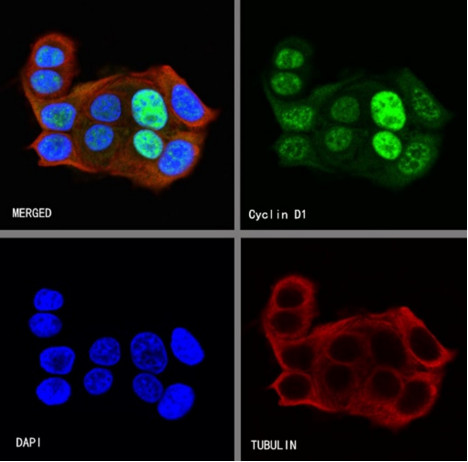
Result Interpretation: Specific staining localizes to nuclei (cytoplasmic staining is nonspecific); weak nuclear staining is diagnostic for mantle cell lymphoma.
Standardization: Establishing consistent interpretation guidelines ensures inter-laboratory comparability.
4.5 Future Research Directions
Basic Research: Exploring Cyclin D1’s interaction networks with cell cycle regulators and its role in targeted therapy resistance.
Clinical Advances: Developing automated, high-sensitivity detection systems; correlating expression levels with treatment responses for personalized therapy.
Technological Innovation: Single-cell analysis to decipher intratumoral Cyclin D1 heterogeneity.
5. Product Empowerment by ANT BIO PTE. LTD.
ANT BIO PTE. LTD.’s STARTER brand, a leader in recombinant antibodies, provides a high-performance tool for tumor diagnosis: the "Cyclin D1 Recombinant Rabbit Monoclonal Antibody" (Catalog No.: S0B2322).
Key Roles of the Product:
Diagnostic Precision: Enables specific nuclear staining of Cyclin D1 in FFPE samples, critical for mantle cell lymphoma diagnosis and differential diagnosis.
Research Versatility: Supports cell cycle regulation studies, tumor prognosis assessment, and CDK4/6 inhibitor efficacy prediction.
Core Advantages: High specificity (minimal background), clear nuclear localization, and batch consistency—ensuring reliable results for clinical diagnosis and basic research.
Technical Support: Comprehensive IHC protocols, antigen retrieval solutions, and interpretation criteria facilitate accurate result acquisition.
ANT BIO PTE. LTD.’s CDK2/Cyclin D1 Protein (UA080214, expressed in Baculovirus-Insect Cells) further supports in vitro functional studies of Cyclin D1-CDK complexes.
6. Brand Mission
ANT BIO PTE. LTD. is dedicated to empowering global life science advancement through three specialized sub-brands: ABSIN (general reagents, ELISA kits), STARTER (antibodies), and UA (recombinant proteins). Leveraging advanced development platforms—including recombinant rabbit/mouse monoclonal antibody generation, recombinant protein expression (E.coli, CHO, HEK293, Insect Cells), and One-Step ELISA—we deliver high-quality, compliant products certified by EU 98/79/EC, ISO9001, and ISO13485. Our mission is to partner with pathological laboratories, pharmaceutical companies, and research institutions worldwide, providing innovative reagents and solutions that accelerate discoveries in tumor diagnosis, precision medicine, and cancer research.
7. Related Product List
| UA080214 |
CDK2/Cyclin D1 Protein |
Host : Human
Expression System : Baculovirus-InsectCells
Conjugation : Unconjugated |
| S0B2322 |
Cyclin D1 Recombinant Rabbit mAb (SDT-R423) |
Host : Rabbit
Conjugation : Unconjugated |
| S0B2322P |
S-RMab® Cyclin D1 Recombinant Rabbit mAb,PBS Only (SDT-R423) |
Host : Rabbit
Conjugation : Unconjugated |
8. AI Disclaimer
This article is AI-compiled and interpreted based on the original work. All intellectual property (e.g., images, data) of the original publication shall belong to the journal and the research team. For any infringement, please contact us promptly and we will take immediate action.
ANT BIO PTE. LTD. – Empowering Scientific Breakthroughs
At ANTBIO, we are committed to advancing life science research through high-quality, reliable reagents and comprehensive solutions. Our specialized sub-brands (Absin, Starter, UA) cover a full spectrum of research needs, from general reagents and kits to antibodies and recombinant proteins. With a focus on innovation, quality, and customer-centricity, we strive to be your trusted partner in unlocking scientific mysteries and driving medical progress. Explore our product portfolio today and elevate your research to new heights.
|
 中文
中文