 中文
中文


Home > News > LECT2: A Liver-Secreted Factor Regulating Renal Fibrosis via Endoplasmic Reticulum Stress and EGFR Signaling
LECT2: A Liver-Secreted Factor Regulating Renal Fibrosis via Endoplasmic Reticulum Stress and EGFR Signaling
- 1. Concept of LECT2 and Renal Fibrosis
Renal fibrosis is a common pathological endpoint of chronic kidney diseases, characterized by persistent inflammation, myofibroblast activation, and excessive extracellular matrix deposition. Leukocyte cell-derived chemotaxin-2 (LECT2) is a hepatocyte-secreted cytokine that plays a pivotal role in inter-organ communication, particularly in regulating renal microenvironment remodeling. Normally localized in the renal tubulointerstitial region, LECT2’s expression expands along vascular structures during fibrosis, indicating its involvement in pathological progression. Loss-of-function studies confirm that LECT2 deficiency alleviates renal fibrosis, highlighting its pro-fibrotic role.
2. Research Frontiers
LECT2 has emerged as a key mediator of renal fibrosis, with research focusing on its cross-talk between endoplasmic reticulum (ER) stress and epidermal growth factor receptor (EGFR) signaling pathways. Recent breakthroughs reveal that LECT2 does not act directly on fibroblasts but indirectly drives fibrosis via renal endothelial cells. Key frontiers include dissecting the "survival-fibrosis" paradox of LECT2 (promoting endothelial cell survival while inducing pro-fibrotic factor secretion), exploring its receptor interaction mechanisms (e.g., EGFR binding), and developing targeted inhibitors. Recombinant LECT2 protein is increasingly used to validate signaling pathways, establish dose-response relationships, and assess therapeutic potential in preclinical models.
3. Research Significance
Understanding LECT2’s role in renal fibrosis provides critical insights into inter-organ communication and fibrotic disease mechanisms. As a liver-derived factor regulating remote renal pathology, LECT2 bridges organ crosstalk, offering a new perspective on fibrotic disease pathogenesis. Its dual regulation of ER stress and EGFR signaling reveals the complexity of cell survival-tissue remodeling balance, guiding the development of novel anti-fibrotic strategies (e.g., targeting LECT2-EGFR interactions). Recombinant LECT2 protein serves as an indispensable tool for validating these mechanisms, accelerating drug discovery for chronic kidney diseases and other fibrotic disorders.
4. Related Mechanisms, Research Methods, and Product Applications
4.1 Core Mechanisms of LECT2-Mediated Renal Fibrosis
LECT2 exerts pro-fibrotic effects through two interconnected signaling pathways:
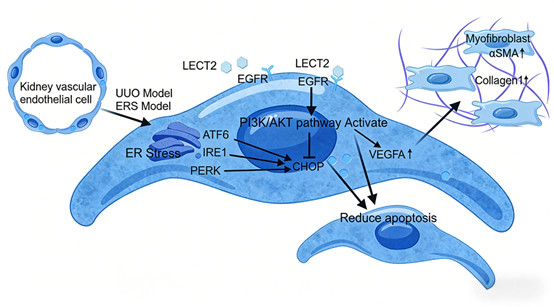
ER Stress Regulation: LECT2 suppresses adaptive ER stress responses. In LECT2-deficient mice, higher baseline CHOP (pro-apoptotic transcription factor) expression confers endothelial cell resistance to damage, mitigating fibrosis. In wild-type mice, fibrotic kidneys show depleted GRP78 (molecular chaperone) and sustained ER stress, promoting pathology.
EGFR/PI3K/AKT Activation: LECT2 directly binds EGFR on renal endothelial cells, activating downstream PI3K/AKT signaling. This inhibits caspase-dependent apoptosis, reduces early apoptosis rates, and promotes secretion of pro-fibrotic factors (e.g., VEGFA), indirectly driving myofibroblast activation and extracellular matrix deposition.
4.2 Key Applications of Recombinant Human LECT2 Protein
Recombinant LECT2 protein is essential for advancing fibrosis research:
Gain-of-Function and Dose-Response Studies: Exogenous LECT2 in cell cultures reverses knockout phenotypes and establishes concentration-dependent effects, mimicking in vivo paracrine/endocrine signaling.
Signaling Pathway Elucidation: Combined with pathway inhibitors, it maps downstream networks (EGFR, PI3K/AKT) to confirm their necessity for LECT2’s pro-fibrotic effects.
Receptor Binding Analysis: Used in SPR and ITC assays to quantify LECT2-EGFR binding affinity (KD) and identify critical structural domains.
Preclinical Disease Modeling: Systemic/local delivery in animal fibrosis models assesses LECT2’s pathogenic role and potential as a therapeutic target.
4.3 Insights into Organ Fibrosis
LECT2 serves as a signaling hub, balancing cell survival and tissue remodeling. Its suppression of adaptive ER stress and activation of EGFR/PI3K/AKT highlight the cell-type-specific complexity of fibrotic pathways. This inter-organ regulatory mechanism (liver-secreted LECT2 regulating renal fibrosis) underscores the importance of systemic signaling in fibrotic diseases, guiding the development of targeted therapies that modulate rather than fully inhibit stress or survival pathways.
5. Brand Mission
ANT BIO PTE. LTD. is dedicated to empowering global life science research and translational medicine through innovative, high-quality biological reagents. We strive to develop cutting-edge recombinant proteins, antibodies, kits, and tools that enable researchers to unravel the mechanisms of fibrotic diseases, inter-organ communication, and signal transduction. Our mission is to accelerate scientific discovery, facilitate the development of novel anti-fibrotic therapeutics, and improve patient outcomes for chronic kidney diseases and related disorders. With a commitment to excellence, innovation, and customer-centricity, we aim to be a trusted partner for researchers advancing the frontiers of cell biology and precision medicine.
6. Related Product List
| Product Code | Product Name | Host |
| S0A0096 | Human LECT2 Protein (His Tag) | Human |
Core Advantages of ANT BIO PTE. LTD.’s Recombinant Human LECT2 Protein
High Bioactivity and Native Conformation: Expressed in HEK293 cells, ensuring proper folding, glycosylation, and formation of bioactive homomeric hexamers. Validated to bind receptors (CD209a, TEK/Tie2) and regulate macrophage chemotaxis, angiogenesis, and hepatic stellate cell activation—mirroring endogenous protein function.
Exceptional Purity and Stability: Multi-step chromatographic purification achieves >95% purity (SDS-PAGE) with endotoxin <1.0 EU/μg. Strict quality control ensures batch-to-batch consistency and physicochemical stability, guaranteeing reliable experimental results.
Key Application Scenarios
Fibrosis Research: Investigates LECT2’s role in renal, liver, and other organ fibrosis models.
Inflammation and Immune Regulation: Studies LECT2’s function as a macrophage chemokine in inflammatory diseases (e.g., rheumatoid arthritis, sepsis).
Angiogenesis and Tumor Biology: Explores LECT2’s impact on tumor angiogenesis and microenvironment remodeling.
Metabolic Disease Studies: Examines LECT2’s involvement in obesity, insulin resistance, and type 2 diabetes.
7. AI Disclaimer
This article is AI-compiled and interpreted based on the original work. All intellectual property (e.g., images, data) of the original publication shall belong to the journal and the research team. For any infringement, please contact us promptly and we will take immediate action.
ANT BIO PTE. LTD. – Empowering Scientific Breakthroughs
At ANTBIO, we are committed to advancing life science research through high-quality, reliable reagents and comprehensive solutions. Our specialized sub-brands (Absin, Starter, UA) cover a full spectrum of research needs, from general reagents and kits to antibodies and recombinant proteins. With a focus on innovation, quality, and customer-centricity, we strive to be your trusted partner in unlocking scientific mysteries and driving medical progress. Explore our product portfolio today and elevate your research to new heights.
Related News
- PTM Analysis is Essential for Antibody Research 7/10/2026
- BioMed X and Boehringer Ingelheim Expand XSeed Labs to Advance Next-Generation E 7/10/2026
- Everest Medicines Announces Close of Exclusive Licensing Agreement with Travere 7/10/2026
- Pan Modification Microspheres for PTM Proteomics 7/9/2026
- Specific Antibodies Drive Targeted Protein Degradation 7/9/2026
- Thermo Fisher Scientific Receives First FBI Approval for Rapid DNA Crime Scene P 7/9/2026
- Selective Chemical Labeling of Protein Lysine Methacrylation 7/8/2026
- Eppendorf Focuses Outreach Programmes to Advance STEM Education in Europe 7/8/2026
- Fumaroylation: A New Hub Linking Metabolism and Epigenetics 7/7/2026
- OECD Publishes Test Guideline for ToxTracker® 7/7/2026