 中文
中文


Home > News > PSEN1 Antibodies: Unveiling the Pathogenic Mechanisms of Alzheimer's Disease and Novel Therapeutic Targets
PSEN1 Antibodies: Unveiling the Pathogenic Mechanisms of Alzheimer's Disease and Novel Therapeutic Targets
- 1. Literature Information
Research Focus: Exploration of PSEN1 (presenilin 1) as a key pathogenic gene for Alzheimer's disease (AD), its molecular functions, mutation-driven pathogenic mechanisms, and the role of PSEN1-specific antibodies in advancing AD research and therapeutic development.
Core Innovation: Systematic demonstration of PSEN1’s dual roles (γ-secretase-dependent and independent) in AD pathogenesis, characterization of its mutation spectrum, and validation of PSEN1 antibodies as indispensable tools for mechanism research, drug screening, and pathological analysis—paving the way for precision therapies.
2. Research Background
Alzheimer's disease (AD) remains one of the most devastating neurodegenerative disorders, with familial Alzheimer's disease (FAD) accounting for a significant subset of cases. The PSEN1 gene, located on human chromosome 14q24.2, encodes a 53 kD transmembrane protein that serves as the core catalytic subunit of the γ-secretase complex. Evolutionarily conserved across species (from nematodes to vertebrates), PSEN1 regulates critical biological processes including neural development, Notch receptor cleavage, and amyloid precursor protein (APP) processing. Among over 318 known PSEN1 mutations, more than 300 are tightly linked to FAD, with additional associations with Pick's disease, frontotemporal dementia, and amyotrophic lateral sclerosis. Despite its central role in neurodegeneration, the precise molecular mechanisms by which PSEN1 mutations drive AD—along with potential therapeutic targets—remain incompletely understood. PSEN1-specific antibodies have emerged as vital tools to address these gaps, enabling detailed analysis of protein function, localization, and interaction networks.
3. Research Approaches
To dissect PSEN1’s role in AD, the research team employed a multi-disciplinary, mechanism-focused strategy:
Molecular Function Characterization: Investigating PSEN1’s dual mechanisms (γ-secretase-dependent APP/Notch cleavage and γ-secretase-independent regulation of Wnt/β-catenin signaling, calcium homeostasis, and autophagy) using biochemical and cellular assays.
Mutation Spectrum Analysis: Mapping PSEN1 mutations (enriched in transmembrane domains and hydrophilic loops) and determining their impact on protein function, subcellular localization, and γ-secretase activity.
Antibody-Based Tools: Utilizing PSEN1-specific antibodies for protein localization (IHC/IF), interaction studies (co-immunoprecipitation), and drug screening (high-throughput evaluation of γ-secretase modulators).
Animal Model Validation: Using genetically engineered models (APP/PS1 double transgenic, 5×FAD, 3×Tg) to study PSEN1’s role in Aβ deposition, tau hyperphosphorylation, and cognitive dysfunction.
Translational Research: Exploring PSEN1-targeted therapies, including mutation-specific γ-secretase modulators and conformational stabilizers.
4. Research Outcomes
4.1 Molecular Functions and Regulatory Mechanisms of PSEN1
PSEN1 exerts biological effects through two core mechanisms:
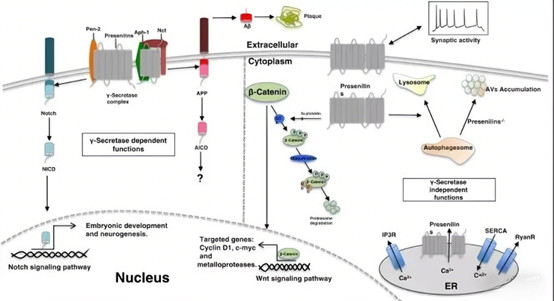
γ-Secretase-Dependent Function: As part of the γ-secretase complex, it cleaves APP and Notch receptors. PSEN1 mutations increase the Aβ42/Aβ40 ratio, promoting neurotoxic amyloid plaque formation.
γ-Secretase-Independent Function: Regulates Wnt/β-catenin signaling, endoplasmic reticulum calcium homeostasis (via SERCA, IP3R, RyanR), and autophagy-lysosome function. It also modulates synaptic plasticity by regulating neurotransmitter release in hippocampal pyramidal neurons—linking to early cognitive impairment in AD.
Structurally, PSEN1 contains nine transmembrane domains with cytoplasmic N- and C-termini, enabling interactions with diverse signaling molecules.
4.2 PSEN1 Mutation Spectrum and Pathogenic Mechanisms
Mutation Characteristics: Over 85% are missense mutations, enriched in transmembrane domains (TM2, TM6, TM7) and hydrophilic loops—regions critical for γ-secretase substrate recognition and catalysis.
Hotspot Mutations: p.Met146Leu, p.Leu286Val, and p.Ala431Glu are strongly associated with early-onset FAD.
Pathogenic Mechanisms: Mutations act via distinct pathways—impaired γ-secretase activity, abnormal subcellular trafficking (endoplasmic reticulum-Golgi mislocalization), or disrupted calcium signaling—leading to neuronal apoptosis and neuroinflammation.
4.3 Core Applications of PSEN1 Antibodies in AD Research
PSEN1-specific antibodies are indispensable for advancing AD research:
Protein Localization & Expression: IHC/IF enables tracking of PSEN1 in neuronal membranes and Golgi apparatus, revealing mutation-induced localization abnormalities.
Molecular Interaction Mapping: Co-immunoprecipitation identifies PSEN1’s binding partners (e.g., APH-1, PEN-2, Nicastrin in the γ-secretase complex).
Pathological Diagnosis & Gene Editing Validation: Assessing PSEN1 expression and functional rescue in patient-derived iPSC models.
Drug Development: High-throughput screening of γ-secretase modulators and other PSEN1-targeted therapies.
4.4 PSEN1-Related Animal Models
Genetically engineered models provide critical in vivo platforms:
Mouse Models: Psen1 knockout (impaired neurogenesis), APP/PS1 double transgenic (Aβ deposition), 5×FAD, and 3×Tg (tau hyperphosphorylation, cognitive dysfunction).
Rat Models: APP21, APP KI, and APPPS1 (advantages for studying blood-brain barrier penetration and systemic pathology).
4.5 Future Directions and Translational Prospects
Precision Stratification: Developing personalized therapies targeting specific PSEN1 mutation types (e.g., γ-secretase modulators).
Multi-Omics Integration: Combining single-cell sequencing and proteomics to analyze mutation-specific effects in distinct neuronal subtypes.
Novel Therapeutic Modalities: Small molecule stabilizers for PSEN1 conformational abnormalities or antibody-mediated targeted degradation of mutant proteins.
Systemic Pathology Insights: PSEN1’s high expression in the central nervous system, testes, thymus, and urinary system suggests potential systemic contributions to AD.
5. Product Empowerment by ANT BIO PTE. LTD.
ANT BIO PTE. LTD.’s STARTER brand, a leader in neuroscience antibodies, provides a cornerstone tool for AD research: the "PSEN1 Recombinant Rabbit Monoclonal Antibody" (Catalog No.: S0B0905). This high-performance antibody is engineered to support the full spectrum of PSEN1-related research.
Key Roles of the Product:
Specific Detection: Precisely recognizes PSEN1 protein, with exceptional staining specificity for membrane structures and Golgi apparatus in FFPE tissues and cell samples—enabling accurate localization and expression analysis.
Multi-Platform Compatibility: Validated for IHC, WB, and IF, supporting diverse applications from protein quantification to subcellular localization and interaction studies.
Reliable Performance: Rigorous quality control ensures minimal batch-to-batch variation and stable staining/detection—critical for reproducible long-term research and drug development.
Translational Value: Facilitates evaluation of γ-secretase modulators, gene editing efficacy, and mutant PSEN1 degradation in preclinical models—accelerating therapeutic development.
6. Brand Mission
ANT BIO PTE. LTD. is dedicated to empowering global life science advancement through three specialized sub-brands: ABSIN (general reagents, ELISA kits), STARTER (antibodies), and UA (recombinant proteins). Leveraging advanced development platforms—including recombinant rabbit/mouse monoclonal antibody generation, rapid antibody development, recombinant protein expression (E.coli, CHO, HEK293, Insect Cells), One-Step ELISA, and PTM Pan-Modification Antibody platforms—we deliver high-quality, compliant products certified by EU 98/79/EC, ISO9001, and ISO13485. Our mission is to partner with innovative pharmaceutical companies, research institutions, and scientists worldwide, providing innovative reagents and solutions that accelerate discoveries in neurodegenerative diseases, neuroscience, and precision medicine.
7. Related Product List
| S0B0905 | PSEN1 Recombinant Rabbit mAb (S-1002-129) | Host : Rabbit Conjugation : Unconjugated |
8. AI Disclaimer
This article is AI-compiled and interpreted based on the original work. All intellectual property (e.g., images, data) of the original publication shall belong to the journal and the research team. For any infringement, please contact us promptly and we will take immediate action.
ANT BIO PTE. LTD. – Empowering Scientific Breakthroughs
At ANTBIO, we are committed to advancing life science research through high-quality, reliable reagents and comprehensive solutions. Our specialized sub-brands (Absin, Starter, UA) cover a full spectrum of research needs, from general reagents and kits to antibodies and recombinant proteins. With a focus on innovation, quality, and customer-centricity, we strive to be your trusted partner in unlocking scientific mysteries and driving medical progress. Explore our product portfolio today and elevate your research to new heights.
Related News
- Prestained Protein Marker: A Comprehensive Guide for Western Blot and Protein El 9/17/2026
- PSEN1 Antibody: A Critical Tool for Deciphering Alzheimer's Disease Pathogenesis 9/16/2026
- SHP Substrate 1 Recombinant Protein: Molecular Design, Functional Mechanisms and 9/15/2026
- Research Progress on Hepatic Lectin H1 Protein 9/14/2026
- PIC Paired Antibodies: A Comprehensive Analysis of Principles, Preparation, and 9/11/2026
- CMS: Initial Prescriptions for Silevimig Injection, the World's First Bispecific 9/10/2026
- Precision in Practice: Why Skilled Manufacturing Remains Central to Titan Enterp 9/10/2026
- Adagene Achieves Milestone in Collaboration with Exelixis for Advancement of SAF 9/10/2026
- Avi-Tag Technology: High-Precision Biotinylation Labeling Facilitates Molecular 9/10/2026
- ANT BIO: The Remarkable Biotinylated Proteins 9/9/2026