 中文
中文


Home > News > How Does PKCζ Regulate the Disease Progression of Autosomal Dominant Polycystic Kidney Disease?
How Does PKCζ Regulate the Disease Progression of Autosomal Dominant Polycystic Kidney Disease?
- 1. Concept of Autosomal Dominant Polycystic Kidney Disease (ADPKD)
Autosomal dominant polycystic kidney disease (ADPKD) is the most common inherited kidney disorder, affecting over 12 million people worldwide. Caused by mutations in PKD1 or PKD2 genes, it is characterized by the formation of numerous fluid-filled cysts in both kidneys. These cysts progressively expand, replacing normal renal parenchyma and leading to end-stage renal disease in most patients by age 60, requiring renal replacement therapy. The pathogenesis centers on dysfunction of polycystin-1 (PC1), a transmembrane glycoprotein that interacts with multiple signaling molecules—including atypical protein kinase Cζ (PKCζ)—making this interaction a key target for understanding disease mechanisms and developing therapies.
2. Research Frontiers
Research focuses on unraveling PKCζ’s regulatory role in ADPKD, particularly its interaction with PC1. Key frontiers include defining how PKCζ phosphorylates PC1’s cytoplasmic fragment (PC1-p30) at specific sites, maintaining PC1 function and regulating pathways like epithelial cell polarity, cilia formation, and calcium signaling—all critical in ADPKD. PKCζ recombinant rabbit monoclonal antibodies enable precise detection of PKCζ expression, phosphorylation, and subcellular localization. Additionally, exploring pharmacologic restoration of PKCζ function (e.g., with FTY720) and validating PKCζ’s role in slow-progressing ADPKD models are active translational directions.
3. Research Significance
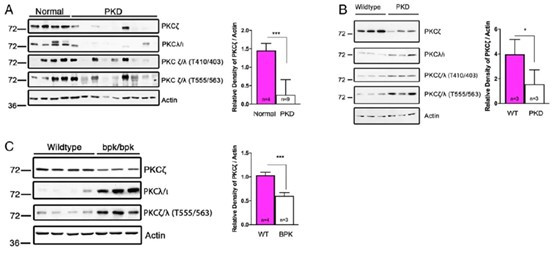
Elucidating PKCζ’s role in ADPKD provides a novel therapeutic target for this incurable disease. PKCζ downregulation in ADPKD patient tissues and animal models disrupts PC1-mediated signaling, promoting cyst formation and renal fibrosis. Restoring PKCζ function with drugs like FTY720 alleviates disease progression, highlighting its therapeutic potential. PKCζ antibodies are indispensable for validating this mechanism, evaluating drug efficacy, and developing biomarkers for disease monitoring. This research also expands understanding of PKCζ’s role in renal physiology, with implications for other kidney disorders involving epithelial dysfunction.
4. Related Mechanisms, Research Methods, and Product Applications
4.1 PKCζ-PC1 Interaction and Functional Regulation
PKCζ interacts with PC1 to maintain renal homeostasis:
• Direct Binding: PKCζ binds the C-terminal cytoplasmic fragment of PC1 (PC1-p30), forming a stable complex.
• Phosphorylation: PKCζ phosphorylates specific sites on PC1-p30, critical for maintaining PC1’s role in cell polarity, cilia formation, and calcium signaling.
• Pathway Integration: PKCζ regulates NF-κB, AMPK, and S6K pathways—dysregulation of which contributes to cyst growth and renal impairment in ADPKD.
4.2 PKCζ Dysregulation in ADPKD Progression
PKCζ function is compromised in ADPKD:
• Reduced Expression: Clinical samples and animal models show markedly decreased PKCζ levels in ADPKD kidney tissues, across different genetic backgrounds.
• Functional Consequences: PKCζ downregulation disrupts renal tubular epithelial cell polarity and ciliary function, promoting cyst formation; abnormal downstream signaling (NF-κB/AMPK/S6K) accelerates renal fibrosis.
4.3 Therapeutic Restoration of PKCζ Function
Pharmacologic activation of PKCζ alleviates ADPKD:
• FTY720-Mediated Activation: The FDA-approved drug FTY720 activates PKCζ via ceramide modulation.
• Therapeutic Effects: In PKD animal models, FTY720 reduces cyst number/volume and renal fibrosis—effects dependent on PKCζ (lost in PKCζ-deficient models).
• Mechanism: FTY720 restores PKCζ expression, normalizes downstream signaling, and inhibits cystogenic processes.
4.4 Application Value of PKCζ Recombinant Rabbit Monoclonal Antibodies
These antibodies are critical for ADPKD research and drug development:
• Mechanistic Studies: Used in Western blot to quantify PKCζ expression; immunohistochemistry to visualize tissue distribution; co-immunoprecipitation to confirm PKCζ-PC1 interaction.
• Drug Evaluation: Assess FTY720 and candidate drugs’ effects on PKCζ expression/phosphorylation, validating target engagement.
• Biomarker Development: Establish PKCζ-based diagnostic methods for disease progression monitoring and treatment efficacy evaluation.
4.5 Product Applications in Advanced Research
ANT BIO PTE. LTD.’s PKCζ antibody supports diverse research scenarios:
• ADPKD and Kidney Disease Research: Study PKCζ’s role in cyst formation, renal fibrosis, and epithelial cell polarity.
• Cell Biology: Explore PKCζ’s function in cell survival (PI3K/Akt/NF-κB pathways), immune cell activation, and insulin signaling/GLUT4 translocation.
• Metabolic Research: Investigate PKCζ’s role in insulin resistance and metabolic homeostasis.
5. Brand Mission
ANT BIO PTE. LTD. is dedicated to empowering global kidney disease research and biopharmaceutical development through innovative, high-quality reagents. We strive to develop cutting-edge antibodies, proteins, kits, and tools that enable researchers to unravel the mechanisms of ADPKD and advance targeted therapeutics. Our mission is to accelerate scientific discovery, facilitate the development of disease-modifying treatments for inherited kidney disorders, and improve patient outcomes by providing reliable, reproducible, and high-performance research solutions. With a commitment to excellence, innovation, and customer-centricity, we aim to be a trusted partner for researchers advancing the frontiers of renal physiology and precision medicine.
6. Related Product List
| Product Code | Product Name | Host |
| S0B0802 | PKC zeta Recombinant Rabbit Monoclonal Antibody (S-1306-34) |
Rabbit |
Core Advantages of ANT BIO PTE. LTD.’s PKCζ Antibody
High Specificity and Phosphorylation Detection: Precisely recognizes PKCζ and its activation-associated phosphorylation sites, distinguishing activated vs. non-activated states for dynamic signaling analysis.
Exceptional Stability and Consistency: Strict quality control ensures minimal batch-to-batch variation and reliable performance across WB, IF, and IP, supporting reproducible signaling research.
7. AI Disclaimer
This article is AI-compiled and interpreted based on the original work. All intellectual property (e.g., images, data) of the original publication shall belong to the journal and the research team. For any infringement, please contact us promptly and we will take immediate action.
ANT BIO PTE. LTD. – Empowering Scientific Breakthroughs
At ANTBIO, we are committed to advancing life science research through high-quality, reliable reagents and comprehensive solutions. Our specialized sub-brands (Absin, Starter, UA) cover a full spectrum of research needs, from general reagents and kits to antibodies and recombinant proteins. With a focus on innovation, quality, and customer-centricity, we strive to be your trusted partner in unlocking scientific mysteries and driving medical progress. Explore our product portfolio today and elevate your research to new heights.
Related News
- Lilac Biosciences and Soin Neuroscience Announce Publication of Clinical Review 7/24/2026
- Matexcel Launches Mid-Year Special Promotion to Support Materials Science Resear 7/24/2026
- Epidermal Growth Factor (EGF): A Revolutionary Molecule from Basic Biology to Re 7/24/2026
- How DPP-4 Research Becomes the National Natural Science Foundation’s "Golden Tra 7/23/2026
- Potent Payloads in ADCs: Enhancing Targeted Cancer Therapy through Payload Techn 7/22/2026
- Axiom Biosciences Announces Intention to Become the First U.S. Biotech to List o 7/22/2026
- Win an INTEGRA Biosciences PIPETBOY GENIUS Pipet Controller! 7/21/2026
- PTEN Companion Diagnostic Antibodies Direct Precision Cancer Therapy 7/21/2026
- Illumina Expands Billion Cell Atlas Program with New AI Drug Developers 7/20/2026
- PTEN Antibody Decodes Tumor Suppressor Inactivation and Precision Therapy 7/20/2026