|
CD8α Antibodies: Unveiling the Regulatory Mechanisms of T Cell Quiescence
hits:25 Date:05/18/26
1. Concept of CD8α and Its Core Functions in T Cells
CD8α is a critical membrane protein subunit expressed on the surface of CD8⁺ T cells, forming a heterodimer with CD8β to constitute the CD8 co-receptor. This complex primarily recognizes major histocompatibility complex class I (MHC-I) molecules, mediating T cell receptor (TCR) signaling and promoting the activation and effector functions of cytotoxic T cells (CTLs). Beyond its well-established role in T cell activation and target cell killing, emerging research highlights CD8α’s central role in maintaining the quiescent state of CD8⁺ T cells—a physiological state characterized by low metabolic activity, slow cell cycle progression, and long-term survival. T cell quiescence is essential for preserving immune memory, functional reserves, and the ability to mount robust responses against new pathogens or tumors; disruption of this state leads to T cell exhaustion, reduced cell numbers, and impaired anti-infection and anti-tumor immunity.
2. Research Frontiers
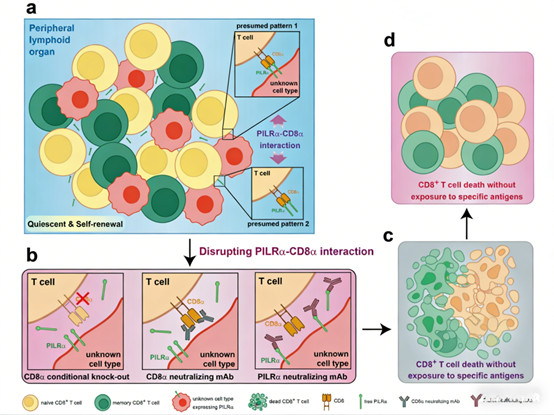
The maintenance of T cell quiescence has emerged as a key focus in immunology, as it underpins immune homeostasis and long-term immune competence. Naive and memory T cells reside in a quiescent state in the absence of antigen stimulation, allowing them to persist in peripheral tissues without unnecessary activation or exhaustion. Recent breakthroughs have identified a novel regulatory axis involving CD8α and its specific ligand PILRα (Paired Immunoglobulin-like Type 2 Receptor α), which directly mediates T cell quiescence. Using high-throughput intercellular receptor screening, researchers confirmed that CD8α interacts with PILRα to inhibit pro-activation intracellular pathways, preventing abnormal T cell activation in the absence of antigens. This discovery expands our understanding of CD8α’s functional diversity, shifting the paradigm from its sole role as an activation co-receptor to a key regulator of T cell quiescence. Additionally, conditional CD8α knockout mouse models have demonstrated the irreplaceable role of CD8α in maintaining T cell homeostasis, opening new avenues for investigating immune deficiencies and T cell exhaustion.
3. Research Significance
Elucidating the regulatory mechanisms of T cell quiescence through CD8α offers profound implications for immunology and translational medicine. T cell quiescence is critical for maintaining immune homeostasis—dysregulation of this state accelerates T cell death, increases susceptibility to infections, and impairs immune memory formation. Understanding how CD8α and PILRα collaborate to sustain quiescence provides new insights into the pathogenesis of immune-related diseases, such as autoimmune disorders, immunodeficiencies, and cancer. For example, targeting the CD8α-PILRα axis could enable the modulation of T cell activation-quiescence balance, offering potential therapeutic strategies to enhance anti-tumor immunity (by reversing T cell exhaustion) or treat autoimmune diseases (by promoting T cell quiescence). Furthermore, CD8α antibodies serve as indispensable tools for validating these mechanisms, facilitating the development of novel immunotherapies and advancing our understanding of immune cell biology.
4. Related Mechanisms, Research Methods, and Product Applications
4.1 The CD8α-PILRα Signaling Axis in T Cell Quiescence Regulation
The CD8α-PILRα interaction is a key molecular mechanism governing T cell quiescence:
Ligand Identification: High-throughput screening of a human transmembrane gene plasmid library in 293T cells, using fluorescently labeled secondary antibodies for binding detection, identified PILRα as the specific ligand for CD8α.
Signaling Pathway: The CD8α-PILRα axis inhibits intracellular pathways associated with excessive T cell activation (e.g., pro-proliferative or pro-inflammatory signaling), preventing CD8⁺ T cells from entering an abnormal activated state in the absence of antigen stimulation. This inhibition ensures long-term quiescence, survival, and self-renewal capacity.
Functional Consequence: Intact CD8α-PILRα signaling maintains the quiescent state of naive and memory CD8⁺ T cells, while disruption (via CD8α knockout or neutralizing antibodies) leads to upregulated activation markers, accelerated cell cycle progression, and massive apoptosis.
4.2 Impact of CD8α Deficiency on T Cell Homeostasis
Conditional CD8α knockout mouse models have provided critical insights into CD8α’s role:
Developmental Phenotype: CD8α deficiency does not affect thymic T cell development but disrupts the quiescence of peripheral naive and memory CD8⁺ T cells.
Functional Deficits: CD8α-deficient mice exhibit reduced peripheral CD8⁺ T cell numbers, impaired immune defense against pathogens, and compromised immune memory, confirming CD8α’s essential role in maintaining T cell homeostasis and immune protection.
4.3 Research and Application Value of CD8α Antibodies
CD8α antibodies are versatile tools in immunology research and translational studies:
Mechanistic Validation: Used to block the CD8α-PILRα interaction, enabling researchers to confirm the axis’s role in maintaining T cell quiescence and dissect downstream signaling pathways.
Immunophenotyping: Applied in flow cytometry (FACS), immunofluorescence (IF), and immunohistochemistry (IHC) to detect CD8α expression dynamics in T cell subsets, facilitating the identification and quantification of CD8⁺ T cells.
Cell Depletion and Functional Studies: Used to deplete CD8⁺ T cells in disease models, exploring their specific roles in anti-tumor, anti-infection, or autoimmune responses.
Therapeutic Potential: Agonistic or antagonistic antibodies targeting the CD8α-PILRα axis hold promise for regulating T cell quiescence-activation balance, offering potential treatments for autoimmune diseases, immunodeficiencies, or cancer.
4.4 Current Challenges and Future Directions
Despite significant progress, CD8α-related research faces several key challenges and opportunities:
Unraveling Downstream Signaling: The specific intracellular signaling networks downstream of the CD8α-PILRα axis remain unclear and require systematic mapping using single-cell sequencing and protein interaction omics.
Synergistic Mechanisms: Understanding how CD8α interacts with other co-stimulatory or co-inhibitory molecules to regulate T cell quiescence and activation.
Clinical Translation: Developing highly specific, low-off-target humanized CD8α antibodies or nanobodies to advance discoveries toward clinical applications.
Expanding Cell Type Research: Exploring CD8α’s potential functions in regulatory T cells, innate lymphoid cells, and other immune subsets to broaden its theoretical and application scope.
4.5 Product Applications in Advanced Research
ANT BIO PTE. LTD.’s CD8α antibodies support a wide range of cutting-edge research applications:
Cytotoxic Immune Response Studies: Identify and analyze peripheral or tissue-infiltrating CD8⁺ T cells in tumor, infection, or autoimmune models, assessing activation, proliferation, effector function, and exhaustion.
Tumor Immune Microenvironment Analysis: Quantify CD8⁺ T cell infiltration density and spatial distribution in tumor tissues via IHC/IF, a key indicator for evaluating "immune-hot" tumors and predicting immunotherapy efficacy.
Immune Cell Sorting and Functional Assays: Isolate high-purity CD8⁺ T cells from spleen, lymph nodes, or tumor tissues for adoptive transfer, in vitro expansion, killing assays, or single-cell sequencing.
Immune Development and Homeostasis Research: Study T cell development in the thymus and the maintenance of CD8⁺ T cell homeostasis in peripheral lymphoid organs.
5. Brand Mission
ANT BIO PTE. LTD. is dedicated to empowering global life science research through innovative, high-quality reagents and tools. We strive to develop cutting-edge antibodies, proteins, kits, and general life science products that enable researchers to unravel the complexities of immune cell biology, including T cell quiescence and activation. Our mission is to accelerate scientific discovery, facilitate the development of novel therapeutics, and improve human health by providing reliable, reproducible, and high-performance research solutions. With a commitment to excellence, innovation, and customer-centricity, we aim to be a trusted partner for researchers advancing the frontiers of immunology and translational medicine.
6. Related Product List
| Product Code |
Product Name |
Host |
| S0B8514 |
Rat Anti-Mouse CD8α Antibody (S-3804) |
Rat |
| S0B8453 |
Mouse Anti-Human CD8α Antibody (S-3972) |
Mouse |
| S0B5118 |
APC-Cy7 Rat Anti-Mouse CD8α Antibody (S-R540) |
Rat |
| S0B8256 |
Alexa Fluor® 647 Rat Anti-Mouse CD8α Antibody (S-R381) |
Rat |
| S0B2307 |
S-RMab® CD8α Mouse mAb (SDT-1036-34) |
Mouse |
Core Advantages of ANT BIO PTE. LTD.’s CD8α Antibodies
High Specificity for Precise Subset Identification: Specifically recognizes the mouse CD8α chain, accurately labeling CD8⁺ T cells and CD8⁺ dendritic cell (cDC1) subsets. Rigorous cross-reactivity validation ensures high-purity target cell identification in complex samples, supporting precise immunophenotyping.
Superior Affinity and Detection Performance: Exhibits high binding affinity, delivering bright fluorescent signals and excellent signal-to-noise ratios in flow cytometry for clear discrimination of positive and negative cell populations. In IHC, it enables specific membrane staining of CD8⁺ T cells in tissues with clear localization and low background.
Exceptional Batch Consistency and Application Compatibility: Mature production processes and strict quality control ensure consistent potency and specificity across batches. Validated for use in FACS, IHC, IF, and WB, providing flexible and reliable options for diverse experimental needs.
7. AI Disclaimer
This article is AI-compiled and interpreted based on the original work. All intellectual property (e.g., images, data) of the original publication shall belong to the journal and the research team. For any infringement, please contact us promptly and we will take immediate action.
ANT BIO PTE. LTD. – Empowering Scientific Breakthroughs
At ANTBIO, we are committed to advancing life science research through high-quality, reliable reagents and comprehensive solutions. Our specialized sub-brands (Absin, Starter, UA) cover a full spectrum of research needs, from general reagents and kits to antibodies and recombinant proteins. With a focus on innovation, quality, and customer-centricity, we strive to be your trusted partner in unlocking scientific mysteries and driving medical progress. Explore our product portfolio today and elevate your research to new heights.
|
 中文
中文