 中文
中文


Home > News > Targeting NF-κB p65 DNA-Binding Activity: Can Sesquiterpene Lactones’ α-M-γ-B Core Improve Arthritis?
Targeting NF-κB p65 DNA-Binding Activity: Can Sesquiterpene Lactones’ α-M-γ-B Core Improve Arthritis?
- 1. Concept of NF-κB p65 and Rheumatoid Arthritis Pathogenesis
Rheumatoid arthritis (RA) is an autoimmune disorder characterized by chronic synovitis, pannus formation, and progressive bone/cartilage destruction. Its pathology is driven by abnormal immune cell infiltration and persistent inflammation in the synovial microenvironment, with macrophage polarization imbalance (excessive pro-inflammatory M1 macrophages) playing a central role. M1 macrophages secrete TNF-α, IL-1β, and IL-6, exacerbating tissue damage. The nuclear factor-κB (NF-κB) signaling pathway is a key regulator of M1 polarization: in resting cells, NF-κB dimers (primarily p65-p50) are sequestered in the cytoplasm by IκBα. Inflammatory stimuli activate the IKK complex, leading to IκBα phosphorylation and degradation. Free p65 translocates to the nucleus, binds κB sites in target gene promoters, and drives pro-inflammatory gene transcription. The nuclear localization and DNA-binding activity of p65 are critical for pathway function, making them ideal targets for RA intervention.
2. Research Frontiers
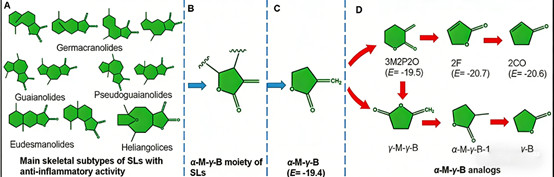
A key frontier in RA research is identifying natural product-derived compounds that target NF-κB p65. Sesquiterpene lactones (SLs), natural anti-inflammatory molecules from Asteraceae plants, share a conserved α-methylene-γ-butyrolactone (α-M-γ-B) core—an α,β-unsaturated ketone pharmacophore acting as a Michael reaction acceptor. Recent studies confirm α-M-γ-B as the essential anti-inflammatory structural unit of SLs. Research now focuses on its mechanism: α-M-γ-B inhibits p65’s DNA-binding activity (without affecting IκBα degradation or nuclear translocation) by covalently modifying key cysteine residues. Additionally, NF-κB p65 (Ser468) phosphorylation antibodies are used to dissect post-translational regulation of p65, enhancing understanding of α-M-γ-B’s specificity and pathway impact.
3. Research Significance
Targeting p65’s DNA-binding activity with α-M-γ-B offers a novel therapeutic strategy for RA. Unlike conventional inhibitors that block upstream pathway activation, α-M-γ-B acts directly on nuclear p65, providing precise control of inflammatory gene transcription. This mechanism avoids off-target effects on other NF-κB-dependent physiological processes. Additionally, α-M-γ-B’s natural origin and structural simplicity make it a promising lead compound for drug development. NF-κB p65 (Ser468) antibodies are indispensable for validating α-M-γ-B’s specificity, exploring feedback regulation of NF-κB signaling, and linking molecular inhibition to pathological improvement in RA models—advancing both basic research and clinical translation.
4. Related Mechanisms, Research Methods, and Product Applications
4.1 The α-M-γ-B Core: Essential for SL Anti-Inflammatory Activity
SLs with anti-inflammatory activity share the α-M-γ-B structural unit:
* This unit features an α,β-unsaturated ketone, forming a Michael reaction acceptor with strong electrophilicity.
* Structural analogs lacking this unit (e.g., γ-M-γ-B) or its electrophilic center show no anti-inflammatory activity, confirming α-M-γ-B as the "universal code" for SL efficacy.
* Synthetic standalone α-M-γ-B mimics SL anti-inflammatory effects, validating it as a lead pharmacophore.
4.2 Mechanism of α-M-γ-B Targeting NF-κB p65
α-M-γ-B exerts anti-inflammatory effects through a specific mechanism:
* It does not affect IκBα degradation or p65 nuclear translocation.
* Acts as a Michael reaction acceptor, covalently modifying key cysteine residues (e.g., Cys38) in p65’s DNA-binding domain.
* This modification sterically hinders p65-DNA binding, blocking transcription of pro-inflammatory genes (TNF-α, IL-1β, IL-6).
* Promotes M1-to-M2 macrophage polarization, correcting the polarization imbalance in RA synovium.
4.3 Application Value of NF-κB p65 (Ser468) Phosphorylation Antibodies
High-specificity p65 (Ser468) antibodies are critical for RA and NF-κB research:
* Mechanism Elucidation: Detect whether α-M-γ-B affects Ser468 phosphorylation, determining if it acts solely on DNA binding or also modulates upstream kinase signaling.
* Specificity Verification: Compare α-M-γ-B with IκB-targeted inhibitors to confirm its unique action on p65-DNA binding.
* Disease Model Monitoring: Evaluate p65 activation (including Ser468 phosphorylation) in RA animal joint tissues, linking molecular inhibition to pathological improvement.
* Feedback Regulation Studies: Explore Ser468 phosphorylation’s role in NF-κB signal termination, a key process in inflammation resolution.
4.4 Product Applications in Advanced Research
ANT BIO PTE. LTD.’s p65 (Ser468) antibody supports diverse research scenarios:
NF-κB Feedback Inhibition: Study Ser468 phosphorylation in late inflammatory stages to understand signal shutdown mechanisms.
GSK-3β Regulation: Investigate how GSK-3β-mediated Ser468 phosphorylation negatively regulates p65 transcriptional activity.
Tumor Biology: Analyze abnormal Ser468 phosphorylation in tumors, linking it to NF-κB-dependent pro-survival functions.
Drug Development: Evaluate effects of anti-inflammatory drugs (e.g., GSK-3β modulators) on Ser468 phosphorylation.
5. Brand Mission
ANT BIO PTE. LTD. is dedicated to empowering global immunology, inflammation, and drug development research through innovative, high-quality reagents. We strive to develop cutting-edge antibodies, proteins, kits, and tools that enable researchers to unravel the mechanisms of autoimmune diseases like RA and advance targeted therapeutics. Our mission is to accelerate scientific discovery, facilitate the development of novel anti-inflammatory drugs, and improve patient outcomes by providing reliable, reproducible, and high-performance research solutions. With a commitment to excellence, innovation, and customer-centricity, we aim to be a trusted partner for researchers advancing the frontiers of precision medicine.
6. Related Product List
| Product Code | Product Name | Host |
| S0B1280 | Phospho-NF-κB p65 (Ser468) Recombinant Rabbit Monoclonal Antibody (S-1124-133) | Rabbit |
Core Advantages of ANT BIO PTE. LTD.’s p65 (Ser468) Antibody
High Phosphorylation Site Specificity: Precisely recognizes Ser468 phosphorylation in p65’s transactivation domain—an important marker for NF-κB feedback inhibition and inflammation resolution.
Exceptional Stability and Consistency: Strict quality control ensures minimal batch-to-batch variation and reliable performance across WB, IF, and other platforms, supporting reproducible signaling pathway research.
7. AI Disclaimer
This article is AI-compiled and interpreted based on the original work. All intellectual property (e.g., images, data) of the original publication shall belong to the journal and the research team. For any infringement, please contact us promptly and we will take immediate action.
ANT BIO PTE. LTD. – Empowering Scientific Breakthroughs
At ANTBIO, we are committed to advancing life science research through high-quality, reliable reagents and comprehensive solutions. Our specialized sub-brands (Absin, Starter, UA) cover a full spectrum of research needs, from general reagents and kits to antibodies and recombinant proteins. With a focus on innovation, quality, and customer-centricity, we strive to be your trusted partner in unlocking scientific mysteries and driving medical progress. Explore our product portfolio today and elevate your research to new heights.
Related News
- Prestained Protein Marker: A Comprehensive Guide for Western Blot and Protein El 9/17/2026
- PSEN1 Antibody: A Critical Tool for Deciphering Alzheimer's Disease Pathogenesis 9/16/2026
- SHP Substrate 1 Recombinant Protein: Molecular Design, Functional Mechanisms and 9/15/2026
- Research Progress on Hepatic Lectin H1 Protein 9/14/2026
- PIC Paired Antibodies: A Comprehensive Analysis of Principles, Preparation, and 9/11/2026
- CMS: Initial Prescriptions for Silevimig Injection, the World's First Bispecific 9/10/2026
- Precision in Practice: Why Skilled Manufacturing Remains Central to Titan Enterp 9/10/2026
- Adagene Achieves Milestone in Collaboration with Exelixis for Advancement of SAF 9/10/2026
- Avi-Tag Technology: High-Precision Biotinylation Labeling Facilitates Molecular 9/10/2026
- ANT BIO: The Remarkable Biotinylated Proteins 9/9/2026