 中文
中文


Home > News > Targeting the CD40/CD40L (CD154) Pathway: A Promising Breakthrough in Immunotherapy
Targeting the CD40/CD40L (CD154) Pathway: A Promising Breakthrough in Immunotherapy
- 1. Concept of the CD40/CD40L (CD154) Pathway
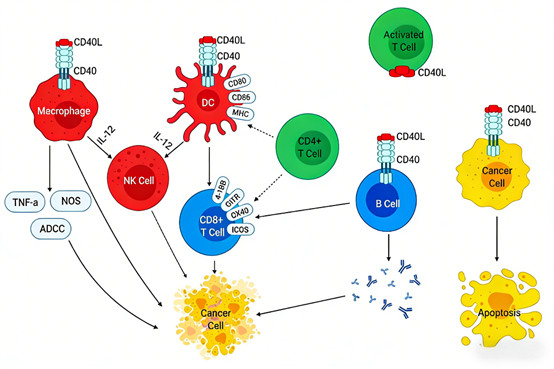
The CD40/CD40L (CD40 ligand, also known as CD154) pathway is a central immunoregulatory axis, acting as a critical bridge between innate and adaptive immune responses. CD40, a member of the tumor necrosis factor receptor (TNFR) superfamily, is a type I transmembrane protein widely expressed on antigen-presenting cells (APCs) such as B cells, dendritic cells (DCs), and macrophages, as well as on some endothelial cells and cancer cells. Its ligand, CD40L (CD154), is a type II transmembrane protein primarily expressed on activated CD4⁺ T cells, with additional expression on activated platelets, natural killer (NK) cells, and some B cells. The binding of CD40L to CD40 delivers a potent activation signal to APCs, triggering downstream signaling cascades that regulate immune response initiation, amplification, and polarization.
2. Research Frontiers
The CD40/CD40L pathway has emerged as a pivotal target in immunotherapy, driving innovations in cancer treatment, autoimmune disease management, and organ transplantation. In oncology, agonist-based strategies (e.g., anti-CD40 agonistic antibodies) aim to activate APCs in the tumor microenvironment (TME), converting "cold tumors" (poorly immunogenic) into "hot tumors" (immunologically active) by enhancing tumor antigen presentation and T cell activation. In autoimmune diseases and transplantation, antagonist/blocker strategies (e.g., anti-CD154 antibodies) seek to inhibit excessive pathway activation, which contributes to pathological inflammation and immune rejection. Recent research frontiers include developing next-generation therapeutics such as bispecific antibodies (targeting CD40 and tumor antigens), engineered antibodies with optimized Fc regions (to balance efficacy and toxicity), and combination therapies (e.g., CD40 agonists with PD-1/PD-L1 inhibitors). Additionally, advances in CD154 antibody technology have improved specificity and safety, enabling more precise pathway modulation for both research and clinical applications.
3. Research Significance
Targeting the CD40/CD40L pathway holds profound significance for advancing immunotherapy. In cancer, activating this pathway bypasses immune tolerance by directly stimulating APCs, enabling the immune system to recognize and eliminate tumor cells—addressing a key limitation of current immunotherapies that rely on pre-existing anti-tumor immunity. For autoimmune diseases (e.g., systemic lupus erythematosus, rheumatoid arthritis), blocking the pathway suppresses pathological immune responses without fully compromising protective immunity, offering a more targeted alternative to broad-spectrum immunosuppressants. In organ transplantation, pathway inhibition reduces donor-specific immune rejection, improving graft survival. Furthermore, CD154 antibodies serve as indispensable research tools to dissect pathway biology, validate therapeutic targets, and evaluate drug efficacy, accelerating the translation of basic research into clinical applications.
4. Related Mechanisms, Research Methods, and Product Applications
4.1 Core Mechanisms of CD40/CD40L Pathway Regulation
CD40 signaling modulates immune responses through multiple interconnected mechanisms:
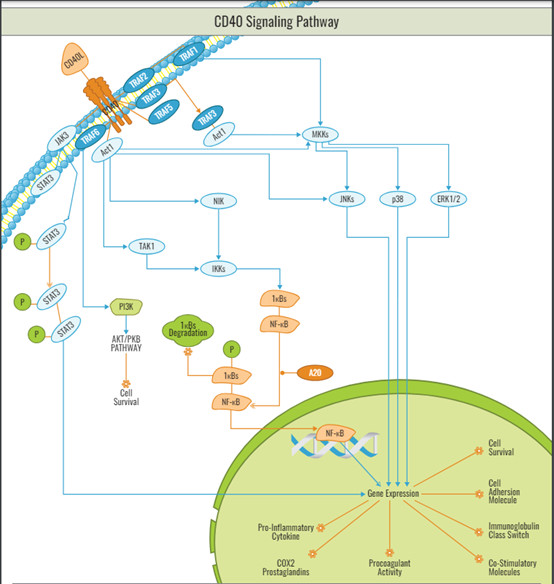
APC Maturation and Activation: CD40 ligation on DCs upregulates co-stimulatory molecules (CD80, CD86) and MHC-II, enhances pro-inflammatory cytokine secretion (IL-12), and promotes DC migration to lymph nodes—enabling efficient naïve T cell activation and polarization. In B cells, CD40 signaling is essential for activation, proliferation, germinal center formation, antibody class switching, and affinity maturation.
Anti-Tumor Immunity Enhancement: In the TME, CD40 agonists activate DCs and macrophages, boosting tumor antigen presentation and T cell priming. Activated macrophages also exhibit enhanced phagocytosis of tumor cells, while CD40 signaling on cancer cells can induce apoptosis or sensitize them to immune-mediated killing.
Pathological Inflammation Modulation: Excessive CD40/CD40L activation drives autoimmune and chronic inflammatory diseases by promoting pro-inflammatory cytokine production and immune cell infiltration. Blocking the pathway with anti-CD154 antibodies inhibits these pathological processes, restoring immune homeostasis.
4.2 Drug Development Strategies Targeting the Pathway
Drug development focuses on two complementary strategies, tailored to different disease contexts:
Agonist Strategy (Cancer Therapy): Agonistic anti-CD40 antibodies cross-link CD40 receptors, mimicking natural CD40L-mediated trimerization to activate downstream signaling. Key design considerations include optimizing the Fc region to bind specific Fcγ receptors (enhancing APC activation) and balancing efficacy with toxicity (avoiding systemic cytokine release syndrome).
Antagonist/Blocker Strategy (Autoimmune Diseases/Transplantation): Blocking antibodies or fusion proteins target CD40 or CD40L (CD154) to inhibit pathological interactions. Anti-CD154 antibodies offer precise suppression, as CD40L expression is restricted to activated immune cells. Next-generation anti-CD154 antibodies, engineered to reduce Fc effector functions, have improved safety profiles and are being evaluated in clinical trials for autoimmune diseases and transplant rejection.
4.3 Core Applications of CD154 Antibodies
CD154 antibodies are versatile tools in research and therapeutic development:
Basic Mechanism Research: Used to detect CD40L expression on activated T cells via flow cytometry, and to block the CD40/CD40L pathway in vitro to verify its role in immune responses (e.g., B cell activation, T cell priming).
Drug Development and Efficacy Evaluation: Support candidate molecule screening, competitive binding assays, and epitope mapping for therapeutic anti-CD154 antibodies. In preclinical models, anti-mouse CD154 antibodies assess pathway blockade effects on disease progression, guiding clinical trial design.
Combination Therapy Exploration: Essential for studying synergistic effects of CD40 agonists with immune checkpoint inhibitors (e.g., anti-PD-1/PD-L1) in cancer, or CD40/CD40L blockers with immunosuppressants in autoimmune diseases.
4.4 Current Challenges and Future Directions
Despite promising progress, the field faces key challenges:
Efficacy-Toxicity Balance: For CD40 agonists, achieving local tumor activation without systemic inflammation requires refined dosing strategies and tissue-targeted delivery.
Biomarker Development: Identifying predictive biomarkers (e.g., APC density, CD40 expression) to stratify patients most likely to benefit from agonists or antagonists.
Next-Generation Therapeutics: Exploring bispecific antibodies, antibody-drug conjugates, and small molecules to improve tissue penetration, pharmacokinetics, and target specificity.
Clinical Translation: Addressing historical safety concerns (e.g., thrombosis with early anti-CD154 antibodies) through antibody engineering and careful clinical trial design.
5. Brand Mission
ANT BIO PTE. LTD. is dedicated to empowering global life science research and translational medicine through innovative, high-quality reagents. We strive to develop cutting-edge antibodies, proteins, kits, and general life science products that enable researchers to unravel the complexities of immune regulation and develop novel immunotherapeutic strategies. Our mission is to accelerate scientific discovery, facilitate the development of targeted therapies for cancer, autoimmune diseases, and transplantation, and improve human health by providing reliable, reproducible, and high-performance research solutions. With a commitment to excellence, innovation, and customer-centricity, we aim to be a trusted partner for researchers advancing the frontiers of immunology and precision medicine.
6. Related Product List
| Product Code | Product Name |
| S0B8327 | FITC Mouse Anti-Human CD154 Antibody (S-R579) |
| S0B8298 | Alexa Fluor® 488 Mouse Anti-Human CD154 Antibody (S-R579) |
| S0B8342 | Pacific Blue Mouse Anti-Human CD154 Antibody (S-R579) |
| S0B0691 | Invivo Anti-Mouse CD40L (CD154) Recombinant mAb |
| S0B5072 | Mouse Anti-Human CD154 Antibody (S-R579) |
Core Advantages of ANT BIO PTE. LTD.’s CD154 Antibodies
High Fluorescence Brightness and Signal-to-Noise Ratio: Conjugated with high-quality fluorophores (FITC, Alexa Fluor® 488, Pacific Blue, APC), these antibodies deliver strong, stable signals resistant to photobleaching. They enable clear discrimination in multicolor flow cytometry, even for low-expression CD154 samples.
Exceptional Specificity: Rigorously validated to specifically recognize human or mouse CD154, with no cross-reactivity to other leukocyte surface antigens. Ensures precise identification of activated CD4⁺ T cells and other CD154-expressing immune subsets.
Ready-to-Use Convenience and Batch Consistency: Supplied in pre-titrated, optimized buffers for immediate use, simplifying experimental workflows. Strict quality control guarantees consistent fluorescence intensity, staining index, and specificity across batches, ensuring reproducible data.
7. AI Disclaimer
This article is AI-compiled and interpreted based on the original work. All intellectual property (e.g., images, data) of the original publication shall belong to the journal and the research team. For any infringement, please contact us promptly and we will take immediate action.
ANT BIO PTE. LTD. – Empowering Scientific Breakthroughs
At ANTBIO, we are committed to advancing life science research through high-quality, reliable reagents and comprehensive solutions. Our specialized sub-brands (Absin, Starter, UA) cover a full spectrum of research needs, from general reagents and kits to antibodies and recombinant proteins. With a focus on innovation, quality, and customer-centricity, we strive to be your trusted partner in unlocking scientific mysteries and driving medical progress. Explore our product portfolio today and elevate your research to new heights.
Related News
- PTM Analysis is Essential for Antibody Research 7/10/2026
- BioMed X and Boehringer Ingelheim Expand XSeed Labs to Advance Next-Generation E 7/10/2026
- Everest Medicines Announces Close of Exclusive Licensing Agreement with Travere 7/10/2026
- Pan Modification Microspheres for PTM Proteomics 7/9/2026
- Specific Antibodies Drive Targeted Protein Degradation 7/9/2026
- Thermo Fisher Scientific Receives First FBI Approval for Rapid DNA Crime Scene P 7/9/2026
- Selective Chemical Labeling of Protein Lysine Methacrylation 7/8/2026
- Eppendorf Focuses Outreach Programmes to Advance STEM Education in Europe 7/8/2026
- Fumaroylation: A New Hub Linking Metabolism and Epigenetics 7/7/2026
- OECD Publishes Test Guideline for ToxTracker® 7/7/2026