 中文
中文



AELAB ATP Fluorescence Detector Series

- Product Detail
- Company Profile
- Food-contact and product-contact surfaces
- Conveyors, filling areas and packaging equipment
- Laboratory benches and preparation worktops
- Mixing vessels and accessible processing surfaces
- Door handles, carts and frequently touched surfaces
- Cleaning tools and selected sanitation equipment
- Rinse water and compatible process-liquid samples
- Cold rooms, storage areas and controlled workspaces
- Changeover and post-cleaning inspection points
- Areas included in HACCP, GMP or internal sanitation programs
- ATP detection sensitivity of 1 × 10⁻¹⁸ mol
- Measurement range of 0–999,999 RLU
- Approximate detection time of 15 seconds
- Built-in self-check and calibration light source
- User ID and result-limit settings
- Rechargeable lithium battery
- MiniUSB connection for result transfer
- ATP detection precision of 1 × 10⁻¹⁵ mol
- Measurement range of 0–9,999 RLU
- Selectable testing time from 1 to 60 seconds
- Low-background, light-shielded detection design
- Storage capacity for more than 3,000 records
- USB result transfer to a computer
- Portable operation using two AA batteries
- Define a consistent sampling area for each test point.
- Use the same swabbing pattern, pressure and sampling duration.
- Establish site-specific RLU limits through baseline and validation studies.
- Store ATP swabs and reagents according to their instructions.
- Check consumable lot numbers and expiry dates before testing.
- Keep the detector’s sampling chamber clean and free from residue.
- Use appropriate control materials according to the monitoring procedure.
- Investigate unexpected results and repeat sampling when required.
- Document failed results and the corresponding corrective action.
- Follow the selected model’s maintenance and verification instructions.
- Multiple handheld models for different ATP monitoring requirements
- Rapid RLU-based hygiene and cleanliness assessment
- Portable designs suitable for on-site testing
- Models with data storage and computer-transfer capabilities
- Options with rechargeable or replaceable battery operation
- Solutions for food, healthcare, pharmaceutical and industrial environments
- Model-selection assistance based on the customer’s application
- Technical specifications and quotation support before purchase
AELAB supplies portable ATP fluorescence detectors for rapid cleanliness verification, sanitation monitoring and biological residue screening in food processing, healthcare, pharmaceutical, biotechnology, water treatment and industrial environments.
ATP monitoring systems measure adenosine triphosphate through a luciferase–luciferin bioluminescence reaction. The emitted light is measured in Relative Light Units (RLU), providing a rapid indication of biological or organic residue on a tested surface or in a compatible sample.
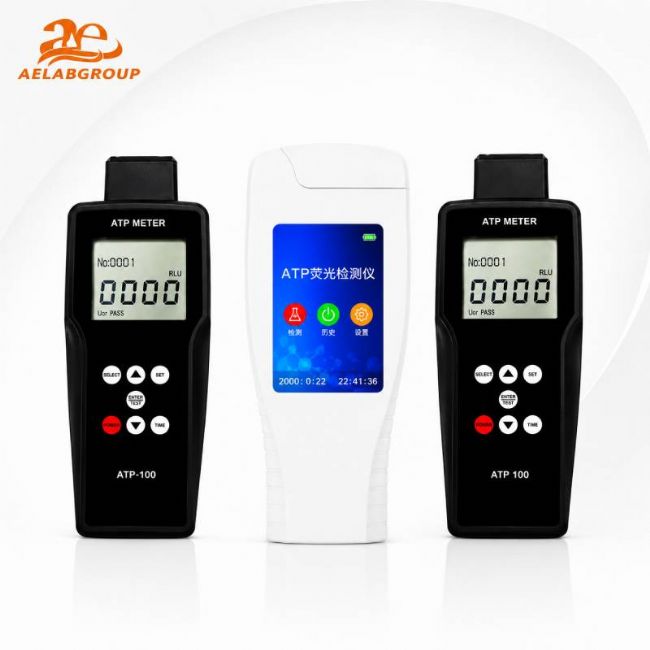
The AELAB ATP detector range includes the LD-ATP, ATP-100 and ATP-100E models. These handheld systems are intended for fast on-site hygiene checks and can support routine cleaning verification programs.
Users can compare available models according to required sensitivity, measurement range, test time, data storage, power supply, operating environment and result-export requirements.
Review portable ATP hygiene monitoring systems for surface cleanliness testing, sanitation verification and rapid contamination screening.
What Does an ATP Fluorescence Detector Measure?
ATP is present in living cells and many types of biological or organic residue. During an ATP test, a sample is collected with a compatible swab or sampling system and reacted with a luciferase-based reagent. The chemical reaction produces light, which is measured by the detector.
The result is normally reported as an RLU value. A higher value generally indicates a greater amount of ATP-containing residue, while a lower value indicates a cleaner tested area according to the limits established by the user’s validated hygiene procedure.
Important: ATP testing is a rapid hygiene-screening and cleaning-verification method. It detects ATP-containing residue but does not identify a specific microorganism or replace pathogen-specific microbiological testing.
Typical ATP Hygiene Testing Workflow
| Testing Stage | Typical Procedure |
|---|---|
| 1. Select the Test Point | Identify the surface, equipment area, worktop or other sampling point included in the hygiene monitoring plan. |
| 2. Collect the Sample | Use a compatible ATP swab and follow a standardized sampling area, direction and pressure. |
| 3. Activate the Reagent | Activate or mix the collected sample with the luciferase-based reagent according to the consumable instructions. |
| 4. Insert and Measure | Place the prepared sampling device into the ATP detector and start the measurement cycle. |
| 5. Review the RLU Result | Compare the result with the site-specific pass, caution or fail limit established for the sampling point. |
| 6. Record Corrective Action | Document the result and repeat cleaning or sanitation when the reading exceeds the validated action limit. |
Typical Applications
Rapid hygiene verification of food-contact surfaces, preparation areas, filling equipment, processing lines and packaging zones.
Routine cleanliness screening of selected environmental surfaces, treatment areas, workstations, carts and shared equipment.
Support for cleaning verification of production surfaces, controlled areas, laboratory benches and selected manufacturing equipment.
Monitoring of work surfaces, shared laboratory equipment, preparation areas and selected controlled workspaces.
Rapid ATP screening in compatible water, rinse-water and environmental hygiene monitoring workflows.
Verification of cleaning effectiveness on kitchen surfaces, utensils, preparation stations and food-service areas.
Common ATP Monitoring Points
How to Select an ATP Fluorescence Detector
Selecting an ATP detector should be based on the intended hygiene-monitoring program rather than sensitivity alone. The user should consider sample type, measurement range, test speed, result storage, data transfer, power supply, operating conditions and compatibility with the selected ATP swabs or reagents.
| Selection Factor | Questions to Consider |
|---|---|
| Required Sensitivity | What level of ATP detection is required for the intended sanitation or cleanliness procedure? |
| Measurement Range | Does the instrument cover the RLU values expected for both clean and contaminated samples? |
| Testing Time | How quickly must operators receive results before production release or corrective cleaning? |
| Sample Type | Will the system be used for surface swabs, compatible liquid samples or both? |
| Result Storage | How many test records must be retained in the instrument before transfer or review? |
| Data Communication | Is USB or another supported connection required for transferring results to a computer? |
| User and Limit Settings | Are multiple users, sampling locations or customized acceptance limits required? |
| Power Supply | Is a rechargeable instrument preferred, or are replaceable batteries more practical for field operation? |
| Operating Environment | Will the detector be used in a laboratory, processing plant, kitchen, hospital or field environment? |
| Consumable Compatibility | Which ATP swabs, reagents and control materials are compatible with the selected model? |
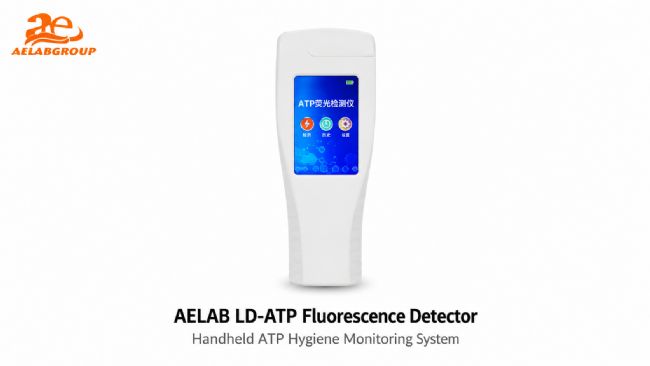
Representative AELAB ATP Fluorescence Detector Models
A handheld ATP hygiene monitoring system designed for rapid surface-cleanliness verification using the luciferase–luciferin bioluminescence principle.
A portable bioluminescence monitor intended for rapid ATP measurement in food, medical, pharmaceutical, environmental and industrial hygiene workflows.
The ATP-100E is included in the AELAB ATP fluorescence detector family as an ultra-sensitive ATP monitoring model. It is intended for users requiring portable ATP-based hygiene assessment and rapid cleanliness verification.
Contact AELAB to confirm the current ATP-100E technical configuration, detection performance, included accessories, compatible consumables and available data-management functions.
Good Practices for Reliable ATP Testing
Why Consider AELAB ATP Fluorescence Detectors?
AELAB is a laboratory equipment and scientific instrument supplier based in Guangzhou, China. The company provides analytical instruments, general laboratory equipment, life-science systems, environmental testing equipment and quality-control solutions for international customers.
AELAB supports distributors, universities, research organizations, testing laboratories and industrial users with product selection, technical information, quotations and laboratory equipment sourcing.
Official website: www.aelabgroup.com
Frequently Asked Questions
What does an ATP fluorescence detector measure?
It measures light produced by a luciferase–luciferin reaction involving ATP. The result is displayed as an RLU value that indicates the relative amount of ATP-containing residue in the sample.
Does an ATP detector directly count bacteria?
No. ATP testing detects ATP from biological and organic material. It is a rapid hygiene indicator and does not directly identify or selectively count a particular microorganism.
Can ATP testing replace microbiological culture?
No. ATP testing is valuable for immediate cleaning verification, while microbiological culture is required when microbial enumeration, confirmation or identification is needed.
What is an acceptable RLU limit?
There is no single universal limit for every application. Pass and fail limits should be established for each surface type and sampling location through a documented baseline and validation procedure.
Which AELAB ATP detector models are available?
The current AELAB category includes the LD-ATP, ATP-100 and ATP-100E ATP fluorescence detector models.
What information should I provide when requesting a model?
Provide the intended application, sample type, required sensitivity, expected RLU range, number of daily tests, data-storage requirements, preferred power supply, destination country and required consumables.
Tell the AELAB technical sales team about your application, sample type, required sensitivity, expected number of tests, data-management requirements and working environment. Suitable ATP fluorescence detector models can then be compared according to your hygiene-monitoring workflow.
The quotation may include the recommended instrument, available technical specifications, standard accessories, compatible consumables, optional accessories, delivery time, packaging and shipping information.
View AELAB ATP Fluorescence Detectors
Email: info@aelabgroup.com
WhatsApp / WeChat: +86 158 0001 6110
Website: www.aelabgroup.com
-
AELAB GUANGZHOU CO., LTD.
AELAB is a laboratory equipment and analytical instrument supplier based in Guangzhou, China. We provide laboratory instruments, quality control equipment, analytical systems, sample preparation equipment, and related laboratory solutions for distributors, industrial laboratories, universities, research organizations, and testing centers worldwide.
AELAB offers both our own-brand products and carefully selected instruments from established manufacturers. OEM and ODM services are available for selected AELAB products, including customized branding, appearance, configuration, power supply, accessories, packaging, and documentation according to customer requirements.
For laboratory projects, distributor orders, government tenders, and complete laboratory setups, our team can provide a one-stop purchasing solution. We assist customers with product selection, technical comparison, quotation preparation, sourcing, quality inspection, export packaging, shipping coordination, and after-sales support.
Our technical team helps customers select suitable equipment based on their application, testing method, required specifications, budget, and local standards. Warranty and technical support are provided according to the product and project requirements.
AELAB operates under an established quality management system. Relevant company and product documentation may include SGS verification, ISO certification, CE, RoHS, FCC, or UL-related documentation, depending on the specific product model and configuration. Customers may contact us to confirm the available certificates before ordering.
Our equipment is widely used in industrial quality control, scientific research, universities, pharmaceutical laboratories, food and agricultural testing, environmental analysis, chemical laboratories, and other professional testing applications.
We are committed to developing long-term cooperation with distributors, laboratories, research institutions, and project contractors. If you are looking for a reliable laboratory equipment supplier with stable service and technical support, please contact AELAB.
Contact AELAB
Website:
https://aelabgroup.com
Email:
info@aelabgroup.com
WhatsApp / WeChat:
+86 15800016110
| Request Information |
| Related News |
| Other Products |
| Related Products |
| Recently viewed products |