 中文




Human IL-10 ELISA Kit

- Product Detail
- Company Profile
- Microplate reader (can measure the absorption value of 450nm detection wavelength and the absorption value of 540nm or 570nm correction wavelength)
- High-precision liquid dispenser and disposable tip
- Distilled water or deionized water
- Bottle washing (spray bottle), multi-channel plate washer or automatic plate washer
- 500mL measuring cylinder
- Reagent preparation (Please place all reagents and samples at room temperature before use and let them stand 15 Minutes. All experimental samples and standards are recommended Do repeat hole detection)
- Prepare all required reagents and standards;
- Take out the microplate from the sealed bag that has been balanced to room temperature. Please put the unused slats back into the aluminum foil bag and reseal them;
- Add 300uL of washing liquid to the microplate, let it stand and soak for 30 seconds, discard the washing liquid and pat the microplate dry on absorbent paper. Please use it immediately and do not let the microplate dry;
- Add different concentration standards, experimental samples or quality control products to the corresponding wells, 100uL per well. Sealing the reaction hole with plate sealing adhesive paper and incubating at room temperature for 2 hours;
- Suck off the liquid in the plate and wash the plate with a bottle washer, a multi-channel plate washer or an automatic plate washer. 300 uL of washing solution was added to each well, and then the washing solution in the plate was aspirated off. Repeat the operation 3 times. Trying to absorb the residual liquid as much as possible every time you wash the plate will help to get good experimental results. At the end of the last plate washing, please suck all the liquid in the plate or turn the plate upside down, and pat all the residual liquid dry on absorbent paper;
- Add 100 uL of detection antibody to each well. Seal the reaction wells with plate sealing tape and incubate at room temperature for 2 hours;
- Repeat the plate washing operation in step 5;
- Add 100uLSA-HRP to each well and incubate at room temperature for 20 minutes. Be careful to avoid light;
- Repeat the plate washing operation in step 5;
- Add 100uL of chromogenic solution to each microwell, incubate at room temperature for 5-30 minutes, and avoid light;
- Add 50uL of stop solution to each microwell, and the color of the solution in the well will change from blue to yellow. If the color of the solution changes to green or the color changes are inconsistent, pat the microplate gently to mix the solution evenly;
- Within 30 minutes after adding the stop solution, measure the absorbance value of 450nm using a microplate reader, and set 540nm or 570nm as the calibration wavelength. If dual-wavelength correction is not used, the accuracy of the results may be affected;
- Calculation results: Mean the corrected absorbance values (OD450-OD540 or OD570) and complex well readings for each standard and sample, and subtract the mean zero standard OD value. Four-parameter logic (4-PL) curve fitting was performed using computer software to create the standard curve. Alternatively, a curve can be generated by plotting the logarithm of the standard concentration versus the logarithm of the corresponding OD value, and the best fit line can be determined by regression analysis. This process can generate a data fit that is sufficiently useful but less accurate. If the sample is diluted, the concentration should be calculated by multiplying the dilution factor.
- Recovery: Different levels of human IL-10 were spiked into cell culture medium samples, and the recovery rate was determined. The recovery range is 88-110%, and the average recovery is 98%.?
- Sensitivity: The lowest measurable dose (MDD) of Human IL-10 is generally 3.9 pg/mL. The lowest measurable value is the corresponding concentration calculated from the mean of the zero-point absorbance values of 20 standard curves plus two standard deviations.
- Calibration: This ELISA kit was calibrated with high purity recombinant Human IL-10 protein expressed by sf21.
- Linearity: 4 different samples were spiked with a high concentration of Human IL-10, and then the samples were diluted to the detection range with diluent (1 ×) to determine their linearity.
- Whiteboard (after the color development is completed, no color appears)
- Flower plate (blank and negative positive controls are normal, but the OD value of specimen wells is obviously higher)
- Please use the kit within the validity period.
- The components of different kits and different batch kits cannot be mixed.
- If the sample value is greater than the highest value of the standard curve, the sample should be diluted with diluent (1 ×) and re-tested; If the cell culture supernatant sample needs to be distributed and diluted, cell culture medium can be used for other intermediate dilutions except dilution with diluent in the last step.
- Differences in test results can be caused by a variety of factors, including the operation of the experimenter, the use of the pipette, the plate washing technique, the reaction time or temperature, the storage of the kit, etc.
- The terminating solution in the kit is an acidic solution. Please protect your glasses, hands, face and clothes when using it.
- For scientific research only, not for in vitro diagnosis.
Product Specification
| Species Reactivity | Human |
|---|---|
| Theory | This kit adopts double antibody sandwich enzyme-linked immunosorbent detection technology. Specific anti-human IL-10 antibodies were pre-coated on high affinity plates. The standard substance, the sample to be tested and the biotinylated detection antibody are added to the well of the enzyme label plate, and after incubation, IL-10 present in the sample binds to the solid phase antibody and the detection antibody to form an immune complex. After washing to remove unbound material, horseradish peroxidase-labeled Streptavidin-HRP was added. After washing, a chromogenic substrate is added to protect the color from light. A stop solution was added to stop the reaction, and the absorbance value was measured at a wavelength of 450 nm (reference calibration wavelength of 540 nm or 570 nm). |
| Synonym | Human interleukin 10ELisa kit, CSIF, CSIFMGC126450, Cytokine synthesis inhibitory factor, GVHDS, IL10, IL-10, IL10A, IL-10MGC126451, interleukin 10, interleukin-10, TGIF, |
| Storage Temp. | Kit unopened, stored at 2-8 °C. |
| Test Range | 31.3pg/mL-2000pg/mL |
Assay Procedure (Click to expand)
Need to bring your own test equipment
1. Preparation before the experiment
1. Sample collection and storage
① Cell culture supernatant: particulate matter should be removed by centrifugation; Test the sample immediately. If the sample is not tested in time after collection, it is recommended to pack it according to the one-time usage amount and store it in a refrigerator at-20 ℃ to avoid repeated freezing and thawing. Samples may need to be diluted with diluent (1 ×).
② Serum: Use a serum separation tube (SST) to collect samples, and place the samples at room temperature for 30 minutes. Centrifuge for 15 minutes at a rotation speed of 1000 g. The serum was removed immediately and tested immediately. If the sample is not tested in time after collection, it is recommended to pack it according to the one-time usage amount and store it in a refrigerator ≤-20 ℃ to avoid repeated freezing and thawing. Samples may need to be diluted with diluent (1 ×).
③ Plasma: Plasma was collected using EDTA, heparin or citric acid as anticoagulant, centrifuged for 15 minutes within 30 minutes after collection, rotated at 1000g, and detected immediately. If the sample is not tested in time after collection, it is recommended to pack it according to the one-time usage amount and store it in a refrigerator ≤-20 ℃ to avoid repeated freezing and thawing. Samples may need to be diluted with diluent (1 ×).
① Preparation of 1 × washing liquid: The concentrated washing liquid in the kit is 20 × mother liquid, which needs to be diluted into 1 × working liquid with distilled water before use.Example: Take 10mL of concentrated washing solution + 190mL of distilled water and make the volume to 200mL. In actual operation, the amount used can be calculated first, and then prepared.
② Preparation of 1 × dilution buffer: The concentration and dilution buffer in the kit is 10 × mother liquor, which should be diluted to 1 × working solution with distilled water before use.Example: Make up to 30 mL with 3 mL of concentration and dilution buffer + 27 mL of distilled water. In actual operation, the required amount of dilution buffer solution can be calculated according to the sample dilution factor, and then prepared.
③ Antibody detection: centrifuge the dry powder to the bottom of the tube, dissolve it with 110uL of dilution buffer (1 ×), and let it stand at room temperature for 5 minutes to obtain 100 × mother liquor; Dilute to 1 × working solution before use. Calculate the required volume according to the dosage of 100uL per well.Example: After 10 wells were used, 10 uL of the detection antibody having a working concentration of 100 times was taken, and the volume was diluted to 1 mL using a dilution buffer (1 ×) to obtain 1 mL of the detection antibody having a working concentration of 1 ×.
④ SA-HRP: SA-HRP is 40 × mother liquor, which needs to be diluted with dilution buffer (1 ×) before use to prepare 1 × working solution, and the required amount per well is 100uL.Example: After 10 wells were used, 25 uL of 40 × mother liquor + 975 uL of dilution buffer (1 ×) was diluted to 1 mL to obtain 1 mL of detection antibody having a 1 × working concentration.
⑤ Color development solution: According to 100uL per hole, calculate the dosage required for the current test, take out the corresponding volume of color development solution, and protect it from light; The chromogenic solution removed is for the same day only.
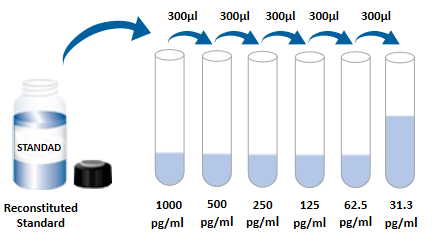
⑥ Standard: The freeze-dried standard is re-dissolved with dilution buffer (1 ×), and the re-dissolving volume is 1000uL to obtain the standard mother liquor with a concentration of 2000pg/mL. Gently shake for at least 5 minutes and it dissolves well. 300 uL of dilution buffer (1 ×) was added to each dilution tube. Make serial dilutions of the standard mother liquor according to the figure below, and each tube must be thoroughly mixed before pipetting to the next tube. The standard mother solution without dilution can be used as the highest point of the standard curve (2000 pg/mL), and the dilution buffer (1 ×) can be used as the zero point of the standard curve (0 pg/mL).
2. Operation steps

Note
The standard curve data provided is for reference only, and the sample content should be calculated according to the standard curve drawn in the same test.
3. Kit parameters
| Dilution factor | Mean/Expected (%) | Range (%) |
|---|---|---|
| 1:2 | 98 | 92-108 |
| 1:4 | 96 | 86-109 |
| 1:8 | 94 | 84-104 |
| 1:16 | 90 | 82-98 |
4. Analysis of frequently asked questions
< td style = "width: 41.4371%; height: 22 px; "> Improper storage of kits; mixed use of different kits
| Serial number | Possible cause | Solutions |
|---|---|---|
| 1 | Purchase new kits and pay attention to storage conditions; Not mixable | |
| 2 | Low application temperature and short time | If the temperature is low, extend the incubation time and color development time |
| 3 | Wrong addition or missed addition of reagents | Add the correct reagent strictly according to the instructions |
| 4 | The container used to prepare the solution is not clean or there is a problem with the water | Use clean containers and qualified distilled water |
| 5 | In the process of plate washing, the soaking time is long, the times of plate washing are too many, and the impact force of plate washing is large | Follow the instructions strictly |
| 6 | Heterogeneity of reagent temperature | All reagents should be equilibrated at room temperature for 30 minutes |
| 7 | Detection antibody and/or HRP concentration too low | Refer to the instructions, do not dilute at will |
| Serial number | Possible cause | Solutions |
|---|---|---|
| 1 | Less washing times, insufficient | Wash as per instructions |
| 2 | The substrate 3, 3 ', 5, 5'-tetramethylbenzidine (TMB) was contaminated or exposed by metal ions or oxidants | Use clean containers and qualified distilled water during preparation; Store protected from light |
| 3 | High incubation temperature and/or excessive time | Controlling the temperature and time of incubation and final enzymatic reaction |
| 4 | The gun tip was not changed during sample loading, resulting in cross-contamination | Change the gun head for each sample |
| 5 | Cross contamination of nearby holes | Vertical clapper, use suitable clapper paper to avoid paper scraps in the hole |
| 6 | Presence of endogenous interfering substances in sample | Estimate possible infectious substances and perform corresponding treatment |
| 7 | Samples were hemolyzed, stored for too long, incomplete agglutination, contaminated by bacteria, influence of additives in blood collection tube | Avoid hemolysis, contamination, long storage and other phenomena |
?
Composition (Click to expand)
Please use within the expiration date of the kit
| form | Specifications | Shelf life of diluted or redissolved reagent after unpacking |
|---|---|---|
| Human IL-10 Microplate | 1 piece | Unused slats can be stored at 2-8 °C for 30 days after being sealed back in aluminum foil bags with desiccant |
| Human IL-10 Standard | 2 sticks | After dissolution, the calculated amount is dispensed and stored at-20 °C for 14 days |
| Human IL-10 detection antibody | 1 stick | After dissolution in concentrated volume, it can be stored at 2-8 °C for 14 days |
| 40 × SA-HRP | 1 stick | 40 × concentration can be stored at 2-8 ° C.; 1 × working concentration Not recommended for storage |
| 10 × Buffer for concentration and dilution | 1 vial | After opening, it can be stored at 2-8 °C for 30 days |
| Chromogenic liquid | 1 vial | After opening, it can be stored at 2-8 °C for 30 days |
| Stop liquid | 1 vial | After opening, it can be stored at 2-8 °C for 30 days |
| 20 × concentrated wash buffer | 1 vial | After opening, it can be stored at 2-8 °C for 30 days |
| Sealing film | 3 sheets | Stored at room temperature, to avoid contamination, not reusable |
Background (Click to expand)
Human interleukin 10 (IL-10), also known as cell growth factor synthesis inhibitor (CSIF), is a member of the IL-10α helix family, which also includes IL-19, IL-20, IL-22, IL-24, and IL-26/ak155. IL-10 can be secreted by a variety of activated hematopoietic cells, hepatic stellate cells, keratinocytes, and placental trophoblast cells. Human IL-10 is active on mouse cells, while mouse IL-10 cannot act on human cells. Mature human IL-10 has 86% amino acid sequence homology with equine IL-10 and between 72-80% homology with bovine, canine, feline, guinea pig, mouse, sheep, pig, and rat IL-10. It contains two intra-chain disulfide bonds and is expressed as a non-covalently bound homodimer with a molecular weight of 36 kDa.
IL-10 mediates its biological activity by a type II cytokine IL-10 receptor subunit alpha and beta heterodimer complex. The IL-10 receptor α subunit is a 110kDa transmembrane glycoprotein mainly expressed in lymphocytes, NK cells, macrophages, monocytes, astrocytes, intestinal epithelial cells, trophoblast cells and activated hepatic stellate cells, while the 75kDa transmembrane receptor β is widely expressed. The IL-10 dimer binds two IL-10Rα chains, triggering the addition of two IL-10Rβ chains. IL-10Rβ does not directly bind IL-10, but is required for signal transduction. IL-10Rβ also forms receptor complexes of IL-22, IL-26, IL-28, and IL-29 with IL-20Rα, IL-22Rα1, and IL-28Rα.
The immunomodulation involved in IL-10 includes inhibitory and stimulatory effects. It promotes M2 macrophages to exert anti-inflammatory effects by inhibiting the expansion and activation of Th1 cells and Th17 cells. The regulation of IL-10 expression by immunoregulatory T cells (Treg) and regulatory B cells is of great significance to Treg proliferation. However, in the tumor environment, IL-10 inhibits the proliferation of Treg and myeloid-derived suppressor cells. IL-10 induces accumulation and activation of CD8 T cells in tumors. IL-10 plays a protective role by limiting tissue damage in arthritis and promoting regeneration after muscle injury, but it may contribute to the persistence of viral infection. IL-10 levels are elevated in Sjogren's syndrome (saliva), primary central nervous system lymphoma (cerebrospinal fluid), ovarian cancer (serum and ascites). Its levels are reduced in the serum of patients with recurrent heart disease or pre-Zi Xian and in the semen of patients with male infertility.
General Notes (Click to expand)
ANT BIO PTE. LTD. – Empowering Scientific Breakthroughs At ANTBIO, we are committed to advancing life science research through high-quality, reliable reagents and comprehensive solutions. Our specialized sub-brands (Absin, Starter, UA) cover a full spectrum of research needs, from general reagents and kits to antibodies and recombinant proteins. With a focus on innovation, quality, and customer-centricity, we strive to be your trusted partner in unlocking scientific mysteries and driving medical progress. Explore our product portfolio today and elevate your research to new heights.
-
AntBio is a biotechnology group company dedicated to serving life sciences, aiming to help scientists accelerate research and improve work efficiency. AntBio provides comprehensive and high-quality reagent tools for basic research, drug development, and diagnosis, including research grade antibodies, proteins, biochemical reagents, and assay kits. These research tools are widely used in different segments of life science research. The group company currently consists of three brands, Absin, Starter-Bio and UA-Bio.
| Request Information |
| Other Products |
| Related Products |

| Recently viewed products |