 中文




Mouse GHb ELISA Kit

- Product Detail
- Company Profile
- Microplate reader (450nm)
- High-precision pipette and pipette tips: 0.5-10uL, 5-50uL, 20-200uL, 200-1000uL
- 37℃ constant temperature box
- Distilled water or deionized water
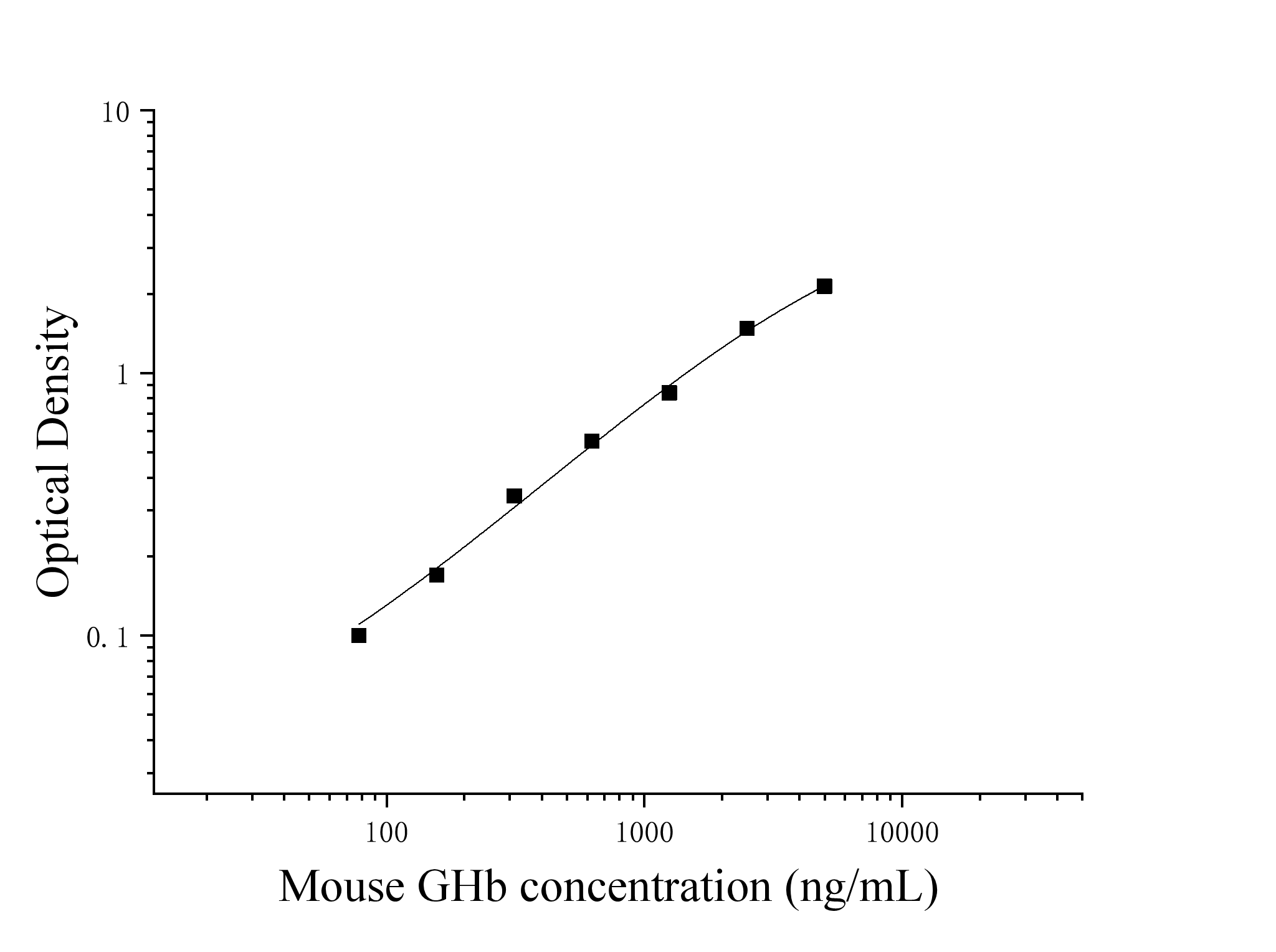
- Please take out the test kit from the refrigerator 10 minutes in advance and equilibrate to room temperature. 2. Prepare the gradient working solution of the standard: Add 1 mL of universal diluent to the lyophilized standard. Let stand for 15 minutes to completely dissolve, then gently mix (concentration is 5000 ng/mL). Then dilute to the following concentrations: 5000 ng/mL, 2500 ng/mL, 1250 ng/mL, 625 ng/mL, 312.5 ng/mL, 156.25 ng/mL, 78.125 ng/mL, and 0 ng/mL. Serial dilution method: Take seven EP tubes and add 500 μL of universal diluent to each tube. Pipette 500 μL of the 5000 ng/mL standard working solution into the first EP tube and mix thoroughly to make a 2500 ng/mL standard working solution. Repeat this procedure for subsequent tubes. The last tube serves as a blank well; there is no need to pipette liquid from the penultimate tube. See the figure below for details. 3. Preparation of biotinylated detection antibody working solution: Centrifuge the concentrated biotinylated antibody at 1000×g for 1 minute 15 minutes before use. Dilute the 100× concentrated biotinylated antibody to a 1× working concentration with universal diluent (e.g., 10uL concentrate + 990uL universal diluent). Prepare and use immediately. 4. Prepare the enzyme conjugate working solution: 15 minutes before use, centrifuge the 100× concentrated enzyme conjugate at 1000×g for 1 minute. Dilute the 100× concentrated HRP enzyme conjugate to a 1× working concentration with universal diluent (e.g., 10 μL of concentrate + 990 μL of universal diluent). Prepare immediately. 5. Prepare the 1× wash solution: Dispense 10 mL of 20× wash solution into 190 mL of distilled water (concentrated wash solution removed from the refrigerator may crystallize; this is normal. Allow to stand at room temperature until the crystals have completely dissolved before preparing). Procedure: 1. Remove the desired strips from the aluminum foil bag after equilibration at room temperature for 10 minutes. Seal the remaining strips in a ziplock bag and return to 4°C. 2. Sample addition: Add 100 μL of sample or standard of varying concentrations to the corresponding wells. Add 100 μL of universal diluent to the blank wells. Cover with a film and incubate at 37°C for 60 minutes. (Recommendation: Dilute the sample to be tested at least 1-fold with universal diluent before adding it to the ELISA plate. This will reduce the impact of matrix effects on the test results. The sample concentration should be multiplied by the corresponding dilution factor when calculating the final sample concentration. It is recommended to run replicates for all test samples and standards.) 3. Add Biotinylated Antibody: Remove the ELISA plate and discard the liquid without washing. Add 100 μL of Biotinylated Antibody Working Solution directly to each well. Cover with a film and incubate at 37°C for 60 minutes. 4. Wash: Discard the liquid and add 300 μL of 1x Wash Solution to each well. Let stand for 1 minute, shake off the wash solution, and pat dry on absorbent paper. Repeat this process three times (a plate washer can also be used). 5. Add Enzyme Conjugate Working Solution: Add 100 μL of Enzyme Conjugate Working Solution to each well. Cover with a film and incubate at 37°C for 30 minutes. 6. Washing: Discard the liquid and wash the plate five times as in step 4. 7. Adding substrate: Add 90 μL of substrate (TMB) to each well, cover with a sealing film, and incubate at 37°C in the dark for 15 minutes. 8. Adding stop solution: Remove the ELISA plate and add 50 μL of stop solution directly to each well. Immediately measure the OD value of each well at a wavelength of 450 nm. Calculating experimental results: 1. Calculate the average OD value of the standard and sample replicates and subtract the OD value of the blank well as a correction factor. Plot the standard curve of the four-parameter logistic function on double-logarithmic graph paper, with concentration as the horizontal axis and OD value as the vertical axis. 2. If the sample OD value is higher than the upper limit of the standard curve, dilute the sample appropriately and retest. Multiply the sample concentration by the corresponding dilution factor.
- Strictly adhere to the specified incubation time and temperature to ensure accurate results. All reagents must be at room temperature (20-25°C) before use. Refrigerate reagents immediately after use.
- Improper plate washing may result in inaccurate results. Ensure that all liquid in the wells is aspirated thoroughly before adding substrate. Do not allow the wells to dry out during incubation.
- Remove any residual liquid and fingerprints from the bottom of the plate, as this will affect the OD value.
- The substrate developer solution should be colorless or very light in color. Do not use substrate solution that has turned blue.
- Avoid cross-contamination of reagents and specimens to prevent erroneous results.
- Avoid direct exposure to strong light during storage and incubation.
- Do not expose any reagents to bleaching solvents or the strong fumes emitted by bleaching solvents. Any bleaching agent will destroy the biological activity of the reagents in the kit.
- Do not use expired products, and do not mix components with different product numbers and batches.
- Recombinant proteins from sources other than the kit may not be compatible with the antibodies in this kit and will not be recognized.
- If there is a possibility of disease transmission, all samples should be managed properly and samples and testing devices should be handled according to prescribed procedures.
Product Specification
| Theory | This kit uses a double-antibody sandwich enzyme-linked immunosorbent assay (ELISA). Sample, standard, biotin-labeled detection antibody, and HRP conjugate are sequentially added to microwells pre-coated with a glycohemoglobin (GHb) capture antibody. After incubation and washing, the sample is developed using the substrate TMB. TMB is converted to blue by HRP peroxidase and to yellow by acid. The intensity of the color is positively correlated with the glycohemoglobin (GHb) content in the sample. The absorbance (OD) is measured at 450 nm using a microplate reader to calculate the sample concentration. |
|---|---|
| Source | Mouse |
| Synonym | Mouse Glycated hemoglobin ELISA Kit |
| Detection Type | Double antibody sandwich method |
| Background | Glycosylated hemoglobin (glycohemoglobin, hemoglobin A1c, HbA1c, less commonly HbA1c, HgbA1c, Hb1c, etc., and also informally referred to by patients as A1C) is a form of hemoglobin (Hb) chemically linked to sugar. It is the product of hemoglobin in red blood cells binding to glucose. It is often used as a reference standard for the average plasma glucose concentration over a period of time. Generally speaking, the proportion of hemoglobin glycosylated is directly proportional to the plasma glucose level over a period of time. Glycosylated hemoglobin measurement is primarily used to determine the average blood glucose level over a three-month period and is used as a diagnostic test for diabetes. It can also be used to assess glycemic control in diabetic patients. |
| Storage Temp. | If the unopened kit is stored at 4°C, the shelf life is 6 months. |
| Test Range | 78.12-5000ng/mL |
| Applications | whole blood |
Assay Procedure (Click to expand)
Experimental equipment required for the experiment:
Sample processing and requirements: Whole blood
Preparation before testing
Composition (Click to expand)
| Name | 9?6 T?Configuration | Remarks |
|---|---|---|
| Pre-coated 96-well enzyme plate | 8 holes×12 strips | None |
| Standard | 2 bottles | Dilution according to the instructions |
| Universal diluent | 2×20mL | None |
| Concentrated biotinylated detection antibody (100×)? | 120uL | |
| Concentrated enzyme conjugate (100×) | 120uL | Dilution according to the instructions |
| 20× Wash solution | 2×10mL | Dilute according to instructions |
| Substrate (TMB) | 10mL | None |
| Stop solution | 6mL | none |
| Sealing film | 4 sheets | None |
| Instructions | 1 serving | None |
General Notes (Click to expand)
ANT BIO PTE. LTD. – Empowering Scientific Breakthroughs At ANTBIO, we are committed to advancing life science research through high-quality, reliable reagents and comprehensive solutions. Our specialized sub-brands (Absin, Starter, UA) cover a full spectrum of research needs, from general reagents and kits to antibodies and recombinant proteins. With a focus on innovation, quality, and customer-centricity, we strive to be your trusted partner in unlocking scientific mysteries and driving medical progress. Explore our product portfolio today and elevate your research to new heights.
-
AntBio is a biotechnology group company dedicated to serving life sciences, aiming to help scientists accelerate research and improve work efficiency. AntBio provides comprehensive and high-quality reagent tools for basic research, drug development, and diagnosis, including research grade antibodies, proteins, biochemical reagents, and assay kits. These research tools are widely used in different segments of life science research. The group company currently consists of three brands, Absin, Starter-Bio and UA-Bio.
| Request Information |
| Other Products |
| Related Products |


| Recently viewed products |