 中文




Dog SAA ELISA KIT

- Product Detail
- Company Profile
- The sample should be clear and transparent, and suspended matter should be removed by centrifugation. Hemolysis of the sample will affect the results, so hemolyzed samples should not be used.
- If the sample is to be tested within one week of collection, it can be stored at 4°C. If testing cannot be done promptly, aliquot the sample into a single-use amount and freeze at -20°C (for testing within one month) or -80°C (for testing within three to six months). Avoid repeated freeze-thaw cycles. Bring the sample to room temperature before the experiment.
- 50-fold dilution: One-step dilution. Dispense 5 μL of sample into 245 μL of Standard and Sample Diluent for a 50-fold dilution.
- 100-fold dilution: One-step dilution. 3. 1000-fold dilution: Two-step dilution. Add 5 μL of sample to 95 μL of standard and sample diluent for a 20-fold dilution. Then, add 5 μL of the 20-fold diluted sample to 245 μL of standard and sample diluent for a 50-fold dilution, for a total of 1000-fold dilution. 4. 100,000-fold dilution: Three-step dilution. Add 5 μL of sample to 195 μL of Standard & Sample Diluent for a 40-fold dilution. Then, add 5 μL of the 40-fold diluted sample to 245 μL of Standard & Sample Diluent for a 50-fold dilution. Finally, add 5 μL of the 2,000-fold diluted sample to 245 μL of Standard & Sample Diluent for a 50-fold dilution, for a total dilution of 100,000-fold. 5. For each dilution step, use at least 3 μL of liquid, and the dilution factor should not exceed 100. Excessively small sample volumes can easily lead to greater errors during mixing. Ensure thorough mixing at each dilution step to avoid foaming.
- If the dilution factor is very high, you can dilute with PBS first, and then use the standard and sample diluent provided in the kit as the final step.
- Normal fresh serum/plasma samples are recommended for testing (1:2-1:10).
- Due to individual differences, the recommended dilution factor is for reference only. For actual testing, please estimate the sample concentration range in advance and determine the dilution factor of the sample to be tested through preliminary experiments.
- Please remove the kit from the refrigerator 30 minutes in advance and equilibrate to room temperature.
- Dilute the 25× concentrated wash buffer to 1× working solution with double-distilled water. Return the unused portion to 4°C. 3. Standards: Add 1.0 mL of Universal Standard & Sample Diluent to the lyophilized standard. Tighten the cap and let stand for 10 minutes to fully dissolve. Then gently mix (concentration: 200 ng/mL). Then, serially dilute the standard to 200 ng/mL, 100 ng/mL, 50 ng/mL, 25 ng/mL, 12.5 ng/mL, 6.25 ng/mL, and 3.13 ng/mL. Use 0 ng/mL as a blank well. Prepare the required amount of standard and set aside. It is recommended to add the prepared standard to the sample within 15 minutes; do not let it sit for an extended period. 4. Biotinylated Antibody Working Solution: Before the experiment, calculate the required amount of biotinylated antibody working solution (based on 100 μL/well, the actual amount should be 100-200 μL more). 15 minutes before use, dilute the concentrated biotinylated antibody (1:100) with biotinylated antibody diluent to the working concentration and use it on the same day. The dilution principle is to add 1 μL of concentrated biotinylated antibody to 99 μL of biotinylated antibody diluent and mix thoroughly with a pipette.
- Enzyme Conjugate Working Solution: Before the experiment, calculate the required volume for the experiment (based on 100 μL/well; add 100-200 μL more). 15 minutes before use, dilute the concentrated HRP enzyme conjugate (1:100) with enzyme conjugate diluent to the working concentration for use that day. The dilution principle is to add 1 μL of concentrated enzyme conjugate to 99 μL of enzyme conjugate diluent and mix thoroughly with a pipette.
- TMB Substrate - Use a pipette to aspirate the required volume of solution. Do not pour any remaining solution back into the reagent bottle.
- Before use, equilibrate all materials and prepared reagents to room temperature. Before use, mix all reagents thoroughly, taking care not to produce any foam.
- The user should calculate the number of samples that may be used in the entire experiment. Please reserve enough samples in advance.
- Please estimate the concentration before measurement. If these values are not within the range of the standard curve, the user must determine the optimal sample dilution for their specific experiment.
- Before starting the experiment, all reagents should be equilibrated to room temperature and all reagents should be prepared in advance. When diluting reagents or samples, they must be mixed thoroughly and try to avoid foaming during mixing. If the sample concentration is too high, dilute it with sample diluent so that the sample is within the detection range of the kit. 2. Add 100 μL of the standard or sample to be tested (if the sample needs to be diluted, refer to the sample dilution guidelines for dilution methods). Be careful not to create bubbles. Add the sample to the bottom of the ELISA plate well, avoiding contact with the well walls. Gently shake to mix. Cover the plate or seal with film and incubate at 37°C for 80 minutes. To ensure the validity of the experimental results, use a fresh standard solution for each experiment. 3. Discard the liquid in the wells, spin dry, and wash the plate three times. Wash each well with 200 μL of wash buffer, soaking for 1-2 minutes. Spin off the liquid in the plate (or wash with a microplate washer). After the final wash, pat the plate dry on absorbent paper. 4. Add 100 μL of biotin antibody working solution to each well (can be prepared 15 minutes in advance). Cover the plate with film and incubate at 37°C for 50 minutes. 5. Discard the liquid in the wells and wash the plate three times. Wash each well with 200 μL of wash buffer, soak for 1-2 minutes, and discard the liquid in the plate (or use a plate washer). After the final wash, pat the plate dry on absorbent paper. 6. Add 100 μL of enzyme conjugate working solution to each well (can be prepared 15 minutes in advance) and incubate at 37°C for 50 minutes. 7. Discard the liquid in the wells and wash the plate five times. Wash each well with 200 μL of wash buffer, soak for 1-2 minutes, and discard the liquid in the plate (or use a plate washer). After the final wash, pat the plate dry on absorbent paper. 8. Add 90 μL of TMB chromogenic substrate solution to each well and incubate at 37°C in the dark for 20 minutes (shorten or extend the time as appropriate depending on the actual color development, but do not exceed 30 minutes). 9. Add 50 μL of stop solution to each well to terminate the reaction (the blue color will immediately turn yellow). The stop solution should be added in the same order as the developer. To ensure accurate experimental results, add the stop solution as soon as possible after the substrate reaction time expires. 10. Immediately measure the optical density (OD) of each well using a microplate reader at a wavelength of 450 nm. The instrument should be preheated and the assay program set before use. Calculation of Results 1. Subtract the OD value of the blank well from the OD value of each standard and sample. If replicate wells are used, the average value should be used for calculation.
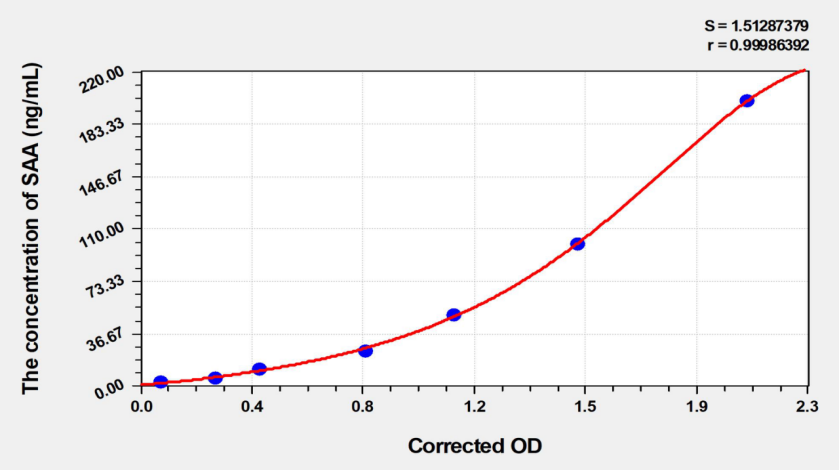
- For ease of calculation, although concentration is the independent variable and OD value is the dependent variable, we still use the OD value of the standard as the horizontal axis (X-axis) and the concentration of the standard as the vertical axis (Y-axis) when drawing the graph. At the same time, for the intuitiveness of the experimental results, the figure provides the original data rather than the logarithmic value. Due to different experimental operating conditions (such as operators, pipetting techniques, plate washing techniques and temperature conditions, etc.), the OD value of the standard curve will vary. The standard curve provided is for reference only, and the experimenter needs to establish a standard curve based on his or her own experiment. The OD value of the used sample can be used to calculate the sample concentration on the standard curve, and then multiplied by the dilution factor to obtain the actual concentration of the sample. It is recommended to use professional curve drawing software, such as Curve Expert.
- Before using the kit, ensure that all components are dissolved and mixed thoroughly. Discard any unused standard after reconstitution. 2. Concentrated biotinylated antibody and enzyme conjugate solutions are small in size and may disperse throughout the tube during transportation. Before use, centrifuge at 1000 × g for 1 minute to allow any liquid on the tube walls or cap to settle to the bottom. Mix the solutions by carefully pipetting 4-5 times before use. Prepare the standard, biotinylated antibody working solution, and enzyme conjugate working solution according to the required volume and use the corresponding diluents. Do not mix them. 3. Concentrated wash solution may crystallize after removal from the refrigerator. This is normal. Dissolve the crystals completely in a water bath or incubator before preparing the wash solution (do not heat above 40°C). The wash solution should be at room temperature before use. 4. Sample addition should be rapid, ideally within 10 minutes for each addition. To ensure experimental accuracy, replicate wells are recommended. When pipetting reagents, maintain a consistent order of addition from one well to the next. This will ensure consistent incubation times for all wells.
- During the wash process, any remaining wash solution in the reaction wells should be patted dry on absorbent paper. Do not place filter paper directly into the reaction wells to absorb water. Before reading, be sure to remove any remaining liquid and fingerprints from the bottom of the wells to avoid affecting the microplate reader reading.
- The chromogen TMB should be protected from direct sunlight during storage and use. After adding the substrate, carefully observe the color changes in the reaction wells. If a gradient is already evident, terminate the reaction early to avoid excessive color changes that may affect the microplate reader reading.
- All test tubes and reagents used in the experiment are disposable. Reuse is strictly prohibited, as this will affect the experimental results.
- Wear a lab coat and latex gloves for proper protection during the experiment, especially when testing blood or other body fluid samples. Please follow the national biological laboratory safety regulations.
- Kit components from different batches must not be mixed (except for the wash solution and the reaction stop solution).
- The enzyme label strips in the kit are detachable. Please use them in batches according to experimental needs.
Product Specification
| Sensitivity | 0.273 ng/mL |
|---|---|
| Species Reactivity | Dog |
| Theory | This kit uses the sandwich assay principle. A specific anti-canine SAA antibody is coated onto a 96-well microplate. A canine SAA standard or sample is added to the microwells, allowing the canine SAA protein in the standard or sample to bind to the anti-canine SAA antibody immobilized on the microplate. Biotinylated anti-canine SAA antibody is then added. Unbound biotinylated antibody is washed away, and HRP-labeled streptavidin is added. After thorough washing again, TMB substrate is added for color development. TMB is converted to blue by peroxidase catalysis and to the final yellow by acid. The intensity of the color is positively correlated with the amount of canine SAA protein in the sample. The absorbance (OD value) is measured at a wavelength of 450 nm using a microplate reader, and the sample concentration is calculated by plotting a standard curve. |
| Synonym | Dog SAA(Serum Amyloid A) ELISA Kit |
| Detection Type | Can detect canine SAA in samples without cross-reacting with other related proteins |
| Storage Temp. | Unopened test kit, stored at 4°C, has a shelf life of 6 months. |
| Test Range | 3.13-200 ng/mL |
Assay Procedure (Click to expand)
Sample Collection, Preparation, and Storage
1. Serum: After placing whole blood samples at room temperature for 2 hours or at 4°C overnight, centrifuge at 1000×g for 20 minutes. Remove the supernatant for testing. Blood collection tubes should be disposable, pyrogen-free, and endotoxin-free. Store at -20°C or -80°C and avoid repeated freezing and thawing.
2. Plasma: Within 30 minutes of collection, centrifuge at 1000×g for 15 minutes at 2-8°C. Remove the supernatant for testing. EDTA-Na2 is recommended as an anticoagulant. Avoid using samples with hemolysis or hyperlipidemia. Store at -20°C or -80°C and avoid repeated freezing and thawing. 3. Tissue Homogenization: Take an appropriate amount of tissue and wash it in pre-chilled PBS (0.01M, pH 7.0-7.2) to remove blood (lysed red blood cells in the homogenate will affect the measurement results). After weighing, mince the tissue and mix it with the appropriate volume of PBS (generally a 1:9 weight-to-volume ratio; the specific volume can be adjusted according to experimental needs and recorded. It is recommended to add protease inhibitors to the PBS). Pour the mixture into a glass homogenizer and grind thoroughly on ice. To further lyse tissue cells, the homogenate can be sonicated or freeze-thawed repeatedly (keep the sonication in an ice bath and repeat the freeze-thaw cycle twice). Finally, centrifuge the homogenate at 5000 × g for 5-10 minutes. Remove the supernatant for analysis. (The tissue homogenate should also be assayed for protein concentration to obtain a more accurate concentration of the test substance per milligram of protein.) 4. Cell Culture Supernatant: Centrifuge the cell supernatant at 1000 × g for 20 minutes to remove impurities and cell debris. Remove the supernatant for testing and store at -20°C or -80°C, but avoid repeated freezing and thawing.
5. Urine: Collect the first morning urine (midstream) or 24-hour urine, centrifuge at 2000×g for 15 minutes, collect the supernatant, and store the sample at -20°C. Avoid repeated freezing and thawing.
6. Saliva: Collect the sample using a saliva sample collection tube, then centrifuge at 1000×g for 15 minutes at 2-8°C. Remove the supernatant for testing, or aliquot and store at -20°C. Avoid repeated freezing and thawing.
7. Other biological samples: Centrifuge at 1000×g for 20 minutes, remove the supernatant, and store at -20°C. Avoid repeated freezing and thawing.
Precautions
Sample Dilution Guidelines
If your test sample requires dilution, the general dilution guidelines are as follows:
Sample Dilution Recommendations
Preparation for Testing
Preparation before the experiment
Operational Steps
?
| Concentration (ng/mL) | OD | Corrected OD |
|---|---|---|
| 200 | 2.204 | 2.11 |
| 100 | 1.612 | 1.518 |
| 50 | 1.182 | 1.088 |
| 25 | 0.876 | 0.782 |
| 12.5 | 0.508 | 0.414 |
| 6.25 | 0.351 | 0.257 |
| 3.13 | 0.165 | 0.071 |
| 0 | 0.094 | 0.000 |
Precision
Intraplate precision (precision within an assay): CV%
Three samples of known concentrations were tested 20 times on each ELISA plate to assess intraplate precision.
Interplate precision (precision between assay plates): CV%
Three samples of known concentrations were tested 40 times on each of three different ELISA plates to assess assay precision.
? Recovery
Recovery experiments were performed by adding known concentrations of canine SAA to different samples to obtain the recovery range and average recovery.
| Sample Type | Recovery Range | Average Recovery |
|---|---|---|
| Serum(n=5) | 82-95% | 88% |
| heparin plasma(n=5) | 87-99% | 93% |
Linearity
The samples spiked with canine SAA were diluted 2-fold, 4-fold, 8-fold and 16-fold respectively for recovery experiments, and the recovery rate range was obtained.
| Sample type | 1:2 | 1:4 | 1:8 | 1:16 |
|---|---|---|---|---|
| Serum (n=5) | 95-103% | 80-96% | 87-98% | 85-92% |
| EDTA?Plasma (n=5) | 86-101% | 86-101% | 87-96% | 92-105% |
| heparin plasma (n=5) | 81-97% | 88-102% | 85-93% | 83-97% |
Composition (Click to expand)
| Chinese Name | 96T | Storage Conditions |
|---|---|---|
| ELISA Plate (Detachable) | 12 strips x 8 wells | 4°C/-20°C |
| Lyophilized Standards | 2 | 4°C/-20°C |
| Standard & Sample Diluent | 20?mL | 4°C/-20°C |
| Concentrated Biotinylated Antibody (100×) | 120?L | 4°C/-20°C |
| Biotinylated Antibody Dilution Buffer | 12?mL | 4°C/-20°C |
| Concentrated HRP Enzyme Conjugate (100?times;) | 120?mL | 4°C/-20°C |
| Enzyme Conjugate Dilution Buffer | 12 mL | 4°C/-20°C |
| Concentrated Wash Buffer (25×) | 20 mL | 4°C/-20°C |
| Chromogenic Substrate Solution (TMB) | 10 mL | 4°C/-20°C (protect from light) |
| Reaction stop solution | 6?mL | 4°C/-20°C |
| Sealing film | 2 | Normal temperature |
General Notes (Click to expand)
ANT BIO PTE. LTD. – Empowering Scientific Breakthroughs
At ANTBIO, we are committed to advancing life science research through high-quality, reliable reagents and comprehensive solutions. Our specialized sub-brands (Starter, Absin, UA) cover a full spectrum of research needs, from general reagents and kits to antibodies and recombinant proteins. With a focus on innovation, quality, and customer-centricity, we strive to be your trusted partner in unlocking scientific mysteries and driving medical progress. Explore our product portfolio today and elevate your research to new heights.
-
AntBio is a biotechnology group company dedicated to serving life sciences, aiming to help scientists accelerate research and improve work efficiency. AntBio provides comprehensive and high-quality reagent tools for basic research, drug development, and diagnosis, including research grade antibodies, proteins, biochemical reagents, and assay kits. These research tools are widely used in different segments of life science research. The group company currently consists of three brands, Absin, Starter-Bio and UA-Bio.
| Request Information |
| Other Products |
| Related Products |


| Recently viewed products |