 中文
中文


Home > News > NF-κB Signaling Pathway: Generation and Regulatory Mechanisms of p105/p50
NF-κB Signaling Pathway: Generation and Regulatory Mechanisms of p105/p50
- 1. Concept of NF-κB Pathway and Its Biological Significance
The nuclear factor-kappa B (NF-κB) signaling pathway is a highly conserved transcriptional regulatory network, serving as a central hub for cellular responses to stress and immune stimuli. It responds to diverse signals—including pro-inflammatory cytokines, pathogen-associated molecular patterns (e.g., LPS), oxidative stress, and developmental cues—to regulate the transcription of target genes involved in immune responses, inflammation, cell proliferation, apoptosis, and tumorigenesis. Dysregulation of this pathway is linked to cancer, autoimmune diseases, chronic inflammation, and neurodegenerative disorders, making it a critical target for basic research and therapeutic development.
2. Research Frontiers
NF-κB signaling research focuses on dissecting the precise regulation of its two activation pathways (canonical and non-canonical) and the functional diversity of family members. A key frontier is understanding the processing of the precursor protein p105 into the mature p50 subunit—an event that not only generates a core NF-κB dimer component but also involves p105 acting as a "molecular sponge" to modulate pathway activity. Recent advances explore how post-translational modifications (e.g., phosphorylation at Ser337) regulate p105 processing and p50 transcriptional function. Additionally, p105/p50-specific antibodies are enabling dynamic tracking of pathway activation, subcellular localization, and disease-related dysregulation, driving progress in personalized medicine and drug development.
3. Research Significance
Understanding the generation and regulation of p105/p50 is critical for unraveling NF-κB pathway complexity. p50, as a core NF-κB subunit, forms functional dimers (e.g., p50/p65, p50/RelB) that govern gene expression, while p105’s dual role as a precursor and IκB-like inhibitor provides a unique layer of signal integration. Dysregulation of p105 processing or p50 function contributes to pathological conditions, making these molecules potential biomarkers and therapeutic targets. High-quality p105/p50-specific antibodies facilitate the study of pathway dynamics, enabling the identification of abnormal activation patterns in disease and the development of targeted interventions.
4. Related Mechanisms, Research Methods, and Product Applications
4.1 Structural Basis of NF-κB Family Function
Mammalian NF-κB family members (RelA/p65, RelB, c-Rel, NF-κB1/p105/p50, NF-κB2/p100/p52) share a conserved Rel homology domain (RHD) for DNA binding and dimerization. They are divided into two categories:
* Transcriptional activators (p65, RelB, c-Rel) with C-terminal transcriptional activation domains (TADs).
* Non-activators (p50, p52) lacking TADs—homodimers often repress transcription, while heterodimers with activators drive gene expression.
In resting cells, NF-κB dimers are sequestered in the cytoplasm by IκB proteins or the IκB-like domains of p105/p100.
4.2 Canonical and Non-Canonical NF-κB Activation Pathways
Canonical Pathway: Triggered by TNF-α, IL-1β, or LPS, activating the IKK complex (IKKβ). Phosphorylated IκB proteins are ubiquitinated and degraded, releasing p50/p65 heterodimers to translocate into the nucleus and induce target gene transcription.
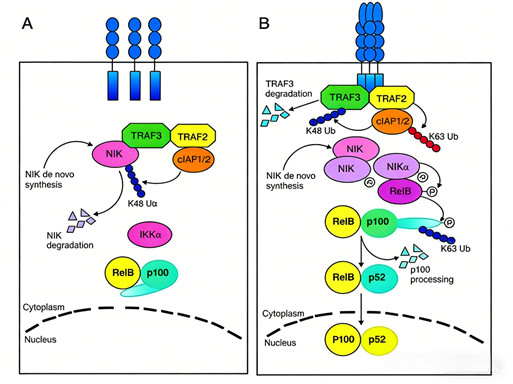
Non-Canonical Pathway: Activated by BAFF or CD40L, relying on NIK and IKKα. NIK accumulation activates IKKα, which phosphorylates p100, leading to its partial processing into p52. p52/RelB dimers enter the nucleus to regulate lymphoid development and B cell survival.
4.3 Generation and Regulatory Mechanisms of p105/p50
p105 processing into p50 involves two tightly regulated mechanisms:
* Co-translational Processing: Constitutive generation of p50 during p105 synthesis.
* Signal-Induced Post-Translational Processing: Stimulus-dependent processing regulated by phosphorylation (e.g., Ser337, Ser932) and ubiquitination, distinct from classical IκBα degradation.
p105 also acts as a "molecular sponge," binding and inhibiting other NF-κB subunits to buffer signal output.
4.4 Key Applications of p105/p50-Specific Antibodies
Specific antibodies targeting p105/p50 are indispensable research tools:
* Track Processing Dynamics: Detect total p105 and mature p50 to monitor processing initiation, rate, and efficiency under different stimuli.
* Localization and Function Analysis: Use immunofluorescence to observe cytoplasmic p105 and nuclear p50 (upon activation), linking localization to function.
* Pathway Differentiation: Simultaneously detect p105/p50 and p100/p52 to distinguish canonical/non-canonical pathway contributions.
* Disease Mechanism Research: Analyze p105/p50 expression, processing, and nuclear accumulation in disease models/clinical samples to identify dysregulation patterns.
4.5 Product Applications in Advanced Research
ANT BIO PTE. LTD.’s p105/p50 antibodies support diverse research scenarios:
NF-κB Signaling Regulation: Explore Ser337 phosphorylation’s role in p50 transcriptional activity (activation/repression) and dimer interactions.
p105 Processing Studies: Investigate correlations between Ser337 phosphorylation and p105 C-terminal processing (e.g., Ser932) under cellular stimulation.
Inflammation and Immunity: Analyze p50 Ser337 phosphorylation dynamics in immune cells (macrophages, DCs) and its impact on inflammatory mediator expression.
Tumor Biology: Explore abnormal p50 Ser337 phosphorylation in tumors, linking it to inflammation, immune evasion, or therapeutic responsiveness.
5. Brand Mission
ANT BIO PTE. LTD. is dedicated to empowering global life science research and drug development through innovative, high-quality reagents. We strive to develop cutting-edge antibodies, proteins, kits, and tools that enable researchers to unravel the complexities of NF-κB signaling and its role in disease. Our mission is to accelerate scientific discovery, facilitate the development of targeted therapeutics, and improve human health by providing reliable, reproducible, and high-performance research solutions. With a commitment to excellence, innovation, and customer-centricity, we aim to be a trusted partner for researchers advancing the frontiers of signal transduction and precision medicine.
6. Related Product List
| Product Code | Product Name | Host |
| S0B1233 | Phospho-NF-κB p105/p50 (Ser337) Recombinant Rabbit Monoclonal Antibody (S-1127-19) | Rabbit |
Core Advantages of ANT BIO PTE. LTD.’s p105/p50 Antibody
High Phosphorylation Site Specificity: Precisely recognizes Ser337 phosphorylation in p105/p50—a key modification regulating p50 transcriptional function by altering DNA binding or co-factor interactions.
Exceptional Stability and Consistency: Strict quality control ensures minimal batch-to-batch variation and reliable performance across WB, IF, and other platforms, supporting reproducible signaling pathway research.
7. AI Disclaimer
This article is AI-compiled and interpreted based on the original work. All intellectual property (e.g., images, data) of the original publication shall belong to the journal and the research team. For any infringement, please contact us promptly and we will take immediate action.
ANT BIO PTE. LTD. – Empowering Scientific Breakthroughs
At ANTBIO, we are committed to advancing life science research through high-quality, reliable reagents and comprehensive solutions. Our specialized sub-brands (Absin, Starter, UA) cover a full spectrum of research needs, from general reagents and kits to antibodies and recombinant proteins. With a focus on innovation, quality, and customer-centricity, we strive to be your trusted partner in unlocking scientific mysteries and driving medical progress. Explore our product portfolio today and elevate your research to new heights.
Related News
- Prestained Protein Marker: A Comprehensive Guide for Western Blot and Protein El 9/17/2026
- PSEN1 Antibody: A Critical Tool for Deciphering Alzheimer's Disease Pathogenesis 9/16/2026
- SHP Substrate 1 Recombinant Protein: Molecular Design, Functional Mechanisms and 9/15/2026
- Research Progress on Hepatic Lectin H1 Protein 9/14/2026
- PIC Paired Antibodies: A Comprehensive Analysis of Principles, Preparation, and 9/11/2026
- CMS: Initial Prescriptions for Silevimig Injection, the World's First Bispecific 9/10/2026
- Precision in Practice: Why Skilled Manufacturing Remains Central to Titan Enterp 9/10/2026
- Adagene Achieves Milestone in Collaboration with Exelixis for Advancement of SAF 9/10/2026
- Avi-Tag Technology: High-Precision Biotinylation Labeling Facilitates Molecular 9/10/2026
- ANT BIO: The Remarkable Biotinylated Proteins 9/9/2026