 中文
中文


Home > News > Soluble fms-like Tyrosine Kinase-1 (sFlt-1): Pathophysiological Roles and Clinical Translations
Soluble fms-like Tyrosine Kinase-1 (sFlt-1): Pathophysiological Roles and Clinical Translations
Soluble fms-like Tyrosine Kinase-1 (sFlt-1): Pathophysiological Roles and Clinical Translations—Powered by ANT BIO PTE. LTD.
1. Concept
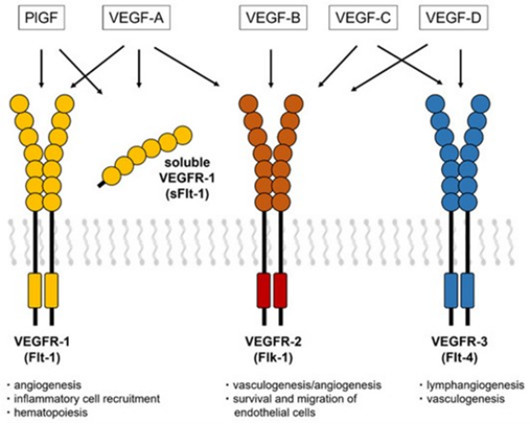
Soluble fms-like Tyrosine Kinase-1 (sFlt-1) is a key endogenous anti-angiogenic factor and splice variant of VEGFR-1 (Flt-1). Structurally, it retains the seven extracellular immunoglobulin-like domains of full-length Flt-1 but lacks transmembrane and intracellular tyrosine kinase regions, with a molecular weight of 90–100 kDa.
sFlt-1 binds VEGF-A, VEGF-B, and placental growth factor (PlGF) with high affinity—its binding to VEGF-A (Kd ≈ 10–20 pM) is approximately 10 times tighter than that of VEGFR-2, making it a master negative regulator of angiogenesis. Two primary human isoforms exist: sFlt-1-i13 (containing 31 intron 13-encoded amino acids) and sFlt-1-e15a (incorporating part of exon 15), each with distinct expression patterns and biological activities. It is generated via alternative splicing or metalloproteinase (ADAM10/17)-mediated shedding of membrane-bound Flt-1, and its levels are tightly regulated by transcriptional, epigenetic, and post-transcriptional
mechanisms.
2. Research Frontiers
sFlt-1 research is advancing across obstetrics, oncology, cardiology, and nephrology. A key frontier is refining its role as a predictive and diagnostic biomarker—particularly the sFlt-1/PlGF ratio—for preeclampsia, with point-of-care testing enabling rapid clinical decision-making. Therapeutic innovations include sFlt-1-specific adsorption columns, siRNA targeting placental sFlt-1, and repurposing drugs like pravastatin to downregulate sFlt-1 expression.
In non-pregnancy disorders, research explores sFlt-1’s dual role in tumor angiogenesis (inhibiting local vascular growth but promoting metastasis) and its utility as a cardiovascular disease biomarker. Technological advancements include digital ELISA and single-molecule array (Simoa) for ultra-sensitive detection, and mass spectrometry for isoform-specific quantification. Future directions involve genetically engineered sFlt-1 variants, peptide mimetics, and nanocarrier-delivered mRNA for targeted therapy, along with AI-driven models to integrate sFlt-1 data into personalized risk stratification.
3. Research Significance
sFlt-1’s significance lies in its central role as a regulator of angiogenesis and vascular homeostasis. In obstetrics, it transforms preeclampsia management by enabling early prediction and targeted therapy, addressing a major cause of maternal-fetal morbidity. In non-pregnancy diseases, it serves as a biomarker for cardiovascular and renal disorders, and a therapeutic target for cancer and diabetic vascular complications.
Basic research clarifies angiogenesis regulation mechanisms, while translational efforts advance precision medicine—ultimately improving outcomes for patients with vascular-related diseases.
4. Pathophysiological Roles, Clinical Applications, and Product Support
4.1 Molecular Regulation and Generation
4.1.1 Core Regulatory Mechanisms
Transcriptional Control: HIF-1α binds hypoxia-response elements (HREs) to upregulate sFlt-1; TNF-α and IL-6 enhance expression in inflammatory states.
Epigenetic Regulation: Promoter DNA methylation inversely correlates with sFlt-1 expression; demethylating agents (e.g., 5-azacytidine) increase production.
Post-Transcriptional Regulation: miR-126 and miR-200 family target sFlt-1 mRNA; splicing factor SF3B1 modulates isoform proportions.
Metabolic Clearance: Kidneys (glomerular filtration) and liver (HSPG-mediated internalization) are primary clearance organs; dimerization extends circulation half-life 2–3 fold.
4.1.2 Generation Pathways
Alternative Splicing: Produces sFlt-1-i13 and sFlt-1-e15a isoforms.
Proteolytic Shedding: ADAM10/17 cleave membrane-bound Flt-1 to release soluble extracellular domains.
4.2 Pathophysiological Roles in Disease
4.2.1 Pregnancy-Related Disorders (Preeclampsia)
Pathogenesis: Placental hypoxia/oxidative stress induces excessive sFlt-1 secretion (3–5 times normal levels), neutralizing VEGF/PlGF to cause endothelial dysfunction, hypertension, and proteinuria.
Biomarker Utility: sFlt-1/PlGF ratio >85 predicts preeclampsia within 4 weeks (12-fold increased risk); ratio <38 rules out disease (99% negative predictive value).
Therapeutics: sFlt-1 adsorption columns, siRNA, and pravastatin normalize sFlt-1 levels and improve outcomes.
4.2.2 Non-Pregnancy Disorders
Cancer: Tumor-derived sFlt-1 inhibits local angiogenesis but promotes hypoxia-driven aggression and metastasis; high expression correlates with better survival in colorectal cancer but increased lung metastases.
Diabetic Vascular Complications: Elevated vitreous sFlt-1 in retinopathy (protective initially, dysfunctional with chronic hyperglycemia); podocyte-derived sFlt-1 accelerates nephropathy via VEGF signaling inhibition.
Cardiovascular Diseases: sFlt-1 rises early in acute coronary syndrome (earlier than troponin) and correlates with heart failure severity; inhibits endothelial progenitor cell function, impairing vascular repair.
Chronic Kidney Disease (CKD): Reduced renal clearance elevates sFlt-1, exacerbating capillary rarefaction and fibrosis; levels predict end-stage renal disease progression.
4.3 Clinical Detection and Applications
4.3.1 Detection Technologies
ELISA: Gold standard with 10–50,000 pg/mL range; automated platforms (Elecsys®) reduce turnaround to 18 minutes.
Ultra-Sensitive Methods: Digital ELISA/Simoa detect 0.1 pg/mL; mass spectrometry quantifies isoforms and post-translational modifications.
Sample Stability: Stable for 48 hours at 4°C and 6 months at −80°C.
4.3.2 Clinical Utility
Obstetrics: Integral to preeclampsia screening and differential diagnosis of pregnancy-related hypertension; reduces unnecessary hospitalizations by 50%.
Oncology: Monitors anti-VEGF therapy response (sFlt-1 rise predicts efficacy); early drops signal resistance.
Cardiology/Nephrology: Risk stratification for cardiovascular events and CKD progression.
4.4 How ANT BIO PTE. LTD. Supports sFlt-1 Research
ANT BIO PTE. LTD., through its sub-brands Starter (antibodies) and UA (proteins), provides high-quality reagents for sFlt-1 research and clinical translation.
Key products and applications:
Recombinant sFlt-1 Proteins (UA Sub-brand): Human/mouse sFlt-1 proteins (full-length/isoforms) for binding assays, inhibitor screening, and standard curve calibration in diagnostic kits.
sFlt-1 ELISA Kits (Starter Sub-brand): High-sensitivity kits for serum/plasma sFlt-1 quantification, with low intra-/inter-assay variation (<5%/<10%) for reliable clinical and preclinical data.
Specific Antibodies (Starter Sub-brand): Isoform-specific antibodies (anti-sFlt-1-i13/anti-sFlt-1-e15a) for Western blotting, immunofluorescence, and isoform characterization.
All products adhere to EU 98/79/EC, ISO9001, and ISO13485 certifications, ensuring consistency and accuracy for biomarker validation, therapeutic development, and clinical research.
5. Brand Mission
ANT BIO PTE. LTD. is dedicated to empowering the global life science community with high-quality, innovative biological reagents and solutions. With 15 years of antibody development experience, the company leverages advanced platforms—including recombinant antibody development (rabbit/mouse monoclonal), recombinant protein expression systems (E.coli, CHO, HEK293, Insect Cells), One-Step ELISA, and PTM Pan-Modification Antibody platforms—to deliver a comprehensive product portfolio.
Through its three specialized sub-brands—Absin (general reagents and kits), Starter (antibodies), and UA (recombinant proteins)—ANT BIO PTE. LTD. adheres to international certifications and strict quality standards. The company’s mission is to accelerate scientific discovery by providing tools that enhance experimental precision, efficiency, and reproducibility. ANT BIO PTE. LTD. is committed to supporting sFlt-1 research and global efforts in obstetric, oncologic, cardiovascular, and renal disease treatment, ultimately advancing human health through interdisciplinary collaboration and innovation.
6. Related Product List
| Product Category | Product Description | Key Features |
| Recombinant sFlt-1 Protein | Human/mouse sFlt-1 (full-length/isoforms, E.coli/HEK293-expressed) | High purity, biologically active for binding assays |
| sFlt-1 ELISA Kit | Sandwich-format assay for serum/plasma sFlt-1 quantification | Detection range: 10–50,000 pg/mL, CV <5% (intra-assay) |
| Isoform-Specific Antibody | Anti-sFlt-1-i13/anti-sFlt-1-e15a recombinant rabbit mAb | High specificity, validated for WB/IF |
7. AI Disclaimer
This article is AI-compiled and interpreted based on the original work. All intellectual property (e.g., images, data) of the original publication shall belong to the journal and the research team. For any infringement, please contact us promptly and we will take immediate action.
ANT BIO PTE. LTD. – Empowering Scientific Breakthroughs
At ANTBIO, we are committed to advancing life science research through high-quality, reliable reagents and comprehensive solutions. Our specialized sub-brands (Absin, Starter, UA) cover a full spectrum of research needs, from general reagents and kits to antibodies and recombinant proteins. With a focus on innovation, quality, and customer-centricity, we strive to be your trusted partner in unlocking scientific mysteries and driving medical progress. Explore our product portfolio today and elevate your research to new heights.
Related News
- Prestained Protein Marker: A Comprehensive Guide for Western Blot and Protein El 9/17/2026
- PSEN1 Antibody: A Critical Tool for Deciphering Alzheimer's Disease Pathogenesis 9/16/2026
- SHP Substrate 1 Recombinant Protein: Molecular Design, Functional Mechanisms and 9/15/2026
- Research Progress on Hepatic Lectin H1 Protein 9/14/2026
- PIC Paired Antibodies: A Comprehensive Analysis of Principles, Preparation, and 9/11/2026
- CMS: Initial Prescriptions for Silevimig Injection, the World's First Bispecific 9/10/2026
- Precision in Practice: Why Skilled Manufacturing Remains Central to Titan Enterp 9/10/2026
- Adagene Achieves Milestone in Collaboration with Exelixis for Advancement of SAF 9/10/2026
- Avi-Tag Technology: High-Precision Biotinylation Labeling Facilitates Molecular 9/10/2026
- ANT BIO: The Remarkable Biotinylated Proteins 9/9/2026