 中文
中文


Home > News > EpCAM Antibodies: Pioneering a New Strategy for Tumor-Targeted Therapy
EpCAM Antibodies: Pioneering a New Strategy for Tumor-Targeted Therapy
- 1. Literature Information
Research Focus: Exploration of EpCAM’s structural characteristics, biological functions, signal transduction mechanisms, role in tumor progression, and the therapeutic/diagnostic potential of EpCAM antibodies.
Core Innovation: Validation of EpCAM as a tumor-specific target (highly expressed in epithelial-derived tumors) and demonstration of EpCAM antibodies as versatile tools for targeted therapy—via direct inhibition, immune activation, and drug delivery—along with clinical value in tumor diagnosis and circulating tumor cell (CTC) detection.
2. Research Background
Epithelial cell adhesion molecule (EpCAM), encoded by the TACSTD1 gene on human chromosome 4q, is a 33-40 kDa type I transmembrane glycoprotein with unique structural features (not belonging to known adhesion molecule families). It mediates cell-cell adhesion and regulates signal transduction via intramembrane proteolysis, promoting tumor proliferation, survival, and progression by activating pathways like PI3K/Akt/mTOR and Wnt. EpCAM’s specific overexpression in epithelial-derived tumors (e.g., breast, colorectal, lung cancer) makes it an ideal target for targeted therapy. EpCAM antibodies address unmet needs in tumor treatment—offering precision over conventional chemotherapy—while serving as diagnostic tools for tumor stratification and CTC detection.
3. Research Approaches
To advance EpCAM antibodies as a targeted therapy strategy, the research team adopted a mechanism-to-translation strategy:
Structural & Functional Characterization: Analyzing EpCAM’s domain structure (extracellular, transmembrane, intracellular) and its role in cell adhesion and signal transduction.
Signal Transduction Deciphering: Investigating EpCAM cleavage by proteases (TACE, γ-secretase) and downstream gene regulation (CD44, cyclin D1, c-Myc) via β-catenin complexes.
Tumor Progression Studies: Evaluating EpCAM’s pro-tumor effects (proliferation, pathway activation) in epithelial-derived tumors.
Antibody Efficacy Validation: Assessing EpCAM antibodies’ anti-tumor mechanisms (signal interference, ADCC, CDC, drug delivery) in preclinical models.
Clinical Application Exploration: Validating EpCAM detection in tumor diagnosis, prognosis, and CTC enrichment.
4. Research Outcomes
4.1 Structural Characteristics and Biological Functions of EpCAM
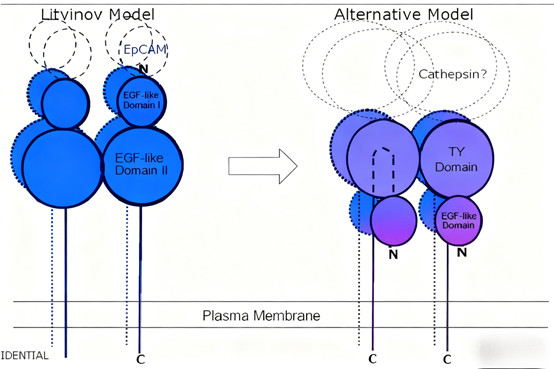
Structure: 314-amino-acid type I transmembrane glycoprotein—extracellular domain (EGF-like/thyroglobulin-like repeats for homotypic adhesion), 23-amino-acid transmembrane region, 26-amino-acid intracellular domain (NPXY motif, α-actinin binding sites).
Functions: Exists as cell surface multimers to mediate cell adhesion; participates in signal transduction and cell cycle regulation.
4.2 EpCAM-Mediated Signal Transduction
Intramembrane Proteolysis: Cleaved by TACE and γ-secretase, releasing extracellular and intracellular domains (ICD).
Nuclear Complex Formation: ICD binds β-catenin, lymphoid enhancer factor, and four-and-a-half LIM domain protein 2 (scaffold protein).
Gene Regulation: Activates CD44, cyclin D1, and c-Myc expression; crosstalks with Wnt signaling to promote cell proliferation and differentiation.
4.3 Role in Tumor Development and Progression
Proliferation Promotion: Overexpression accelerates cell cycle progression; downregulation inhibits tumor growth.
Pathway Activation: Downregulates PTEN/E-cadherin, upregulates phosphorylated AKT/mTOR—activating PI3K/Akt/mTOR signaling.
Tumor Specificity: Highly expressed in epithelial-derived tumors; correlates with malignancy and metastatic potential.
4.4 Therapeutic Potential of EpCAM Antibodies
EpCAM antibodies exert anti-tumor effects via multiple mechanisms:
Signal Interference: Bind EpCAM to block cleavage and downstream signaling, inhibiting proliferation.
Immune Activation: Induce antibody-dependent cell-mediated cytotoxicity (ADCC) and complement-dependent cytotoxicity (CDC) to eliminate tumor cells.
Targeted Drug Delivery: Serve as carriers for cytotoxic drugs, radionuclides, or immunomodulators—improving efficacy and reducing systemic toxicity.
Engineering Advancements: Bispecific antibodies and antibody-drug conjugates (ADCs) enhance precision and overcome resistance.
4.5 Clinical Diagnostic Value of EpCAM Detection
Tumor Origin Identification: Distinguishes epithelial tumors (carcinomas) from sarcomas; clarifies primary sites of metastatic tumors.
Prognostic Marker: High EpCAM expression correlates with poor prognosis in multiple cancers.
CTC Detection: Serves as a core marker for liquid biopsies (immunomagnetic enrichment, microfluidic capture)—enabling early diagnosis, treatment monitoring, and recurrence warning.
4.6 Future Research Directions
Basic Research: Elucidating EpCAM’s role in cancer stem cells, epigenetic regulation, and tumor microenvironment modulation.
Translational Development: Advancing bispecific antibodies, ADCs, and combination therapies (with immune checkpoint inhibitors/chemotherapy).
Precision Medicine: Establishing EpCAM-based biomarker systems for patient stratification.
5. Product Empowerment by ANT BIO PTE. LTD.
ANT BIO PTE. LTD.’s STARTER brand, a leader in recombinant antibodies, provides a high-performance tool for tumor therapy and diagnosis: the "S-RMab® EpCAM Recombinant Rabbit Monoclonal Antibody" (Catalog No.: S0B2028).
Key Roles of the Product:
Targeted Therapy Support: Enables development of EpCAM-targeted antibodies/ADCs—facilitating preclinical validation of signal interference and drug delivery efficacy.
Diagnostic Precision: Exhibits clear membrane staining in FFPE samples, aiding epithelial tumor identification and prognosis assessment.
CTC Detection: Serves as a core marker for CTC enrichment and identification in liquid biopsies.
Research Versatility: Supports cancer stem cell studies (enriching EpCAM-high subpopulations) and pathway activation analysis.
Core Advantages: High specificity, minimal batch variation, and stable staining—ensuring reliable results for clinical translation.
ANT BIO PTE. LTD.’s portfolio includes conjugated variants (Alexa Fluor® 488/700) for fluorescence-based applications (flow cytometry, imaging).
6. Brand Mission
ANT BIO PTE. LTD. is dedicated to empowering global life science advancement through three specialized sub-brands: ABSIN (general reagents, ELISA kits), STARTER (antibodies), and UA (recombinant proteins). Leveraging advanced development platforms—including recombinant rabbit/mouse monoclonal antibody generation, PTM Pan-Modification Antibody Platform, and One-Step ELISA—we deliver high-quality, compliant products certified by EU 98/79/EC, ISO9001, and ISO13485. Our mission is to partner with pharmaceutical companies, research institutions, and clinical laboratories worldwide, providing innovative reagents and solutions that accelerate discoveries in targeted therapy, precision oncology, and diagnostic imaging.
7. Related Product List
| S0B1558 | EpCAM Recombinant Rabbit mAb (Alexa Fluor® 700 Conjugate) (SDT-078-13) |
Host : Rabbit Conjugation : Alexa Fluor® 700 |
| S0B1526 | EpCAM Recombinant Rabbit mAb (Alexa Fluor® 488 Conjugate) (S-078-13) |
Host : Rabbit Conjugation : Alexa Fluor® 488 |
| S0B2436 | EpCAM Recombinant Rabbit mAb (SDT-078-128) |
Host : Rabbit Conjugation: Unconjugated |
| S0B2436P | EpCAM Recombinant Rabbit mAb,PBS Only (SDT-078-128) |
Host : Rabbit Conjugation : Unconjugated |
| S0B2028P | S-RMab® EpCAM Recombinant Rabbit mAb,PBS Only (SDT-078-13) | Host : Rabbit Conjugation : Unconjugated |
| S0B2028 | S-RMab® EpCAM Recombinant Rabbit mAb (SDT-078-13) |
Host : Rabbit Conjugation : Unconjugated |
8. AI Disclaimer
This article is AI-compiled and interpreted based on the original work. All intellectual property (e.g., images, data) of the original publication shall belong to the journal and the research team. For any infringement, please contact us promptly and we will take immediate action.
ANT BIO PTE. LTD. – Empowering Scientific Breakthroughs
At ANTBIO, we are committed to advancing life science research through high-quality, reliable reagents and comprehensive solutions. Our specialized sub-brands (Absin, Starter, UA) cover a full spectrum of research needs, from general reagents and kits to antibodies and recombinant proteins. With a focus on innovation, quality, and customer-centricity, we strive to be your trusted partner in unlocking scientific mysteries and driving medical progress. Explore our product portfolio today and elevate your research to new heights.
Related News
- Prestained Protein Marker: A Comprehensive Guide for Western Blot and Protein El 9/17/2026
- PSEN1 Antibody: A Critical Tool for Deciphering Alzheimer's Disease Pathogenesis 9/16/2026
- SHP Substrate 1 Recombinant Protein: Molecular Design, Functional Mechanisms and 9/15/2026
- Research Progress on Hepatic Lectin H1 Protein 9/14/2026
- PIC Paired Antibodies: A Comprehensive Analysis of Principles, Preparation, and 9/11/2026
- CMS: Initial Prescriptions for Silevimig Injection, the World's First Bispecific 9/10/2026
- Precision in Practice: Why Skilled Manufacturing Remains Central to Titan Enterp 9/10/2026
- Adagene Achieves Milestone in Collaboration with Exelixis for Advancement of SAF 9/10/2026
- Avi-Tag Technology: High-Precision Biotinylation Labeling Facilitates Molecular 9/10/2026
- ANT BIO: The Remarkable Biotinylated Proteins 9/9/2026