 中文
中文


Home > News > Eppendorf Award for Young European Investigators 2026 goes to Martin Pačesa from the University of Zurich
Eppendorf Award for Young European Investigators 2026 goes to Martin Pačesa from the University of Zurich
- Hamburg, July 17, 2026 – This year, the Hamburg-based life science company Eppendorf SE is awarding its prestigious research prize for the 31st time. The independent jury chaired by Prof. Laura Machesky, Cambridge, UK, selected Dr. Martin Pačesa, University of Zurich, Switzerland, as the winner of the Eppendorf Award for Young European Investigators 2026.
Martin Pačesa, born in 1993, receives the 20,000 Euro award for his research on AI-guided de novo design of functional protein binders. The jury acknowledged the importance of his contributions to this field and the impact of the tools he developed on the research community.
“It still feels a bit unreal to receive the 2026 Eppendorf Award for Young European Investigators”, says Martin Pačesa, Assistant Professor at the University of Zurich. “This recognition reflects our work on deep learning-based protein design, particularly BindCraft, which enables accurate and accessible design of protein binders. Much of biology can be framed as a binder-target problem, and the ability to design these interactions on demand opens new possibilities in biological research. I am grateful to my colleagues at École Polytechnique Fédérale de Lausanne (EPFL), especially Prof. Bruno Correia, Lennart Nickel, and Christian Schellhaas, as well as to my wife, my new lab at the University of Zurich, and the support from the European Research Council. There’s still a lot to figure out, but it feels like we are moving towards a point where protein design can become genuinely routine for the everyday biologist.”
In addition to the winner of the Eppendorf Award 2026, two finalists were honored.
Sebastiaan De Schepper, Assistant Professor and Group Leader at VIB-Center for Molecular Neurology (CMN), Wilrijk, Belgium, is honored for his research on “Understanding the immune mechanisms driving neurodegenerative diseases along the gut-brain axis”. The topicality and medical relevance of his contributions to understanding the possible connections between gut and brain in neurodegenerative diseases convinced the jury, as did the great potential of his research for future medical applications.
Tanita Wein, Group Leader at the Weizmann Institute of Science, Rehovot, Israel, is honored for her research on “From bacterial defense to human inflammation”. The jury panel was impressed by the creativity and novelty of her research and its potential to reveal fundamental principles of nature.
The Award Ceremony took place on July 16, 2026, at the Advanced Training Center of the European Molecular Biology Laboratory (EMBL) in Heidelberg, Germany.
Further information on application modalities, selection criteria, and past recipients of the Eppendorf Award for Young European Investigators can be found at www.eppendorf.com/award.
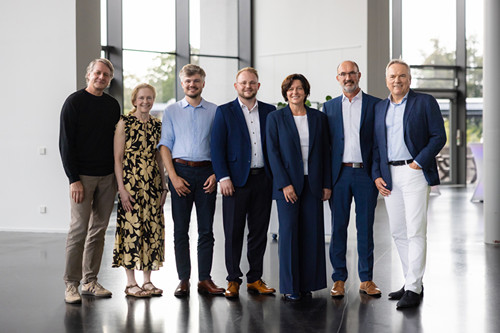
Caption: (From left to right) Prof. Michael Sixt, Member of the Award Jury, Prof. Laura Machesky, Chair of the Award Jury, Dr. Sebastiaan De Schepper, Finalist 2026, Dr. Martin Pačesa, Winner 2026, Dr. Christine Munz, CEO Eppendorf Group, Dr. Axel Jahns, Vice President Corporate Citizenship and Governmental Affairs, Eppendorf SE and Prof. Matthias Hentze, Member of the Award Jury.
About the Eppendorf Award for Young European Investigators
With the Eppendorf Award for Young European Investigators, which was established in 1995, Eppendorf SE honors outstanding work in biomedical research and supports young scientists in Europe up to the age of 35. The Eppendorf Award is presented in partnership with the scientific journal Nature. The Award winner is selected by an independent committee composed of Laura Machesky (University of Cambridge, UK), Richard Benton (Université de Lausanne (UNIL), Switzerland), Matthias Hentze (Director of EMBL, Heidelberg, Germany), Madeline Lancaster (MRC Laboratory of Molecular Biology, Cambridge, UK), Ben Lehner (Wellcome Sanger Institute, Cambridge, UK; Center for Genomic Regulation PRBB, Barcelona, Spain), Stefan Raunser (Max-Planck-Institut für Molekulare Physiologie, Dortmund, Germany) and Michael Sixt (Institute of Science and Technology Austria ISTA, Klosterneuburg, Austria).
About the Eppendorf Group (www.eppendorf.com)
Eppendorf is a leading international life science company that develops, manufactures, and distributes instruments, consumables, and services for use in laboratories around the world.
The product portfolio of the business units Liquid Handling & Consumables, Separation & Instrumentation and Bioprocess includes, for example, pipettes, pipette tips, centrifuges, mixers, ultra-freezers and bioreactors for cell and gene research. In addition, Eppendorf offers a wide range of high-quality consumables. In fiscal year 2025, the Eppendorf Group recorded consolidated revenue of €924 million and invested €60.9 million in research and development (R&D).
Eppendorf products are used in academic or industrial research laboratories, such as pharmaceutical, biotech, chemical, and food industries, as well as clinical, environmental, forensic, and industrial laboratories for process analysis, production, and quality assurance.
Since 1945, the Eppendorf Group has been headquartered in Hamburg, Germany, and today operates production and R&D sites in Europe, Asia and North America and has subsidiaries in 30 countries. Today, the Group employs more than 4,000 people worldwide. They all act in accordance with the purpose of the company's founders: to improve human living conditions.
Related News
- GE HealthCare Announces Five New Global Clinical Collaborations to Advance the N 10/23/2026
- ASN 2026: HighTide Therapeutics Presents New HTD1801 Data Highlighting Therapeut 10/23/2026
- Cotecna Acquires Energon Labs to Boost Pharma Testing & Expand in India 10/21/2026
- Investigating the Complex Behaviour of Plasma Jets for Fusion Research 10/21/2026
- Human IL-28B Protein: Mechanisms of Antiviral Immunity and Inflammatory Regulati 10/20/2026
- Empowering Labs Globally: Tianlong’s Brand-New 2026 Instrument Lineup 10/16/2026
- Thermo Fisher Scientific Showcases New Solutions and Expanded Capabilities at CP 10/13/2026
- Two Former Moderna Cancer Vaccine Scientists Join Everest Medicines to Advance I 10/12/2026
- Help Shape the Future of Pipetting with INTEGRA Biosciences 10/12/2026
- Malvern Panalytical Acquires Dimer Instruments to Accelerate Innovation in Bioph 10/10/2026