 中文
中文


Home > News > Achieving Efficient Broad-Spectrum Detection in Complex Biological Systems: The Power of Polyclonal Antibodies
Achieving Efficient Broad-Spectrum Detection in Complex Biological Systems: The Power of Polyclonal Antibodies
- 1. Concept
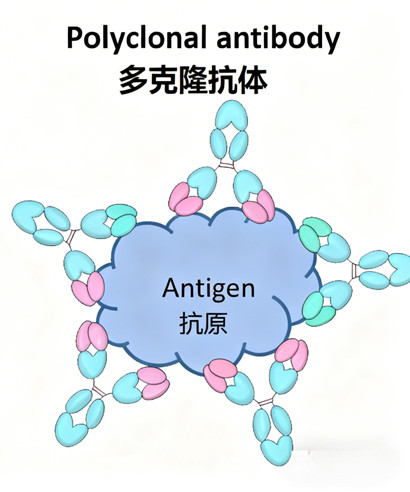
Polyclonal antibodies are naturally occurring antibody mixtures produced by the immune response, generated by multiple B-cell clones targeting distinct epitopes of the same antigen. When a foreign antigen enters the body, its multiple antigenic determinants activate different B-lymphocyte clones, which proliferate and differentiate into plasma cells secreting specific antibodies against individual epitopes. This heterogeneous composition—reflecting the body’s natural immune response—endows polyclonal antibodies with epitope recognition diversity. These characteristics make them uniquely suited for efficient broad-spectrum detection in complex biological systems, where targets may exist in low abundance, exhibit conformational variability, or have genetic variations.
2. Research Frontiers
2.1 Biological Basis and Defining Characteristics of Polyclonal Antibodies
Polyclonal antibodies’core traits stem from their immune origin:
* Epitope Diversity: Recognize multiple epitopes (linear and conformational) on a single antigen, providing redundancy that enhances detection reliability.
* Heterogeneous Composition: A mixture of antibodies with distinct binding affinities and specificities, mirroring the body’s natural immune response to antigens.
* Natural Immune Mimicry: Accurately reflect how the immune system interacts with antigens in vivo, making them valuable for studying physiological and pathological immune responses.
2.2 Production Processes and Quality Control Points
Polyclonal antibody production follows classical immunological principles with strict quality oversight:
* Production Workflow: Key steps include antigen preparation (purified peptide or protein), standardized immunization of host animals (rabbits, goats, donkeys), serum collection, antibody purification (affinity chromatography), and quality testing.
* Efficiency Advantages: Short production cycle (≈3 months) and cost-effectiveness compared to monoclonal antibody development.
* Quality Control Challenges: Batch-to-batch variation is a primary concern, addressed through standardized immunization protocols, rigorous monitoring of antibody titer/specificity, and consistent purification methods to ensure product comparability.
2.3 Unique Molecular Advantages of Polyclonal Antibodies
Polyclonal antibodies’ molecular properties drive their broad-spectrum detection capabilities:
* Broad Epitope Recognition: Simultaneous binding to multiple epitopes on the target antigen improves detection robustness, even if some epitopes are modified or degraded.
* Avidity Effect: Combined affinity of multiple antibodies produces a stronger overall binding capacity than individual monoclonal antibodies, enhancing sensitivity.
* Conformational Flexibility: Recognize native, denatured, or post-translationally modified antigen forms, adapting to diverse experimental conditions.
* Cross-Species Reactivity: Better recognition of conserved epitopes in homologous proteins across different species, facilitating cross-species research.
2.4 Optimal Application Scenarios
Polyclonal antibodies excel in research scenarios requiring broad-spectrum or flexible detection:
* Low-Abundance Protein Detection: Signal amplification from multi-epitope binding significantly improves sensitivity for targets with low expression levels.
* Immunoprecipitation (IP) Experiments: Multi-epitope binding enhances antigen capture efficiency, particularly for protein complex isolation and analysis.
* Unknown Protein Screening: Broad recognition of protein variants, splice isoforms, or post-translational modifications (e.g., phosphorylation, acetylation) aids in discovering novel targets.
* Multi-Species Comparative Studies: Recognition of evolutionarily conserved epitopes enables protein expression analysis across diverse organisms.
* Diagnostic Reagent Development: Increased detection coverage for pathogen variants reduces the risk of missed detection in clinical diagnostics.
2.5 Limitations and Countermeasures
Polyclonal antibodies face inherent limitations, with targeted solutions to mitigate risks:
* Cross-Reactivity: Risk of binding to structurally similar non-target proteins. Countermeasures include optimizing antigen design (selecting specific regions), affinity purification using solid-phase antigens, and validating specificity via Western blot (WB) or mass spectrometry.
* Batch-to-Batch Variation: Addressed through strict quality control standards, serum pool management, and standardized production processes to ensure consistency.
* Experimental Design: Inclusion of adequate negative controls and careful result interpretation to distinguish specific signals from non-specific binding.
2.6 Future Development Directions
Polyclonal antibody technology is evolving with biotechnological advancements:
* Recombinant Polyclonal Technology: Simulating polyclonal characteristics by combining multiple recombinant monoclonal antibodies, ensuring batch consistency while retaining multi-epitope recognition.
* Host System Optimization: Developing novel host animals (e.g., rabbits, alpacas) to produce antibodies with improved affinity and specificity.
* Epitope-Directed Design: Rationally designing immunogens to control epitope distribution in the antibody response, enhancing target-specificity.
* Quality Control Upgrades: Applying next-generation sequencing to monitor antibody library diversity and ensure product quality.
3. Research Significance
Polyclonal antibodies address a critical need for efficient broad-spectrum detection in complex biological systems. Their multi-epitope recognition, avidity effect, and conformational flexibility make them indispensable for studying low-abundance targets, protein complexes, and cross-species samples. By overcoming limitations through optimized production and validation, they provide reliable tools for basic research, diagnostic development, and drug discovery. As technology advances, polyclonal antibodies will continue to play a vital role in unraveling complex biological mechanisms, bridging gaps in our understanding of physiology and disease.
4. Related Mechanisms, Research Methods, and Product Applications
4.1 Mechanisms
Polyclonal antibodies achieve broad-spectrum detection through two core mechanisms:
* Multi-Epitope Binding: Recognition of multiple distinct epitopes on the target antigen ensures detection even if some epitopes are altered or inaccessible.
* Avidity Enhancement: Cooperative binding of multiple antibodies to the same antigen amplifies the signal, improving sensitivity for low-abundance targets.
4.2 Research Methods
Key methods leveraging polyclonal antibodies include:
* Detection Assays: WB (protein expression analysis), enzyme-linked immunosorbent assay (ELISA) (quantitative detection), and immunofluorescence (IF) (cellular localization).
* Protein Isolation: IP and co-immunoprecipitation (Co-IP) for capturing antigens or protein complexes.
* Diagnostic Development: Lateral flow assays and ELISA-based diagnostics for pathogen or biomarker detection.
4.3 Product Applications
ANT BIO PTE. LTD.’s polyclonal antibodies—exemplified by the "L-Lactyl Lysine Rabbit Polyclonal Antibody" (Catalog No.: S0B0719)—are high-performance tools for cutting-edge research:
* Metabolic-Epigenetic Crosstalk: Investigates how lactate regulates cellular functions via protein lactylation, linking metabolism to epigenetics.
* Immune and Inflammatory Research: Studies lactylation’s role in macrophage polarization and tumor microenvironment formation.
* Gene Expression Regulation: Identifies histone lactylation sites and their functions in transcriptional activation and chromatin dynamics.
* Disease Mechanism Exploration: Explores abnormal protein lactylation in tumors, metabolic diseases, and infections, aiding biomarker discovery.
The S0B0719 antibody offers high modification specificity, broad recognition, and excellent batch consistency—ensuring reliable results in long-term research projects.
5. Brand Mission
ANT BIO PTE. LTD. is dedicated to empowering the global life science community with high-quality, innovative biological reagents and solutions. Leveraging advanced development platforms—including recombinant rabbit monoclonal antibody, recombinant mouse monoclonal antibody, rapid monoclonal antibody, and multi-system recombinant protein expression platforms (E.coli, CHO, HEK293, Insect Cells)—and adhering to rigorous international certifications (EU 98/79/EC, ISO9001, ISO13485), we strive to deliver reliable, performance-proven tools that accelerate scientific breakthroughs in epigenetics, immunology, and translational medicine. Our commitment to quality and innovation aims to support researchers and clinicians in advancing human health through precise detection and cutting-edge life science research.
6. Related Product List
| Catalog No. | Product Name | Host |
| S0B3060 | Tau Recombinant Rabbit mAb (SDT-171-67) | Rabbit |
| S0B3059 | Tau Recombinant Rabbit mAb (SDT-171-45) | Rabbit |
| S0B0450 | TRF Recombinant Rabbit mAb (S-613-85) | Rabbit |
| S0B0719 | L-Lactyl Lysine Rabbit Polyclonal Antibody | Rabbit |
| S0B0655 | Acetyllysine Rabbit polyclonal antibody | Rabbit |
7. AI Disclaimer
This article is AI-compiled and interpreted based on the original work. All intellectual property (e.g., images, data) of the original publication shall belong to the journal and the research team. For any infringement, please contact us promptly and we will take immediate action.
ANT BIO PTE. LTD. – Empowering Scientific Breakthroughs
At ANTBIO, we are committed to advancing life science research through high-quality, reliable reagents and comprehensive solutions. Our specialized sub-brands (Absin, Starter, UA) cover a full spectrum of research needs, from general reagents and kits to antibodies and recombinant proteins. With a focus on innovation, quality, and customer-centricity, we strive to be your trusted partner in unlocking scientific mysteries and driving medical progress. Explore our product portfolio today and elevate your research to new heights.
Related News
- PIC Paired Antibodies: A Comprehensive Analysis of Principles, Preparation, and 9/11/2026
- CMS: Initial Prescriptions for Silevimig Injection, the World's First Bispecific 9/10/2026
- Precision in Practice: Why Skilled Manufacturing Remains Central to Titan Enterp 9/10/2026
- Adagene Achieves Milestone in Collaboration with Exelixis for Advancement of SAF 9/10/2026
- Avi-Tag Technology: High-Precision Biotinylation Labeling Facilitates Molecular 9/10/2026
- ANT BIO: The Remarkable Biotinylated Proteins 9/9/2026
- ANT BIO: Applications of the Biacore System 9/8/2026
- Everest Medicines Strengthens Its Cardiovascular Portfolio with CARDAMYST(R) App 9/7/2026
- CMS: Innovative Drug Lumirix Approved in China for Additional Indication of Atop 9/7/2026
- OGT Expands SureSeq™ Universal NGS Unique Dual Index (UDI) Capabilities to 9/7/2026