 中文
中文


Home > News > Enhancing Biomedical Research Efficiency: The Unique Immune Properties of Rabbit-Derived Antibodies
Enhancing Biomedical Research Efficiency: The Unique Immune Properties of Rabbit-Derived Antibodies
- 1. Concept
Rabbit-derived antibodies leverage the unique immune system of rabbits—evolved to generate diverse and high-affinity antibodies—to boost efficiency in biomedical research. Unlike humans and mice, rabbits possess a more diverse antibody gene repertoire, with complex V(D)J segment combinations and 14 IgA subtypes (vs. 2 in humans, 1 in mice) that support mucosal immunity research. Their simplified IgG system (single subtype) avoids cross-reactivity issues associated with multiple subtypes in other species, simplifying experimental interpretation. These traits, combined with high affinity, broad epitope recognition, and compatibility with multiple research platforms, make rabbit-derived antibodies indispensable tools for basic and translational research.
2. Research Frontiers
2.1 Unique Biological Value of the Rabbit Immune System
The rabbit immune system’s evolutionary adaptations underpin its research utility:
* Antibody Diversity: Expanded V(D)J gene segment combinations generate a broader repertoire of antigen-binding sites, enabling recognition of conserved or weakly immunogenic targets.
* IgA Subtype Richness: 14 IgA subtypes provide specialized tools for studying mucosal immunity—critical for understanding pathogen defense at epithelial barriers.
* Simplified IgG System: A single IgG subtype eliminates cross-reactivity from multiple subtypes, ensuring consistent binding and easier result interpretation.
2.2 Molecular Advantages of Rabbit-Derived Antibodies
Rabbit IgG exhibits structural and functional traits that outperform other species’ antibodies:
* Structural Features: Standard rabbit IgG (150kD) consists of two 50kD heavy chains and two 25kD light chains linked by disulfide bonds, with a flexible hinge region enhancing epitope access.
* High Affinity: Unique somatic hypermutation and affinity maturation mechanisms produce antibodies with stronger binding to antigens than murine counterparts.
* Broad Epitope Recognition: Recognize linear and conformational epitopes, making them ideal for detecting low-abundance antigens, conserved proteins, and post-translationally modified targets.
* IHC Superiority: Exceptional sensitivity and low background staining in immunohistochemistry (IHC), often requiring no antigen retrieval.
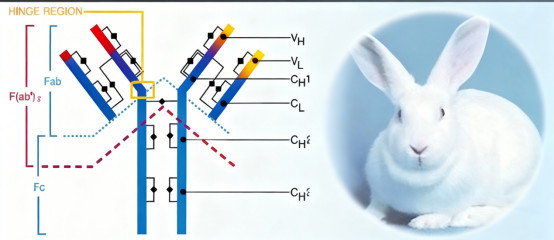
2.3 Optimization of Rabbit Polyclonal Antibody Production
Rabbits are preferred for polyclonal antibody production, with optimized processes ensuring high quality:
* Host Advantages: Moderate size, easy handling, and short reproductive cycles enable efficient serum collection.
* Production Workflow: Key steps include antigen design (peptide or protein immunogens), optimized immunization protocols (adjuvant selection, injection frequency), serum collection, and purification (affinity chromatography).
* Performance Improvements: Novel adjuvants and immunization schemes enhance antibody titer and specificity. High-quality rabbit polyclonal antibodies recognize multiple epitopes, delivering strong, stable signals in Western blot (WB), immunoprecipitation (IP), and enzyme-linked immunosorbent assay (ELISA).
2.4 Breakthroughs in Rabbit Monoclonal Antibody Technology
Rabbit monoclonal antibodies combine the best of polyclonal and murine monoclonal traits:
* Technological Innovations: Transgenic technology and cell fusion advancements have established stable rabbit hybridoma systems, overcoming limitations of traditional murine monoclonal antibodies.
* Key Advantages: Merge rabbit antibodies’ high affinity with monoclonal antibodies’ uniformity and specificity, excelling at targeting conserved or weakly immunogenic antigens.
* Application Superiority: In IHC, they exhibit higher sensitivity, lower background, and higher working dilutions than murine monoclonals—reducing experimental costs and improving efficiency.
2.5 Practical Application Performance of Rabbit-Derived Antibodies
Systematic comparisons confirm rabbit-derived antibodies’ superior performance across research areas:
* Tumor Marker Detection: Higher sensitivity for estrogen receptor (ER), progesterone receptor (PR), and Ki-67 than murine antibodies, improving cancer diagnostics and research.
* Neurobiology Research: Outstanding recognition of synaptic proteins (e.g., synaptophysin) enables precise localization and quantification in neural tissues.
* Signal-to-Noise Ratio: Stronger detection signals and better specificity minimize false positives, enhancing data reliability.
* Species Compatibility: Effective across human, mouse, rat, and other common model organisms, though tissue-specific validation is recommended.
2.6 Improvements in Supporting Reagent Systems
Comprehensive supporting reagents expand rabbit-derived antibodies’ applicability:
* Secondary Antibodies: Optimized goat, sheep, or donkey anti-rabbit secondary antibodies minimize cross-reactivity, ensuring specific detection in multi-species experiments.
* Target Coverage: Expanding antibody libraries cover metabolic enzymes, cell surface markers, and signaling pathway proteins, supporting diverse research needs.
* In Vitro Translation Tools: Rabbit reticulocyte lysate provides a high-efficiency system for in vitro protein expression and function studies.
2.7 Future Development Directions
Rabbit-derived antibody technology is evolving toward greater versatility and efficiency:
* Recombinant Antibody Libraries: Phage display technology enables antibody development without animal immunization, accelerating discovery and customization.
* Genetically Engineered Rabbit Models: Humanized or disease-specific models support preclinical research and therapeutic antibody development.
* Single B Cell Cloning: Improves rabbit monoclonal antibody development efficiency by directly isolating antigen-specific B cells.
* Therapeutic Applications: Expanding from research tools to diagnostic and therapeutic agents, leveraging high affinity and specificity for targeted therapy.
3. Research Significance
Rabbit-derived antibodies address critical needs in biomedical research by delivering higher affinity, broader epitope recognition, and simplified interpretation compared to antibodies from other species. They enhance efficiency in target detection, protein quantification, and functional studies, accelerating progress in oncology, neurobiology, immunology, and drug development. Their compatibility with multiple platforms (WB, IHC, IP, ELISA) and species makes them versatile tools, reducing experimental complexity and costs. As technology advances, rabbit-derived antibodies will play an increasingly vital role in bridging basic research and clinical translation, driving innovations in diagnosis and therapy.
4. Related Mechanisms, Research Methods, and Product Applications
4.1 Mechanisms
Rabbit-derived antibodies’ performance stems from two core mechanisms:
* Immune System Diversity: Expanded V(D)J recombination and somatic hypermutation generate a diverse antibody repertoire, enabling recognition of a wide range of antigens.
* Structural Adaptations: Flexible IgG hinge regions and high-affinity antigen-binding sites enhance epitope access and binding stability, even for low-abundance or conserved targets.
4.2 Research Methods
Key methods leveraging rabbit-derived antibodies include:
* Protein Detection and Quantification: WB (protein expression analysis), ELISA (quantitative antigen detection), and IHC/immunofluorescence (IF) (tissue/cell localization).
* Protein-Protein Interaction Studies: IP and co-immunoprecipitation (Co-IP) to isolate and identify protein complexes.
* Functional Assays: Neutralization assays (antibody-mediated inhibition of protein function) and flow cytometry (cell surface marker detection).
4.3 Product Applications
ANT BIO PTE. LTD.’s rabbit-derived antibodies—exemplified by the "β-actin Rabbit Monoclonal Antibody" (Catalog No.: S0B0005)—are high-performance tools for biomedical research:
* Reference Calibration: β-actin, α-tubulin, and GAPDH antibodies serve as loading controls and protein expression normalization standards in WB and IF.
* Cytoskeleton Research: Antibodies targeting β-actin, vimentin, and α-tubulin enable cytoskeleton structure observation and cell morphology studies.
* Experimental Quality Control: Evaluate sample preparation, electrophoresis transfer efficiency, and experimental system stability.
* Broad Sample Compatibility: Effective in cancer cell lines, animal tissues, primary cells, and human samples, supporting cross-species research.
The S0B0005 antibody offers high specificity, broad applicability, and exceptional batch consistency—ensuring reliable, comparable results across experiments.
5. Brand Mission
ANT BIO PTE. LTD. is dedicated to empowering the global life science community with high-quality, innovative biological reagents and solutions. Leveraging advanced development platforms—including recombinant rabbit monoclonal antibody, recombinant mouse monoclonal antibody, rapid monoclonal antibody, and multi-system recombinant protein expression platforms (E.coli, CHO, HEK293, Insect Cells)—and adhering to rigorous international certifications (EU 98/79/EC, ISO9001, ISO13485), we strive to deliver reliable, performance-proven tools that accelerate scientific breakthroughs in oncology, neurobiology, immunology, and drug development. Our commitment to quality and innovation aims to support researchers and clinicians in advancing human health through cutting-edge biomedical research.
6. Related Product List
| Catalog No. | Product Name | Host |
| S0B0043 | α-tubulin Recombinant Rabbit mAb (SDT-R091) | Rabbit |
| S0B2004 | Vimentin Recombinant Rabbit mAb (SDT-029-20) | Rabbit |
| S0B0005 | β-actin Rabbit mAb (SDT-R015) | Rabbit |
| S0B0261 | GAPDH Recombinant Rabbit mAb (S-240-147) | Rabbit |
| S0B0079 | Histone H3 Recombinant Rabbit mAb (SDT-266-44) | Rabbit |
7. AI Disclaimer
This article is AI-compiled and interpreted based on the original work. All intellectual property (e.g., images, data) of the original publication shall belong to the journal and the research team. For any infringement, please contact us promptly and we will take immediate action.
ANT BIO PTE. LTD. – Empowering Scientific Breakthroughs
At ANTBIO, we are committed to advancing life science research through high-quality, reliable reagents and comprehensive solutions. Our specialized sub-brands (Absin, Starter, UA) cover a full spectrum of research needs, from general reagents and kits to antibodies and recombinant proteins. With a focus on innovation, quality, and customer-centricity, we strive to be your trusted partner in unlocking scientific mysteries and driving medical progress. Explore our product portfolio today and elevate your research to new heights.
Related News
- PIC Paired Antibodies: A Comprehensive Analysis of Principles, Preparation, and 9/11/2026
- CMS: Initial Prescriptions for Silevimig Injection, the World's First Bispecific 9/10/2026
- Precision in Practice: Why Skilled Manufacturing Remains Central to Titan Enterp 9/10/2026
- Adagene Achieves Milestone in Collaboration with Exelixis for Advancement of SAF 9/10/2026
- Avi-Tag Technology: High-Precision Biotinylation Labeling Facilitates Molecular 9/10/2026
- ANT BIO: The Remarkable Biotinylated Proteins 9/9/2026
- ANT BIO: Applications of the Biacore System 9/8/2026
- Everest Medicines Strengthens Its Cardiovascular Portfolio with CARDAMYST(R) App 9/7/2026
- CMS: Innovative Drug Lumirix Approved in China for Additional Indication of Atop 9/7/2026
- OGT Expands SureSeq™ Universal NGS Unique Dual Index (UDI) Capabilities to 9/7/2026