 中文
中文


Home > News > Systematically Analyzing Inflammatory Cell Death Mechanisms: The Power of Pyroptosis Detection Kits
Systematically Analyzing Inflammatory Cell Death Mechanisms: The Power of Pyroptosis Detection Kits
- 1. Concept
Pyroptosis is a programmed inflammatory cell death pathway characterized by inflammasome-dependent activation of caspase family proteins, release of pro-inflammatory factors, and robust inflammatory responses. Morphologically, it is defined by cell swelling, plasma membrane pore formation, loss of membrane integrity, and leakage of cellular contents. Unlike apoptosis, pyroptosis is inherently inflammatory, playing critical roles in pathological processes such as infectious diseases, neurological disorders, atherosclerosis, and cancer. Pyroptosis detection kits integrate tools to analyze key molecular markers and pathways, enabling systematic investigation of this cell death mechanism—from inflammasome activation to effector molecule execution.
2. Research Frontiers
2.1 Biological Characteristics and Pathological Significance of Pyroptosis
Pyroptosis’s unique traits distinguish it from other cell death modalities:
* Inflammatory Nature: Releases pro-inflammatory factors (IL-1β, IL-18, HMGB1) that recruit immune cells and amplify inflammatory responses, contributing to both host defense and pathological tissue damage.
* Morphological Hallmarks: Cell swelling, membrane pore formation (1–2nm), and cytoplasmic content leakage—distinct from the shrinkage and apoptotic body formation seen in apoptosis.
* Pathological Relevance: Implicated in a broad range of diseases, including sepsis (via excessive inflammation), neurodegenerative disorders (neuroinflammation), and cancer (tumor microenvironment modulation).
2.2 Core Molecular Pathways of Pyroptosis
Pyroptosis proceeds through two interconnected phases (initiation and execution) and two main pathways:
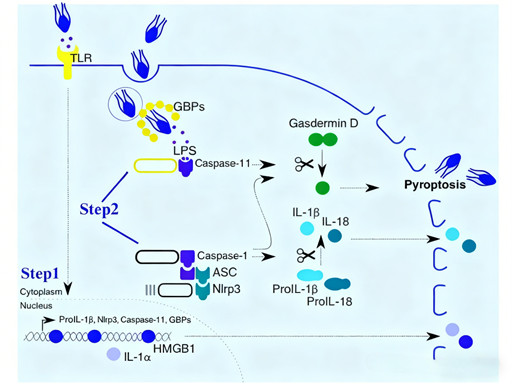
* Initiation Phase: Inflammasomes recognize pathogen-associated molecular patterns (PAMPs) or damage-associated molecular patterns (DAMPs), triggering transcriptional activation of pro-IL-1β, pro-IL-18, and NLRP3.
* Execution Pathways:
Caspase-1-Dependent Pathway: Inflammasomes (e.g., NLRP3) recruit and activate pro-caspase-Active caspase-1 cleaves pro-IL-1β/pro-IL-18 into mature cytokines and cleaves Gasdermin D (GSDMD) to release its N-terminal domain, which forms membrane pores.
Caspase-4/5/11-Dependent Pathway: Bacterial LPS directly activates caspase-4/5/11, which cleaves GSDMD to induce membrane perforation. This pathway also indirectly activates the NLRP3 inflammasome to promote cytokine maturation.
2.3 Central Regulatory Role of Inflammasomes in Pyroptosis
Inflammasomes are cytoplasmic multiprotein complexes that act as pyroptosis “sensors”:
* Composition: Consist of sensor proteins (e.g., NLRP1, NLRP3, NLRC4, AIM2, Pyrin), adaptor protein ASC, and pro-caspase-1, assembled via CARD or PYD domains.
* Signal Recognition: Different inflammasomes recognize specific signals—NLRP3 detects cellular stress (e.g., ROS, ATP), AIM2 recognizes cytosolic DNA, and NLRC4 responds to bacterial flagellin.
* Targeted Immunity: This specificity ensures tailored inflammatory responses against diverse pathogens and cellular damage.
2.4 Gasdermin D: The Key Executor of Pyroptosis
GSDMD is the central effector molecule driving pyroptosis:
* Domain Structure: Contains an N-terminal effector domain and a C-terminal inhibitory domain. In resting cells, autoinhibition between these domains keeps GSDMD inactive.
* Activation Mechanism: Caspase-1 or -4/5/11 cleaves GSDMD at a specific site, releasing the N-terminal domain. This domain oligomerizes to form membrane pores, disrupting ion gradients, inducing cell swelling, and causing membrane rupture.
* Essential Role: Ectopic expression of the GSDMD N-terminal domain alone is sufficient to induce pyroptosis, while GSDMD knockout completely abrogates the pathway.
2.5 Establishing a Systematic Pyroptosis Detection Protocol
Comprehensive pyroptosis analysis requires multi-level validation using complementary assays:
GSDMD Cleavage Analysis: Western blot to detect the conversion of full-length GSDMD (53 kDa) to the N-terminal fragment (30 kDa)—the most specific pyroptosis marker.
Caspase Activity Assay: Quantitative measurement of caspase-1/-4/5/11 activity using fluorescent substrates or activity kits.
Inflammatory Factor Quantification: ELISA or Western blot to measure mature IL-1β and IL-18 levels in cell supernatants.
Morphological Observation: Scanning electron microscopy or fluorescence microscopy to visualize membrane pores and cell swelling.
Membrane Integrity Assessment: Propidium iodide (PI) staining (a membrane-impermeable dye) to detect membrane rupture.
2.6 Technical Challenges in Pyroptosis Detection
Key challenges in pyroptosis research include:
* Cell Type Heterogeneity: Pyroptosis features vary across cell types (e.g., immune cells vs. epithelial cells), requiring cell-specific optimization.
* Pathway Overlap: Morphological and molecular similarities with other cell death pathways (e.g., necroptosis) can lead to misclassification.
* Real-Time Monitoring Limitations: Traditional assays lack sensitivity for live-cell dynamic tracking of pyroptosis.
* Solutions: Multi-parameter validation (combining marker detection and morphological analysis) and functional confirmation using pharmacological inhibitors (e.g., caspase inhibitors) or gene editing (e.g., GSDMD knockout).
3. Research Significance
Pyroptosis detection kits address a critical need for standardized, comprehensive tools to dissect inflammatory cell death mechanisms. By enabling systematic analysis of key molecular events—from inflammasome activation to GSDMD cleavage and cytokine release—these kits advance our understanding of pyroptosis’s role in health and disease. This knowledge informs the development of targeted therapies: inhibiting excessive pyroptosis to treat inflammatory diseases (e.g., sepsis) or inducing pyroptosis to enhance antitumor immunity. Additionally, standardized detection protocols promote data reproducibility and collaboration across the scientific community, accelerating progress in pyroptosis research.
4. Related Mechanisms, Research Methods, and Product Applications
4.1 Mechanisms
Pyroptosis is driven by two core mechanisms:
* Cytokine-Mediated Inflammation: Cleavage of pro-IL-1β/pro-IL-18 by caspases releases mature cytokines that amplify inflammatory responses.
* Membrane Pore Formation: GSDMD N-terminal domain oligomerization creates pores, leading to cell lysis and release of cytoplasmic pro-inflammatory molecules (e.g., HMGB1, IL-1α).
4.2 Research Methods
Key methods for pyroptosis research include:
* Molecular Marker Detection: Western blot (GSDMD cleavage, caspase activation), ELISA (IL-1β/IL-18), and immunofluorescence (GSDMD localization, inflammasome assembly).
* Functional Assays: Caspase activity kits, PI staining for membrane integrity, and LDH release assays for cell lysis.
* Imaging Techniques: Scanning electron microscopy (membrane pores) and live-cell imaging (dynamic tracking of pyroptosis).
* Genetic Manipulation: CRISPR-Cas9 knockout (e.g., GSDMD, NLRP3) or overexpression to validate pathway components.
4.3 Product Applications
ANT BIO PTE. LTD.’s “Pyroptosis MiniAb Set” (Catalog No.: S0M1032) is a high-performance tool for pyroptosis research:
* Comprehensive Pathway Coverage: Includes validated antibodies targeting key molecules (GSDMD, Caspase-1, IL-1β, ASC), enabling systematic monitoring of pyroptosis from initiation to execution.
* Key Application Scenarios:
Mechanistic Studies: Validate pyroptosis activation and molecular events in cell models, animal models, or clinical samples.
Infection and Immunity Research: Investigate inflammasome assembly and pyroptosis in host defense against pathogens and immunopathological processes.
Inflammatory and Neurodegenerative Diseases: Explore pyroptosis contributions to autoinflammatory disorders, atherosclerosis, Alzheimer’s disease, and other conditions.
Cancer Immunotherapy: Study pyroptosis induced by chemotherapy, radiation, or immune checkpoint inhibitors, and its role in antitumor immunity.
The S0M1032 set offers exceptional advantages: batch consistency, cross-experimental compatibility, and pre-optimized conditions—ensuring reliable, efficient research outcomes.
5. Brand Mission
ANT BIO PTE. LTD. is dedicated to empowering the global life science community with high-quality, innovative biological reagents and solutions. Leveraging advanced development platforms—including recombinant rabbit monoclonal antibody, recombinant mouse monoclonal antibody, rapid monoclonal antibody, and multi-system recombinant protein expression platforms (E.coli, CHO, HEK293, Insect Cells)—and adhering to rigorous international certifications (EU 98/79/EC, ISO9001, ISO13485), we strive to deliver reliable, performance-proven tools that accelerate scientific breakthroughs in immunology, inflammation, and oncology. Our commitment to quality and innovation aims to support researchers and clinicians in advancing human health through precise detection and cutting-edge life science research.
6. Related Product List
| Catalog No. | Product Name |
| S0M1032 | Pyroptosis MiniAb Set |
7. AI Disclaimer
This article is AI-compiled and interpreted based on the original work. All intellectual property (e.g., images, data) of the original publication shall belong to the journal and the research team. For any infringement, please contact us promptly and we will take immediate action.
ANT BIO PTE. LTD. – Empowering Scientific Breakthroughs
At ANTBIO, we are committed to advancing life science research through high-quality, reliable reagents and comprehensive solutions. Our specialized sub-brands (Absin, Starter, UA) cover a full spectrum of research needs, from general reagents and kits to antibodies and recombinant proteins. With a focus on innovation, quality, and customer-centricity, we strive to be your trusted partner in unlocking scientific mysteries and driving medical progress. Explore our product portfolio today and elevate your research to new heights.
Related News
- BCA Protein Quantification Kit: Principle, Applications, and Comprehensive Exper 9/22/2026
- Proteinase K: A Versatile and Indispensable Tool Enzyme in Molecular Biology Res 9/21/2026
- Lipid Nanoparticles (LNPs) for Protein Delivery: Breaking Through Therapeutic Ba 9/20/2026
- PMSF Protease Inhibitor: The Indispensable Guardian of Proteins in Laboratory Re 9/19/2026
- Neutral Protease: Core Properties, Experimental Applications and High-Quality Pr 9/18/2026
- Prestained Protein Marker: A Comprehensive Guide for Western Blot and Protein El 9/17/2026
- PSEN1 Antibody: A Critical Tool for Deciphering Alzheimer's Disease Pathogenesis 9/16/2026
- SHP Substrate 1 Recombinant Protein: Molecular Design, Functional Mechanisms and 9/15/2026
- Research Progress on Hepatic Lectin H1 Protein 9/14/2026
- PIC Paired Antibodies: A Comprehensive Analysis of Principles, Preparation, and 9/11/2026