 中文
中文


Home > News > Uncovering the Clinicopathological Significance of Basal-Like Phenotype in Lung Adenocarcinoma
Uncovering the Clinicopathological Significance of Basal-Like Phenotype in Lung Adenocarcinoma
Uncovering the Clinicopathological Significance of Basal-Like Phenotype in Lung Adenocarcinoma: The Critical Role of CK5/6 Antibodies
1. Concept
Lung adenocarcinoma (LUAD) stands as the most prevalent histological subtype of lung cancer, and precise pathological diagnosis is indispensable for formulating optimal treatment strategies. In routine differential diagnosis, thyroid transcription factor-1 (TTF-1) and p40 are widely recognized as reliable markers for LUAD and lung squamous cell carcinoma (LUSC), respectively. However, emerging clinical evidence reveals that CK5/6—traditionally regarded as a specific marker for squamous epithelium—exhibits aberrant expression in a subset of LUAD cases. This unexpected expression pattern challenges conventional diagnostic frameworks, making CK5/6 a pivotal tool for delineating a unique "basal-like" LUAD subtype. Exploring the clinicopathological and molecular features of CK5/6-positive LUAD is crucial for refining lung cancer classification systems, optimizing prognostic assessment, and guiding personalized therapeutic decisions.
2. Research Frontiers
2.1 Diagnostic Challenges and Clinical Significance of CK5/6 Expression in LUAD
The aberrant expression of CK5/6 in LUAD introduces notable diagnostic complexities and clinical implications:
* Paradigm Disruption: CK5/6 was previously considered exclusive to LUSC, but its expression in approximately 16.3% of LUAD cases blurs the traditional histological boundary between LUAD and LUSC.
* Clinical Relevance: Investigating the biological behavior of CK5/6-positive LUAD is essential to address unmet needs in diagnostic accuracy, prognostic stratification, and treatment personalization.
* Therapeutic Guidance: Identifying this subtype helps avoid inappropriate treatment selection, as CK5/6-positive LUAD exhibits distinct molecular profiles and responses to therapy compared to conventional LUAD.
2.2 Epidemiological and Morphological Features of CK5/6-Positive LUAD
CK5/6-positive LUAD displays unique demographic and pathological characteristics:
* Demographic Predisposition: It predominantly affects male patients with a smoking history, differing from the typical LUAD population (more common in never-smoking females).
* Pathological Aggressiveness: This subtype is associated with advanced clinical stages, invasive growth patterns, increased lymph node metastasis rates, and a higher tendency for pleural vascular invasion.
* Histological Subtype Preference: CK5/6-positive LUAD frequently exhibits mucinous differentiation, with significantly elevated expression rates in invasive mucinous adenocarcinoma (IMA) and enteric-type adenocarcinoma.
2.3 Molecular Pathological Characteristics and Classification System
CK5/6-positive LUAD harbors a distinct genetic landscape, supporting a subtype-specific classification:
* Key Genetic Alterations: It is primarily characterized by EGFR wild-type status, a higher frequency of KRAS mutations, and occasional ALK/ROS1 rearrangements.
* Three-Subtype Classification (based on TTF-1 expression and mucinous differentiation):
Type I: TTF-1-positive, no mucinous differentiation—features high-grade histological components and heterogeneous genetic alterations.
Type II: TTF-1-positive, with mucinous differentiation—closely associated with ALK/ROS1 rearrangements, predominantly high-grade tumors.
Type III: TTF-1-negative, with mucinous differentiation—strongly linked to KRAS mutations, mainly encompassing IMA and enteric-type adenocarcinoma.
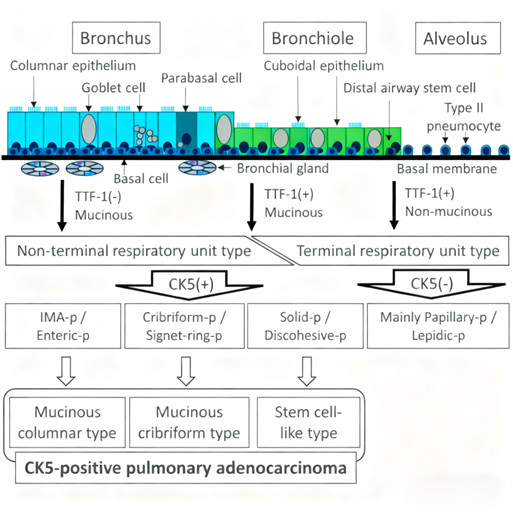
2.4 Biological Significance of CK5/6 Expression and the Stem Cell Hypothesis
CK5/6 expression in LUAD is closely linked to a stem cell-like dedifferentiation phenotype:
* Normal Tissue Expression: In healthy lung tissue, CK5/6 is specifically expressed in the basal cell layer of bronchial epithelium—cells endowed with stem cell properties that participate in tissue repair and regeneration.
* Tumor Dedifferentiation: The presence of CK5/6 in LUAD is hypothesized to reflect tumor cell dedifferentiation, acquiring stem cell-like traits that contribute to increased invasiveness, metastasis, and treatment resistance.
* Distinct Differentiation Pathways: Immunofluorescence double staining experiments demonstrate limited co-expression of CK5/6 and TTF-1, indicating that these markers represent distinct cellular differentiation lineages within LUAD.
2.5 Clinical Prognostic Impact and Predictive Value of CK5/6 Expression
CK5/6 serves as a robust prognostic and predictive biomarker for LUAD:
* Poor Prognosis: Survival analyses consistently show that patients with CK5/6-positive LUAD have significantly shorter disease-free survival (DFS) and overall survival (OS) compared to those with CK5/6-negative LUAD.
* Independent Prognostic Factor: Multivariate analysis confirms that CK5/6 expression is an independent poor prognostic indicator for LUAD—findings that are also validated in other tumor types such as breast and ovarian cancers, suggesting CK5/6 may denote a cross-tumor aggressive biological phenotype.
* Predictive Potential: The correlation between CK5/6 expression and specific molecular alterations (e.g., ALK/ROS1 rearrangements, KRAS mutations) makes it a valuable auxiliary indicator for predicting these genetic changes, thereby guiding targeted therapy selection.
2.6 Diagnostic Practice Considerations and Technical Aspects
Several critical considerations guide the clinical application of CK5/6 in LUAD diagnosis:
* Differential Diagnosis: It is essential to distinguish CK5/6-positive LUAD from adenosquamous carcinoma (ASC). CK5/6-positive LUAD lacks p40 expression and definitive morphological features of squamous differentiation, which are hallmark characteristics of ASC.
* Marker Specificity: While the CK5/6 antibody cocktail is widely used, some studies suggest that CK5 alone may offer higher specificity for identifying the basal-like phenotype in LUAD.
* Standardization: Establishing uniform positive criteria (e.g., ≥10% tumor cell staining) and rigorous quality control processes is crucial to ensure the consistency and comparability of diagnostic results across different laboratories.
3. Research Significance
CK5/6-positive LUAD represents a distinct subtype with unique clinicopathological, molecular, and prognostic features. Its identification challenges traditional lung cancer classification systems, highlighting the need for an integrated diagnostic approach combining morphology, immunohistochemistry, and molecular profiling. Recognizing this basal-like phenotype enables more accurate prognostic stratification, facilitates the selection of appropriate targeted therapies based on associated genetic alterations, and prevents misdiagnosis with LUSC or ASC. Furthermore, insights into the biological role of CK5/6 in LUAD advance our understanding of tumor dedifferentiation and stem cell-driven aggressiveness, opening new avenues for the development of novel therapeutic strategies targeting this high-risk subtype.
4. Related Mechanisms, Research Methods, and Product Applications
4.1 Mechanisms
The aggressive behavior of CK5/6-positive LUAD is linked to two core mechanisms:
* Stem Cell-Like Properties: CK5/6 expression correlates with the acquisition of stem cell-like traits, including enhanced self-renewal, invasiveness, and resistance to chemotherapy and targeted therapies.
* Epithelial-Mesenchymal Transition (EMT): CK5/6 may promote EMT, a biological process that enhances tumor cell motility and invasiveness by downregulating epithelial markers and upregulating mesenchymal markers.
4.2 Research Methods
Key research methods for investigating CK5/6 in LUAD include:
* Immunohistochemistry (IHC): The primary technique for detecting CK5/6 expression in formalin-fixed paraffin-embedded (FFPE) tissue samples, often combined with TTF-1, p40, and mucin markers for subtype classification.
* Molecular Profiling: Next-generation sequencing (NGS) to identify genetic alterations (e.g., EGFR, KRAS, ALK, ROS1) and correlate them with CK5/6 expression status.
* Survival Analysis: Kaplan-Meier survival curves and multivariate Cox regression models to assess the prognostic impact of CK5/6 expression.
* Functional Assays: In vitro cell line studies and in vivo xenograft models to validate the role of CK5/6 in regulating tumor cell proliferation, invasion, metastasis, and drug resistance.
4.3 Product Applications
ANT BIO PTE. LTD.’s CK5/6 antibodies, exemplified by the STARTER brand’s "S-RMab® CK5/6 Recombinant Rabbit Monoclonal Antibody" (Catalog No.: S0B2138), are indispensable tools for * lung cancer research and clinical diagnostics:
Lung Cancer Subtyping: Enables accurate differential diagnosis between LUAD, LUSC, and ASC, supporting precise pathological classification.
* Basal-Like Phenotype Identification: Specifically labels CK5/6-positive basal-like LUAD, facilitating prognostic stratification and personalized treatment planning.
* Breast Cancer Molecular Typing: Serves as a key marker for identifying basal-like triple-negative breast cancer (TNBC), a subtype with aggressive clinical behavior.
* Mesothelioma Differentiation: Assists in distinguishing malignant mesothelioma (typically CK5/6-positive) from LUAD (typically CK5/6-negative).
* Prostate Cancer Research: Labels the basal cell layer of prostate glands, aiding in the differentiation between benign prostatic hyperplasia and prostate cancer (which lacks a basal cell layer).
The S0B2138 antibody, developed using ANT BIO PTE. LTD.’s proprietary S-RMab® recombinant rabbit monoclonal platform and validated for IHC, offers exceptional advantages: high specificity with clear cytoplasmic localization (ensuring reliable identification of basal-like cells in FFPE samples) and superior staining stability with minimal batch variation—critical for consistent results in clinical diagnostics and translational research.
5. Brand Mission
ANT BIO PTE. LTD. is dedicated to empowering the global life science community with high-quality, innovative biological reagents and solutions. Leveraging advanced development platforms—including recombinant rabbit monoclonal antibody, recombinant mouse monoclonal antibody, rapid monoclonal antibody, and multi-system recombinant protein expression platforms (E.coli, CHO, HEK293, Insect Cells)—and adhering to rigorous international certifications (EU 98/79/EC, ISO9001, ISO13485), we strive to deliver reliable, performance-proven tools that accelerate scientific breakthroughs in oncology, pathology, and translational medicine. Our commitment to quality and innovation aims to support researchers and clinicians in advancing human health through precise diagnosis and cutting-edge life science research.
6. Related Product List
| Catalog No. | Product Name | Host |
| S0B2138 | S-RMab® CK5/6 Recombinant Rabbit mAb (SDT-P004) | Rabbit |
| S0B2138P | S-RMab® CK5/6 Recombinant Rabbit mAb, PBS Only (SDT-P004) | Rabbit |
7. AI Disclaimer
This article is AI-compiled and interpreted based on the original work. All intellectual property (e.g., images, data) of the original publication shall belong to the journal and the research team. For any infringement, please contact us promptly and we will take immediate action.
ANT BIO PTE. LTD. – Empowering Scientific Breakthroughs
At ANTBIO, we are committed to advancing life science research through high-quality, reliable reagents and comprehensive solutions. Our specialized sub-brands (Absin, Starter, UA) cover a full spectrum of research needs, from general reagents and kits to antibodies and recombinant proteins. With a focus on innovation, quality, and customer-centricity, we strive to be your trusted partner in unlocking scientific mysteries and driving medical progress. Explore our product portfolio today and elevate your research to new heights.
Related News
- Prestained Protein Marker: A Comprehensive Guide for Western Blot and Protein El 9/17/2026
- PSEN1 Antibody: A Critical Tool for Deciphering Alzheimer's Disease Pathogenesis 9/16/2026
- SHP Substrate 1 Recombinant Protein: Molecular Design, Functional Mechanisms and 9/15/2026
- Research Progress on Hepatic Lectin H1 Protein 9/14/2026
- PIC Paired Antibodies: A Comprehensive Analysis of Principles, Preparation, and 9/11/2026
- CMS: Initial Prescriptions for Silevimig Injection, the World's First Bispecific 9/10/2026
- Precision in Practice: Why Skilled Manufacturing Remains Central to Titan Enterp 9/10/2026
- Adagene Achieves Milestone in Collaboration with Exelixis for Advancement of SAF 9/10/2026
- Avi-Tag Technology: High-Precision Biotinylation Labeling Facilitates Molecular 9/10/2026
- ANT BIO: The Remarkable Biotinylated Proteins 9/9/2026