 中文
中文


Home > News > Unraveling CD44’s Multifaceted Roles: Regulation of Tumor Progression and Cell Migration
Unraveling CD44’s Multifaceted Roles: Regulation of Tumor Progression and Cell Migration
- 1. Concept
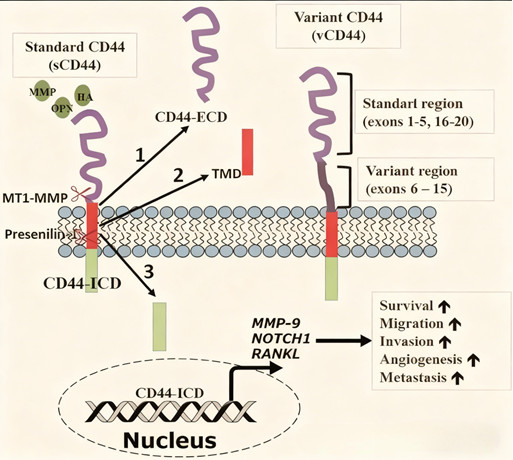
CD44 is a widely expressed cell surface glycoprotein encoded by the CD44 gene on human chromosome 11. As a key cell adhesion receptor, it mediates cell-cell interactions, adhesion, and migration—core processes in both physiological development and pathological conditions like tumor progression. The CD44 gene generates multiple isoforms through complex alternative splicing: standard CD44 (sCD44) is the most conserved form, while variant CD44 (vCD44) isoforms contain inserted exon sequences near the extracellular transmembrane domain, resulting in larger molecular weight subtypes. These structural differences directly influence ligand-binding specificity and biological functions, enabling CD44 to exert diverse regulatory effects in different cellular contexts.
2. Research Frontiers
2.1 Structural and Genetic Traits of the CD44 Molecule
CD44’s structure underpins its multifunctional role:
· Core Domain Composition: The molecule consists of an extracellular domain (responsible for ligand binding), a single transmembrane domain, and a cytoplasmic tail (involved in signal transduction). The extracellular domain includes a hyaluronic acid (HA)-binding motif, enabling interaction with key extracellular matrix (ECM) components.
· Alternative Splicing Diversity: Alternative splicing of the CD44 gene produces over 20 known isoforms, with vCD44 isoforms differing in the number and location of inserted exons. This diversity allows CD44 to adapt to distinct biological needs, from normal tissue homeostasis to tumor progression.
2.2 Key Mechanisms of CD44 in Tumor Development and Progression
CD44 regulates tumor progression through three interconnected mechanisms:
· Ligand-Mediated Cell Migration and Invasion: CD44 binds to ECM ligands such as hyaluronic acid, osteopontin, and collagen, triggering signaling pathways that enhance tumor cell motility, degrade the ECM, and promote invasion into surrounding tissues.
· Tumor Stem Cell (TSC) Maintenance: CD44 serves as a canonical surface marker for TSCs in various malignancies. It maintains TSC self-renewal, drug resistance, and metastatic potential, contributing to tumor recurrence and treatment failure.
· Nuclear Translocation of Intracellular Domain: Following proteolytic cleavage, the CD44 intracellular domain (CD44-ICD) translocates to the nucleus, where it regulates the expression of genes involved in tumor cell survival, metastasis, and angiogenesis—amplifying pro-tumorigenic signals.
2.3 Functional Differences Among CD44 Isoforms
CD44 isoforms exhibit distinct roles in tumor biology:
· Standard CD44 (sCD44): Widely expressed in normal cells and early-stage tumors, sCD44 is involved in basic cell adhesion and tissue homeostasis. Its expression is often associated with less aggressive tumor phenotypes.
· Variant CD44 (vCD44): Specific vCD44 isoforms (e.g., CD44v3, CD44v6, CD44v10) are highly expressed in advanced, metastatic tumors such as colon cancer, gastric cancer, and breast cancer. Their overexpression correlates with increased malignancy, metastatic tendency, and poor prognosis. These isoforms possess unique ligand-binding properties and signal transduction capabilities, enabling them to drive tumor progression in the specialized tumor microenvironment.
2.4 Impact of CD44 Proteolytic Processing on Function
CD44’s functional versatility is dynamically regulated through proteolytic cleavage:
· Sequential Cleavage Process: Membrane-type matrix metalloproteinases (MT-MMPs) first cleave the CD44 extracellular domain, followed by γ-secretase-mediated cleavage of the transmembrane domain. This generates three fragments: extracellular fragments (CD44ECD), transmembrane domain fragments, and intracellular domain fragments (CD44-ICD).
· Functional Consequences: CD44ECD can act as a soluble ligand to modulate neighboring cells, while CD44-ICD translocates to the nucleus to activate transcription factors (e.g., NOTCH1) and regulate genes involved in cell survival, migration, and metastasis. This processing mechanism allows CD44 to switch between membrane-bound receptor and nuclear signaling roles, providing a molecular basis for its dynamic regulation in tumors.
2.5 Clinical Diagnostic and Therapeutic Applications of CD44
CD44 has emerged as a valuable tool in clinical oncology:
· Diagnostic Biomarkers: Elevated levels of soluble CD44 (sCD44ECD) in serum correlate with tumor burden, metastatic status, and poor prognosis in various cancers—serving as a non-invasive biomarker for disease monitoring. Additionally, isoform-specific CD44 expression (e.g., CD44v6) facilitates precise tumor subtyping and patient stratification for personalized therapy.
· Therapeutic Targets: Antibody-based drugs targeting CD44 are under preclinical and clinical development to interfere with CD44-ligand interactions, inhibit TSC function, and block pro-tumorigenic signaling. CD44’s role as a TSC marker also makes it a target for therapies aimed at eliminating cancer stem cells and preventing recurrence.
2.6 Main Challenges and Future Research Directions
Despite significant progress, CD44 research faces key challenges:
· Isoform-Specific Functions: The precise roles of individual CD44 isoforms in tumor initiation, progression, and metastasis remain incompletely understood, particularly in context-dependent settings.
· Nuclear Signaling Mechanisms: The detailed pathways through which CD44-ICD regulates gene expression and nuclear interactions require further clarification.
· Isoform-Specific Targeting: Developing tools (e.g., antibodies, small molecules) that specifically recognize and target individual CD44 isoforms is critical to avoid off-target effects on normal cells.
· Technological Advances: Single-cell RNA sequencing, spatial transcriptomics, and gene editing technologies (e.g., CRISPR-Cas9) will enable deeper exploration of CD44 isoform heterogeneity and function in tumors, paving the way for novel diagnostic and therapeutic strategies.
3. Research Significance
CD44’s multifaceted roles in tumor progression and cell migration address a critical need in cancer research: understanding the molecular mechanisms driving metastasis—the leading cause of cancer-related death. By elucidating CD44’s structural diversity, proteolytic regulation, and isoform-specific functions, researchers gain insights into tumor cell migration, invasion, and stem cell maintenance. This knowledge not only advances our understanding of cancer biology but also enables the development of isoform-specific diagnostics and targeted therapies. CD44’s utility as a biomarker and therapeutic target holds promise for improving early detection, patient stratification, and treatment outcomes in a wide range of malignancies.
4. Related Mechanisms, Research Methods, and Product Applications
4.1 Mechanisms
CD44 mediates tumor progression through three core pathways:
· Adhesion and Migration: CD44-ligand (e.g., HA) interactions activate signaling cascades (e.g., PI3K-AKT, MAPK) that enhance actin cytoskeleton rearrangement, cell motility, and ECM degradation—promoting tumor cell invasion and metastasis.
· Tumor Stem Cell Maintenance: CD44 maintains TSC self-renewal and drug resistance by activating stem cell signaling pathways (e.g., Wnt/β-catenin, Hedgehog).
· Nuclear Signaling: CD44-ICD nuclear translocation regulates gene expression related to cell survival, angiogenesis, and metastasis—amplifying pro-tumorigenic responses.
4.2 Research Methods
Key research methods for studying CD44 include:
· Expression Analysis: Immunohistochemistry (IHC), flow cytometry, and Western blotting to detect CD44 expression and isoform profiles in tumor tissues and cells.
· Functional Assays: Cell adhesion, migration, and invasion assays to evaluate CD44-mediated cellular behaviors; sphere formation assays to assess TSC self-renewal capacity.
· Proteolytic Processing Studies: Immunoprecipitation and Western blotting to detect CD44 cleavage fragments; confocal microscopy to visualize CD44-ICD nuclear translocation.
· In Vivo Models: Xenograft and genetically engineered mouse models to investigate CD44’s role in tumor growth, metastasis, and response to therapy.
· Isoform-Specific Analysis: RT-PCR, RNA sequencing, and isoform-specific antibodies to quantify and characterize individual CD44 isoforms.
4.3 Product Applications
ANT BIO PTE. LTD.’s CD44 antibodies, represented by the STARTER brand’s "CD44 Recombinant Rabbit Monoclonal Antibody" (Catalog No.: S0B2228), are essential tools for cancer research and clinical diagnostics:
· Tumor Stem Cell Research: Enables identification and isolation of TSC subpopulations in solid tumors (e.g., breast cancer, colorectal cancer, pancreatic cancer) through specific CD44 detection.
· Tumor Invasion and Metastasis Evaluation: Supports analysis of the correlation between CD44 expression levels and tumor aggressiveness, metastatic potential, and patient prognosis.
· Cell Adhesion and Migration Studies: Facilitates investigation of CD44-ligand interactions (e.g., CD44-HA) and their role in cell adhesion, motility, and invasion mechanisms.
· Inflammation and Immune Response Research: Aids in studying CD44’s functions in lymphocyte activation, homing, and inflammatory responses—relevant to both cancer and autoimmune diseases.
The S0B2228 antibody, developed using ANT BIO PTE. LTD.’s recombinant rabbit monoclonal platform and validated for IHC, offers exceptional advantages: high specificity with clear membrane localization (ensuring reliable detection in FFPE samples) and superior staining stability with minimal batch variation—critical for consistent results in clinical diagnostics and translational research.
5. Brand Mission
ANT BIO PTE. LTD. is dedicated to empowering the global life science community with high-quality, innovative biological reagents and solutions. Leveraging advanced development platforms—including recombinant rabbit monoclonal antibody, recombinant mouse monoclonal antibody, rapid monoclonal antibody, and multi-system recombinant protein expression platforms (E.coli, CHO, HEK293, Insect Cells)—and adhering to rigorous international certifications (EU 98/79/EC, ISO9001, ISO13485), we strive to deliver reliable, performance-proven tools that accelerate scientific breakthroughs in oncology, immunology, and cell biology. Our commitment to quality and innovation aims to support researchers and clinicians in advancing human health through cutting-edge life science research and clinical translation.
6. Related Product List
| Catalog No. | Product Name | Host |
| S0B2228 | CD44 Recombinant Rabbit mAb (SDT-R107) | Rabbit |
| S0B1318 | Rat Anti-Mouse CD44 Antibody (S-923-31) | Rat |
| S0B0337 | CD44 Mouse mAb (SDT-630-174) | Mouse |
| S0B0165 | CD44 Mouse mAb (Alexa Fluor® 647 Conjugate) (S-630-174) | Mouse |
| S0B8143 | Biotin Mouse Anti-Human CD44 Antibody (S-630-174) | Mouse |
7. AI Disclaimer
This article is AI-compiled and interpreted based on the original work. All intellectual property (e.g., images, data) of the original publication shall belong to the journal and the research team. For any infringement, please contact us promptly and we will take immediate action.
ANT BIO PTE. LTD. – Empowering Scientific Breakthroughs
At ANTBIO, we are committed to advancing life science research through high-quality, reliable reagents and comprehensive solutions. Our specialized sub-brands (Absin, Starter, UA) cover a full spectrum of research needs, from general reagents and kits to antibodies and recombinant proteins. With a focus on innovation, quality, and customer-centricity, we strive to be your trusted partner in unlocking scientific mysteries and driving medical progress. Explore our product portfolio today and elevate your research to new heights.
Related News
- PIC Paired Antibodies: A Comprehensive Analysis of Principles, Preparation, and 9/11/2026
- CMS: Initial Prescriptions for Silevimig Injection, the World's First Bispecific 9/10/2026
- Precision in Practice: Why Skilled Manufacturing Remains Central to Titan Enterp 9/10/2026
- Adagene Achieves Milestone in Collaboration with Exelixis for Advancement of SAF 9/10/2026
- Avi-Tag Technology: High-Precision Biotinylation Labeling Facilitates Molecular 9/10/2026
- ANT BIO: The Remarkable Biotinylated Proteins 9/9/2026
- ANT BIO: Applications of the Biacore System 9/8/2026
- Everest Medicines Strengthens Its Cardiovascular Portfolio with CARDAMYST(R) App 9/7/2026
- CMS: Innovative Drug Lumirix Approved in China for Additional Indication of Atop 9/7/2026
- OGT Expands SureSeq™ Universal NGS Unique Dual Index (UDI) Capabilities to 9/7/2026