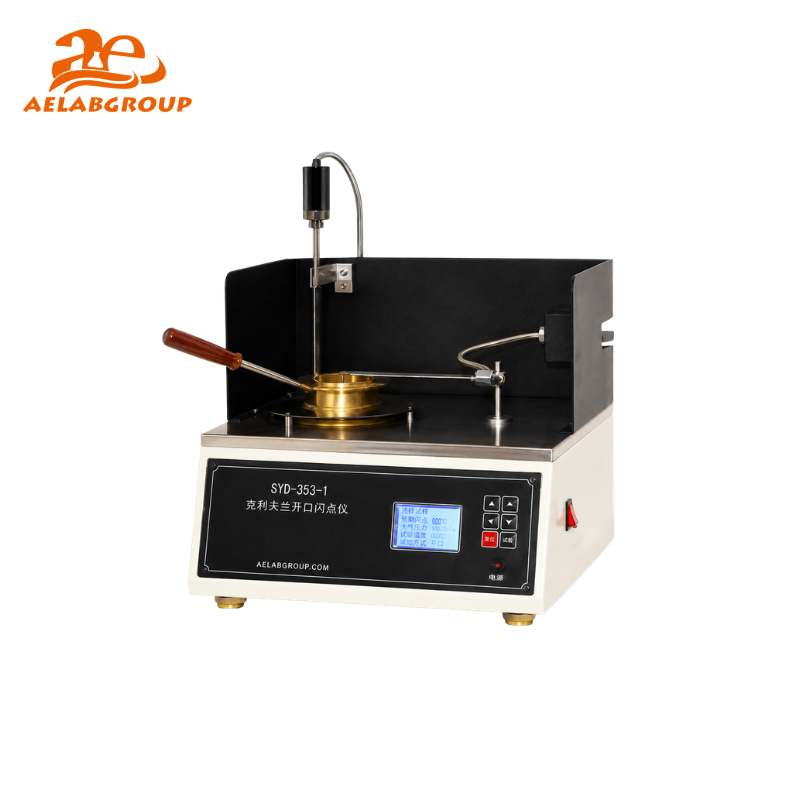
AELAB Flash Point Testers for Petroleum Product Analysis
AELAB supplies flash point testing instruments for evaluating the ignition characteristics of petroleum products, fuels, lubricating oils, solvents and other combustible liquid samples.
The AELAB flash point tester range includes manual, semi-automatic and automatic instruments designed for laboratory quality control, petroleum analysis, refinery testing, fuel inspection, lubricant evaluation and industrial research applications.
Available models can be selected according to the required test method, sample type, expected flash point range, heating control, ignition system, automation level and laboratory testing volume.
Customers can compare AELAB flash point testers according to their testing standard, operational requirements, sample characteristics and preferred level of automation.
What Is a Flash Point Tester?
A flash point tester is a laboratory instrument used to determine the lowest temperature at which vapors produced by a liquid sample can ignite under specified test conditions.
Flash point measurement is commonly used to evaluate product safety, storage requirements, transportation classification, contamination, volatility and consistency during petroleum production and quality control.
The reported result can depend on the selected test method, apparatus configuration, sample preparation, heating rate, atmospheric conditions and operator procedure. For this reason, the instrument should be selected according to the required laboratory method and product specification.
Common Flash Point Testing Methods
| Test Method or Apparatus |
Typical Application |
| Cleveland Open Cup |
Flash point and fire point testing of petroleum products with relatively higher flash point temperatures, including many lubricating oils and heavy petroleum materials. |
| Pensky-Martens Closed Cup |
Closed-cup testing of fuels, oils, biodiesel products and other petroleum liquids where vapor containment is required during measurement. |
| Abel Closed Cup |
Testing of selected low-flash-point petroleum products, solvents and combustible liquids according to the applicable laboratory procedure. |
| Tag Closed Cup |
Determination of flash point for selected low-viscosity liquids and petroleum-related materials within the method's applicable range. |
| Automatic Flash Point Testing |
Routine laboratories requiring programmed heating, automatic ignition, result detection, improved repeatability and reduced operator involvement. |
| Manual Flash Point Testing |
Laboratories that prefer direct operator control, straightforward operation and economical testing for lower sample volumes. |
Typical Applications
- Petroleum refinery quality control
- Lubricating oil inspection and product verification
- Diesel fuel and fuel oil testing
- Petrochemical product analysis
- Transformer and insulating oil evaluation
- Combustible liquid safety assessment
- Solvent and chemical product testing
- Incoming raw material inspection
- Finished petroleum product quality control
- Storage and transportation safety evaluation
- Research and development laboratories
- Universities and petroleum engineering laboratories
- Third-party inspection and certification laboratories
- Oil blending and formulation facilities
- Industrial maintenance and condition-monitoring laboratories
Why Is Flash Point Measurement Important?
Product Safety
Flash point data helps laboratories evaluate the ignition risk associated with handling, storage and use of combustible liquids.
Quality Control
Unexpected changes in flash point may indicate contamination, formulation variation, incorrect blending or product degradation.
Product Classification
Flash point results can support the classification of petroleum products for handling, packaging and transportation purposes.
Process Monitoring
Regular testing helps manufacturers monitor production consistency and confirm that finished products meet internal specifications.
How to Select the Right Flash Point Tester
Selecting a flash point tester should begin with the required test method. Laboratories should also consider sample characteristics, expected temperature range, testing frequency, automation level, ignition system, data management requirements and operator experience.
| Selection Factor |
Questions to Consider |
| Required Test Method |
Does the procedure require an open-cup or closed-cup apparatus, and which specific testing method must be followed? |
| Sample Type |
Will the instrument test lubricating oil, fuel, diesel, solvent, insulating oil, heavy petroleum material or another liquid? |
| Expected Flash Point |
What is the approximate flash point range of the sample, and is the model suitable for that temperature range? |
| Open or Closed Cup |
Does the product specification require an open test cup or a sealed test chamber during heating and ignition? |
| Automation Level |
Is a manual instrument sufficient, or is automatic heating, ignition, detection and result recording preferred? |
| Heating Control |
Does the laboratory require programmable heating control and automatic adjustment of the temperature rise? |
| Ignition Source |
What type of ignition system is required, and is the laboratory installation compatible with the instrument configuration? |
| Testing Volume |
How many samples will be tested each day, and is increased automation needed for routine operation? |
| Result Documentation |
Are internal result storage, printing, computer communication or laboratory data transfer functions required? |
| Power Supply |
What voltage and frequency are available at the installation location? |
View Available AELAB Flash Point Tester Models
Manual vs. Automatic Flash Point Testers
| Feature |
Manual Tester |
Automatic Tester |
| Operation |
Requires greater operator participation during the testing process. |
Automates selected testing steps and reduces routine operator involvement. |
| Heating Control |
Heating is monitored and adjusted primarily by the operator. |
Heating can be controlled according to a programmed test sequence. |
| Ignition and Detection |
Typically depends more heavily on operator observation and action. |
May provide automatic ignition application and flash detection, depending on model. |
| Testing Frequency |
Suitable for occasional testing and lower daily sample volumes. |
Suitable for routine testing and laboratories processing more samples. |
| Operator Training |
Requires close attention to procedural timing and visual observation. |
Simplifies routine operation but still requires proper method training. |
| Budget |
Generally selected where an economical and straightforward solution is preferred. |
Selected where workflow efficiency, automation and repeatability are priorities. |
Information Required for Model Selection
To receive a more accurate model recommendation and quotation, customers can send the following information to the AELAB technical sales team:
- Name and type of the sample
- Required flash point test method
- Open-cup or closed-cup requirement
- Expected flash point temperature range
- Manual or automatic operation preference
- Required testing standards or laboratory procedure
- Number of samples tested per day
- Required data output or printing functions
- Local power supply and plug type
- Required accessories and spare parts
- Destination country and delivery city
Why Choose AELAB Flash Point Testers?
- Manual and automatic configurations for different laboratory workflows
- Solutions for petroleum, fuel, lubricant and combustible liquid analysis
- Models designed for routine laboratory quality control
- Technical model-selection assistance before ordering
- Support for matching the instrument to the required testing method
- Optional accessories and spare parts according to model availability
- International supply and export packaging support
- Shipping assistance for distributors and end users worldwide
- Power supply configuration according to destination requirements where available
- Support for laboratories, universities, inspection companies and industrial customers
About AELAB
AELAB is a laboratory equipment brand and supplier based in Guangzhou, China. The company provides analytical instruments, petroleum testing equipment, laboratory systems and quality control solutions for customers in different countries.
AELAB serves distributors, universities, research centers, testing laboratories, industrial companies and quality control departments requiring laboratory equipment for routine analysis and specialized applications.
The product portfolio includes petroleum testing instruments, analytical laboratory equipment, environmental testing systems, pharmaceutical testing equipment, weighing instruments, sample preparation equipment and customized laboratory solutions.
Official website: www.aelabgroup.com
Frequently Asked Questions
What does a flash point tester measure?
It determines the lowest temperature at which vapors from a liquid sample can ignite under the specified conditions of the selected test method.
What is the difference between open-cup and closed-cup testing?
In an open-cup apparatus, the sample surface is exposed to the surrounding atmosphere. In a closed-cup apparatus, the sample is heated in a covered test chamber, which retains more vapor during testing. Results from different methods should not be treated as interchangeable.
Which samples can be tested with a Cleveland open cup tester?
Cleveland open cup instruments are commonly selected for suitable petroleum products with relatively higher flash points, including many lubricating oils and heavier petroleum materials. The applicable method and sample requirements should always be confirmed before selection.
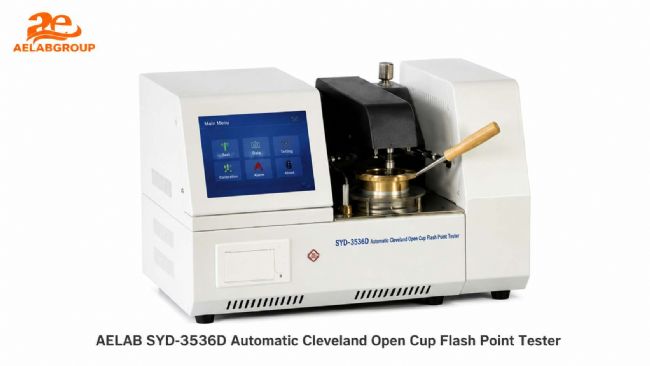
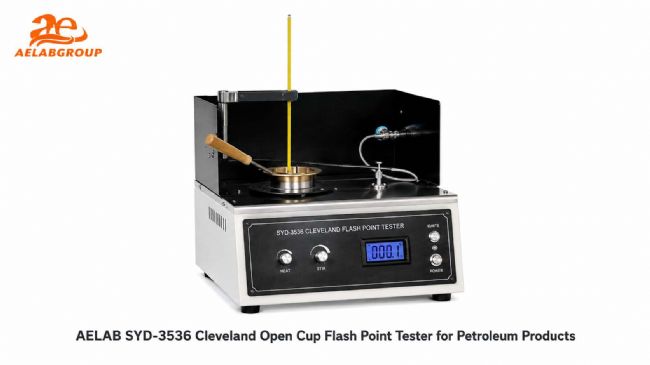
Should I select the SYD-3536 or SYD-3536D?
The SYD-3536 can be considered when a practical operator-controlled solution is preferred. The automatic SYD-3536D is more suitable when the laboratory requires additional automation and performs flash point testing regularly.
Can one flash point tester be used for every petroleum product?
No. The correct instrument depends on the product, expected flash point, open-cup or closed-cup requirement and the testing method specified by the laboratory or product standard.
Is an automatic tester more accurate than a manual tester?
Automation can improve consistency by controlling selected test steps and reducing operator variation. However, reliable results also depend on correct sample preparation, calibration, maintenance and compliance with the required test procedure.
What information should I provide before requesting a quotation?
Send the sample name, required testing method, expected flash point range, preferred automation level, power supply, destination country and any required accessories or data-output functions.
Can AELAB recommend a suitable flash point tester?
Yes. The AELAB technical sales team can review the application information and recommend a suitable model, configuration and optional accessories before preparing the quotation.
Request Flash Point Tester Price and Technical Proposal
Tell the AELAB technical sales team which petroleum product or combustible liquid you need to test, the required test method, expected flash point range and preferred automation level.
A suitable quotation can include recommended models, technical specifications, available accessories, spare parts, delivery time, export packaging and shipping information.
View AELAB Flash Point Testers Contact AELAB on WhatsApp
Email: info@aelabgroup.com
WhatsApp / WeChat: +86 158 0001 6110
Website: www.aelabgroup.com
bio-equip.cn AELAB GUANGZHOU CO., LTD.
AELAB is a laboratory equipment and analytical instrument supplier based in Guangzhou, China. We provide laboratory instruments, quality control equipment, analytical systems, sample preparation equipment, and related laboratory solutions for distributors, industrial laboratories, universities, research organizations, and testing centers worldwide.
AELAB offers both our own-brand products and carefully selected instruments from established manufacturers. OEM and ODM services are available for selected AELAB products, including customized branding, appearance, configuration, power supply, accessories, packaging, and documentation according to customer requirements.
For laboratory projects, distributor orders, government tenders, and complete laboratory setups, our team can provide a one-stop purchasing solution. We assist customers with product selection, technical comparison, quotation preparation, sourcing, quality inspection, export packaging, shipping coordination, and after-sales support.
Our technical team helps customers select suitable equipment based on their application, testing method, required specifications, budget, and local standards. Warranty and technical support are provided according to the product and project requirements.
AELAB operates under an established quality management system. Relevant company and product documentation may include SGS verification, ISO certification, CE, RoHS, FCC, or UL-related documentation, depending on the specific product model and configuration. Customers may contact us to confirm the available certificates before ordering.
Our equipment is widely used in industrial quality control, scientific research, universities, pharmaceutical laboratories, food and agricultural testing, environmental analysis, chemical laboratories, and other professional testing applications.
We are committed to developing long-term cooperation with distributors, laboratories, research institutions, and project contractors. If you are looking for a reliable laboratory equipment supplier with stable service and technical support, please contact AELAB.
Contact AELAB
Website:
https://aelabgroup.com
Email:
info@aelabgroup.com
WhatsApp / WeChat:
+86 15800016110
|
 中文
中文