1.Details
His-tag protein purification process typically employs immobilized metal ion affinity chromatography (IMAC) method, which utilizes the metal ions chelated by the ligand to adsorb histidine-tagged proteins. As the His-tagged recombinant protein can undergo affinity adsorption with chelated metal ions (such as Ni2+, Co2+, Cu2+, etc.), the adsorption and desorption of the target protein can be achieved by adjusting the eluent concentration in the solution, thereby accomplishing protein separation and purification. Bogen His-tag Purification Resins (IDA series) are specifically designed for His-tag fusion protein purification. It uses polyacrylate microspheres with rigid structure as the matrix and Triethylenediamine Triacetic Acid (TED) as the metal chelating ligand. Nickel chelate in standard reserve solution (commonly known as nickel resins). Even in solutions containing a certain amount of EDTA, Ni2+ can stably adsorb without detachment; meanwhile, during CIP cleaning, there is no need to re-plate nickel, and NaOH solution can be directly used for cleaning. This product can significantly save sample pretreatment and column post-treatment time, especially suitable for purifying His-tagged proteins secreted and expressed by eukaryotic cells such as insect cells and mammalian cells.
2.Features
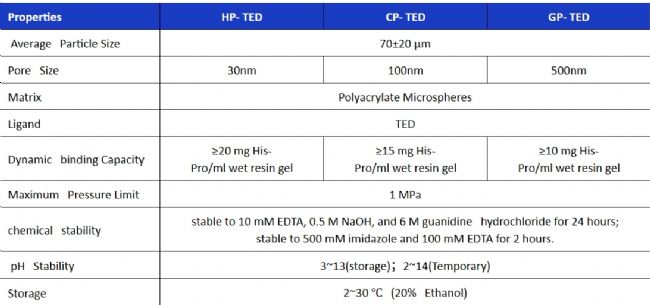
Operation Methods
The chromatographic operation of His-tag Purification Resins (IDA series) usually includes five steps such as equilibration, loading, washing, elution, and regeneration. The specific operations for each step are as follows:
1. Equilibration: Equilibrate the chromatography column with 5~10CV of equilibration buffer until the conductivity and pH of the effluent remain constant (consistent with the equilibration buffer). In practical operation, neutral/weakly alkaline (pH 7~8) high-salt (0.15~1.0 M NaCl or other neutral salt) buffer is commonly used. Phosphate buffer system is commonly chosen( 20 mM PB+0.5 M NaCl, pH 7.4.) For proteins with strong binding histidine tags, low concentration (20~40 mM) imidazole can be added to the equilibration buffer.
2. Sample loading: The conductivity and pH of loading sample should be as consistent as possible with the equilibration buffer. Solid samples can be dissolved and prepared in equilibration buffer; low-concentration sample solutions can be dialyzed with equilibration buffer; high-concentration sample solutions can be diluted with equilibration buffer. To avoid blocking the column, samples should be centrifuged or microfiltered. The loading volume can be calculated based on the binding capacity and the target protein content. To reduce non-specific protein adsorption on the column, imidazole concentration in the sample buffer can be appropriately increased while ensuring target protein adsorption. For inclusion body proteins, 8M urea or 6M guanidine hydrochloride can be added to the buffers for equilibration, sample loading, and elution accordingly.
3. Washing: After sample loading, column should be continue washed with equilibration buffer until the UV absorbance drops to baseline.
4. Elution: There are generally two methods of elution: competitive reagents elution and pH elution. Imidazole (0-0.5M), histidine (0-0.05M), or ammonium chloride (0-2M) can be used as competitive reagents to displace proteins from the column; target proteins can also be eluted by adjusting the pH value, as most proteins can be eluted at pH 4-6. When using competitive reagents imidazole or pH reduction to elute proteins, metal ions remain bound to the column; if histidine or ammonium chloride is used, both metal ions and protein complexes will be eluted together. The elution buffer should contain 0.15-1.0 M NaCl to eliminate ion exchange effects. Gradient elution should be performed at a constant pH of the initial equilibration buffer, using either linear or step gradients.
5. Regeneration: After multiple uses (depending on characteristics of loading samples), or before chelating other metal ions, regeneration is required.
(1) This product can is stable to certain concentrations of NaOH solution. For cleaning, NaOH solution can be used directly without nickel removal. Use 5-10 volumes of 0.1M NaOH to clean the column, remove pigments or other strongly adsorbed proteins, then rinse with 10-20 volumes of equilibrium buffer or deionized water to remove residual solution.
(2) When changing the chelated metal ion, nickel removal and regeneration are necessary.
Nickel removal: Clean the column with 5 volumes of EDTA solution (0.2M EDTA + 0.5M NaCl, pH 7.0) at a low flow rate (recommended 1/2 of normal loading flow rate), then rinse with 5 volumes of 0.5M NaCl to remove residual EDTA.
Nickel loading: Mix 3-5 volumes of 0.1M NiSO4 solution with the resins and stir for 4 hours, then filter. (Alternatively, in-column cleaning can be used: pass 3-5 column volumes of 0.1M NiSO4 solution through the column at a low flow rate. For thorough nickel loading, recirculate the NiSO4 solution three times.)
Equilibration: Clean the column with 3 volumes of deionized water, then rinse with 5-10 volumes of 0.25M imidazole + 0.5M NaCl solution to remove residual Ni2+, finally clean with 5 volumes of deionized water.
6. Storage: Clean the column with 2-5 volumes of 20% ethanol and store at 2-30°C.
7. Other attentions: Avoid column dry-out or leaks during use and storage to prevent air bubbles.
3.Specification
|
Product name
|
Item No.
|
Specification
|
Product name
|
Item No.
|
Specification
|
|
His-tag Purification Resins (HP-TED)
|
BG11-1113-02
|
50mL
|
His-tag Purification Resins (GP-TED)
|
BG11-3113-02
|
50mL
|
|
BG11-1113-04
|
500mL
|
BG11-3113-04
|
500mL
|
|
BG11-1113-05
|
1L
|
BG11-3113-05
|
1L
|
|
BG11-1113-07
|
10L
|
BG11-3113-07
|
10L
|
|
BG11-1113-08
|
20L
|
BG11-3113-08
|
20L
|
|
His-tag Purification Resins (CP-TED)
|
BG11-2113-02
|
50mL
|
|
|
BG11-2113-04
|
500mL
|
|
BG11-2113-05
|
1L
|
|
BG11-2113-07
|
10L
|
|
BG11-2113-08
|
20L
|
bio-equip.cn
Duoning Biotech is a leading one-stop bioprocess solutions provider from China, committed to offering products and services required for the discovery, development and commercialization production of biologics, including reagents, consumables, instruments, equipment, and services. Leveraging our integrated bioprocess system, we empower our customers to achieve effective, reliable, lower-cost and higher-quality biologics manufacturing processes.
 中文
中文