1.Details
His-tagged recombinant proteins are typically purified using immobilized metal ion affinity chromatography (IMAC), which relies on metal ions chelated by the ligand on the resin to selectively bind proteins containing histidine tags on their surface. The His tag on recombinant proteins can form affinity interactions with chelated metal ions (such as Ni²⁺, Co²⁺, Cu²⁺, etc.). By adjusting the concentration of the eluting agent in the solution, adsorption and desorption of the tagged proteins can be controlled, thereby achieving protein separation and purification.
The His-tag protein purification resin (TED) uses agarose gel microspheres as the matrix and employs triethylenediamine (TED) as the metal-chelating ligand. The standard preloaded metal ion is Ni²⁺ (commonly referred to as nickel resin). The chelated Ni²⁺ remains stably bound even in solutions containing certain amounts of EDTA. Additionally, during CIP cleaning, the resin does not require recharging with Ni²⁺ and can be cleaned directly with NaOH solution.
This product significantly reduces both sample pretreatment and post-purification resin handling time. It is particularly suitable for purifying His-tagged proteins secreted by eukaryotic expression systems such as insect cells and mammalian cells. Upon request, the resin can also be chelated with Cu²⁺, Co²⁺, Zn²⁺, and other metal ions.
2.Features
|
Parameter
|
Specification
|
|
Average Particle Size
|
90 ± 15 μm
|
|
Matrix
|
Agarose Gel Microspheres
|
|
Ligand
|
TED
|
|
Dynamic Binding Capacity
|
≥20 mg His-Pro/mL wet resin gel
|
|
Maximum Pressure Limit
|
0.3 MPa
|
|
Chemical Stability
|
Stable for 24 h in 10 mM EDTA, 0.5 M NaOH, and 6 M Guanidine HCl; stable for 2 h in 500 mM Imidazole and 100 mM EDTA
|
|
pH Stability
|
pH 3–13
|
|
Storage
|
2–30 °C (20% Ethanol)
|
Instructions for Use
Chromatographic operations for the His-tag Protein Purification Resin (BG TED FF) typically include the steps of equilibration, sample loading, washing, elution, and regeneration.
The detailed procedures are as follows:
-
Equilibration: Equilibrate the chromatography column with 5–10 CV of equilibration buffer until the conductivity and pH of the effluent remain constant (consistent with the equilibration buffer). In practice, neutral or weakly alkaline high-salt buffers (pH 7–8, containing 0.15–1.0 M NaCl or other neutral salts) are commonly used. Phosphate buffer systems are often used, such as 20 mM PB + 0.5 M NaCl, pH 7.4. For His-tagged proteins with strong binding affinity, a low concentration of imidazole (20–40 mM) may be added to the equilibration buffer.
-
Sample Loading: The sample buffer should be as consistent as possible with the equilibration buffer. Solid samples may be dissolved in equilibration buffer; dilute samples may be dialyzed against equilibration buffer; and concentrated samples may be diluted with equilibration buffer. To avoid clogging the column, the sample must be centrifuged or microfiltered before loading. The feed volume should be calculated based on the binding capacity of the resin and the content of the target protein in the sample solution. To reduce nonspecific protein adsorption on the column, the concentration of imidazole in the sample buffer may be appropriately increased while ensuring sufficient binding of the target protein. For inclusion body proteins, 8 M urea or 6 M guanidine hydrochloride may be added to the equilibration, loading, and elution buffers.
-
Washing: After sample loading, continue washing with equilibration buffer until the UV absorbance drops to baseline.
-
Elution: Protein elution is generally performed using one of the following methods:
-
Competitive elution: Using agents such as imidazole (0–0.5 M), histidine (0–0.05 M), or ammonium chloride (0–2 M) to displace the protein from the resin.
-
pH reduction: Lowering the pH can elute the target protein; most proteins can be eluted at pH 4–6.
When eluting with imidazole or lowering the pH, the metal ions remain bound to the resin; however, elution with histidine or ammonium chloride will elute the metal–protein complex together.
The elution buffer must contain 0.15–1.0 M NaCl to eliminate ion-exchange interactions. Gradient elution is best performed at a constant pH of the equilibration buffer and may be carried out using a linear or stepwise gradient.
-
Regeneration: After multiple uses (depending on sample and impurity characteristics) or before chelating other metal ions, the resin must be regenerated.
(1) Alkaline cleaning without removing Ni: The resin tolerates certain concentrations of NaOH and can be cleaned directly with NaOH without removing Ni.
Use 5–10 CV of 0.1 M NaOH to clean the resin to remove pigments and strongly adsorbed proteins, followed by 10–20 CV of equilibration buffer or deionized water to remove residual NaOH.
(2) Metal ion replacement—removal and recharging of Ni:
Ni removal: Wash the resin with 5 CV of EDTA solution (0.2 M EDTA + 0.5 M NaCl, pH 7.0) at a low flow rate (recommended: half the normal loading rate), followed by 5 CV of 0.5 M NaCl to remove residual EDTA.
Ni recharging: Mix the resin with 3–5 CV of 0.1 M NiSO₄ solution and stir for 4 hours, then filter. (Alternatively, apply 3–5 CV of 0.1 M NiSO₄ onto the column at a low flow rate. For complete recharging, NiSO₄ solution may be circulated through the column three times.)
Re-equilibration: Wash the resin with 3 CV of deionized water, then with 5–10 CV of 0.25 M imidazole + 0.5 M NaCl solution to remove residual Ni²⁺, and finally wash with 5 CV of deionized water.
-
Storage: Wash the resin with 2–5 CV of 20% ethanol and store at 2–30°C.
-
Other Considerations: During use and storage, avoid drying the column or improper sealing to prevent air bubbles from entering.
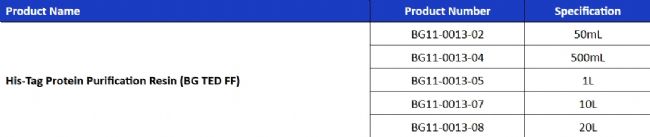
3.Specification
bio-equip.cn
Duoning Biotech is a leading one-stop bioprocess solutions provider from China, committed to offering products and services required for the discovery, development and commercialization production of biologics, including reagents, consumables, instruments, equipment, and services. Leveraging our integrated bioprocess system, we empower our customers to achieve effective, reliable, lower-cost and higher-quality biologics manufacturing processes.
 中文
中文