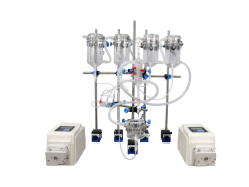
Introduction:
This system is a comprehensive set of eguipment designed to perform ex vivo cardiac perfusion experiments. in theseexperiments, the heart is removed from an animal and connected to a specialized perfusion device. it is then perfused with asolution to maintain cardiac activity. This system is used to study changes in cardiac func tion and hemodynamics under path ologicaand physiological conditions. it is an effective tool for studying cardiac physiology, pathology, phamacology, and myocardialbiochemistry and metabolism.With its high repeatability an d stability, this system ensuresreliableresearch results.
Langendorff Perfusion System:
·Langendorf perfusion is a simple perfusion method in which oxygenated Krebs-Henseleit (KH) solution or Tyrode's solution isperfused through the aorta directly into the coronary arteries to maintain cardiac activity.
·The perfusion solution does not enter the atria orventricles because there is no fuid in the ventrides. This perfusion method iscritical fordemonstrating the mechanisms of cardiac pacing.
·Typically, cardiac activity can be maintained for several hours. Parameters that can be monitored include perfusion pressure.ventricular pressure (using a balloon method), cardiac metabolism, electrocardiogram (ECG), myocardial tension, and others.Thismethodalso allows easyisolation of myocardial.
Working Heart Perfusion System:
·The Working Heartmodel, introduced by Neely et al.in 1967 as an adaptation ofthe Langendorff model, is widely adopted for itsability to better replicate physiological conditions. ts primary advantage lies in the adjustable left ventricular prelo ad, allowingthe heart to perform work similar to that in vivo. This setup cosely approximates in vivo conditions when measuring cardiacenergy metabolismand myocardial enzyme profiles.
·In the Working Heart perfusion experiment, perfusate flows through the left atrium into the left ventricle. The ventricularcontraction then overcomes aortic resistance, ejecting the solution into a simulated aortic pathway, thereby maintainingphysiological perfusion conditions. Within this system, left ventricular filling pressure (preload) and aortic columnheight (afterload) can be held constant, accurately simulating in vivo cardiac workload. This approach provides significant insights for advanced research.
·To enable researchers to customize systems according to their specific needs, this setup features a fully modular design.Starting from a Langendorff perfusion system, additional measurement components can be integrated to upgrade to aWorking Heart perfusion model, allowingfor flexible, tailored configurations.
bio-equip.cn
MappingLab is a leading enterprise specializing in the R&D of electrophysiological mapping scientific research equipment, co-founded by world-renowned, highly experienced scientists from the University of Oxford and the University of Manchester in the United Kingdom. PEVI Instruments Co. Ltd, Henan serves as MappingLab's translational entity in China, holding the registered trademark of MappingLab for the Chinese market. In late 2023, the company successfully established a localized production line for MappingLab in China.
Our mission is to provide the global community of electrophysiological researchers with the highest-quality mapping systems, and to address the critical challenges in electrophysiological detection across key areas including the fundamental research on the mechanisms of heart diseases, preclinical cardiac safety evaluation of pharmaceuticals, and the electrophysiological testing of induced pluripotent stem cell-derived cardiomyocytes (iPSC-CMs) and other differentiated cells.
To date, leveraging our robust product advantages, comprehensive professional technical support, extensive practical experience, and a commitment to rigorous customer service, our core products—including Electrical Mapping systems and Optical mapping systems—have been widely adopted by research institutions worldwide. We have forged strategic collaborations with the most esteemed experts in the global electrophysiological research field and established a strong network of authorized equipment distributors.
Additionally, we maintain close academic exchanges with a roster of world-class universities and research institutions, such as the University of Oxford, the University of Manchester, Harvard University, Peking University, the University of Toronto, and the University of Technology Sydney.
At MappingLab, we are unwaveringly dedicated to designing and developing highly automated instruments for researchers across the globe. We uphold a customer-centric approach by empowering .
 中文
中文