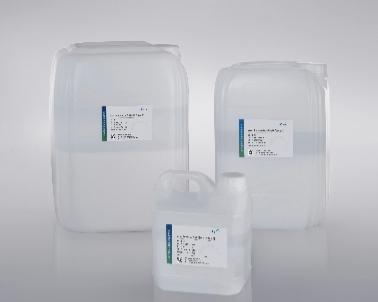
1.Details
Ion exchange chromatography (IEC) is one of the most commonly used methods for the separation and purification of biomacromolecules, based on the specificity of surface charges (type, number, and distribution) on biological molecules. The high-capacity weak anion exchange resins developed by Duoning use polymethacrylate microspheres with a rigid structure as the matrix. Through proprietary surface modification technology, the hydrophilicity of the polymer matrix is significantly enhanced. Additionally, high-capacity ligands designed by Duoning improve the adsorption performance of ion-exchange functional groups, giving the resins the advantages of high binding capacity, low nonspecific adsorption, and excellent biocompatibility.
These resins fully meet the purification needs of biomacromolecules such as peptides, recombinant proteins, nucleic acids, vaccines, antibodies and their derivatives, viruses, and virus-like particles. This type of resin from Duoning features high throughput and is particularly suitable for viscous feed materials. A series of products with various particle sizes and pore sizes can be provided to meet different customer application requirements, supporting capture, intermediate purification, polishing, and analytical purification. This enables comprehensive solutions for biological sample purification from laboratory scale to industrial production.
2.Features
Product Specifications
Table 1: Overview of Duoning Microporous High-capacity Weak Anion Exchange HPDEAEHL Series Resin Parameters
|
Specifications / Model
|
HPDEAEHL-30
|
HPDEAEHL-60
|
|
Average Particle Size
|
40μm±10μm
|
70μm±20μm
|
|
Pore Size
|
30nm
|
|
Matrix
|
Polymethacrylate
|
|
Functional Group
|
Tertiary Amine (-(CH2)2N(C2H5)2)
|
|
Functional Group Type
|
Weak Base Ligand
|
|
Dynamic Binding Capacity
|
≥80mg BSA/ml wet resin gel
|
≥60mg BSA/ml wet resin gel
|
|
Typical Applications
|
Polishing Purification of Recombinant Proteins, Enzymes, Peptides, Nucleic Acids, etc.
|
|
Maximum Pressure Limit
|
1 MPa
|
|
pH Stability
|
pH 3-13
|
|
Storage
|
2~30 ℃ (20% Ethanol)
|
Table 2: Overview of Duoning Macroporous High-capacity Weak Anion Exchange CPDEAEHL Series Resin Parameters
|
Specifications / Model
|
CPDEAEHL-30
|
CPDEAEHL-60
|
|
Average Particle Size
|
40μm±10μm
|
70μm±20μm
|
|
Pore Size
|
100nm
|
|
Matrix
|
Polymethacrylate
|
|
Functional Group
|
Tertiary Amine (-(CH2)2N(C2H5)2)
|
|
Functional Group Type
|
Weak Base Ligand
|
|
Dynamic Binding Capacity
|
≥40mg BSA/ml wet resin gel
|
|
Typical Applications
|
Recombinant Proteins, Blood Products, Enzymes, Polysaccharides, Nucleic Acids, etc.
|
|
Maximum Pressure Limit
|
1 MPa
|
|
pH Stability
|
pH 3-13
|
|
Storage
|
2~30 ℃ (20% Ethanol)
|
Table 2: Overview of Duoning Super-Macroporous High-capacity Weak Anion Exchange GPDEAEHL Series Resin Parameters
|
Specifications / Model
|
GPDEAEHL-60(500)
|
|
Average Particle Size
|
70μm±20μm
|
|
Pore Size
|
500nm
|
|
Matrix
|
Polymethacrylate
|
|
Functional Group
|
Tertiary Amine (-(CH2)2N(C2H5)2)
|
|
Functional Group Type
|
Weak Base Ligand
|
|
Dynamic Binding Capacity
|
≥20mg BSA/ml wet resin gel
|
|
Typical Applications
|
Macromolecules such as Nucleic Acids, Plasmids, Viruses, Vaccines, Blood Products, etc.
|
|
Maximum Pressure Limit
|
1 MPa
|
|
pH Stability
|
pH 3-13
|
|
Storage
|
2~30 ℃(20%Ethanol)
|
Instructions for Use
Duoning High-capacity Weak Anion Exchange Resins are widely used for the chromatographic separation of recombinant proteins, blood products, enzymes, polysaccharides, nucleic acids, and other biomolecules. Typical chromatographic operations include alkaline cleaning/disinfection, equilibration, sample loading, washing, elution, regeneration, and in-place cleaning (CIP).
The detailed procedures are as follows:
Alkaline Cleaning/Disinfection: Rinse the chromatography column at a low flow rate with 0.5 M NaOH for 30 minutes.
Equilibration:
Acidic Buffers: First, rinse with high-concentration buffer (e.g., 500 mM HAc-NaAc, pH 5.2) for 10 CV, then equilibrate with deionized water for approximately 5 CV, and finally equilibrate with low-concentration buffer (e.g., 20 mM HAc-NaAc, pH 5.2; the exact buffer system should be screened and optimized based on the stability and isoelectric point of the target protein) at 250–500 cm/h for 4–6 CV until the conductivity and pH of the effluent are stable (consistent with the equilibration buffer).
Basic Buffers: Equilibrate the column with 10–20 CV of buffer A (e.g., 20 mM Tris-HCl, pH 8.0; the exact buffer system should be screened and optimized according to the stability and isoelectric point of the target protein) at 250–500 cm/h until the conductivity and pH of the effluent remain stable (consistent with the equilibration buffer).
Sample Loading: The sample buffer should be as consistent as possible with the equilibration buffer. Solid samples can be dissolved in equilibration buffer; low-concentration samples can be dialyzed against equilibration buffer or supplemented with an appropriate amount of salt; high-concentration samples can be diluted with equilibration buffer. To avoid column clogging, the sample should be centrifuged or microfiltered (0.45 μm) before loading. The loading volume should be calculated based on the resin capacity and the content of the target protein in the sample.
Washing: After sample loading, continue washing with equilibration buffer until the UV absorbance returns to baseline.
Elution: Elute the target protein using elution buffer (e.g., 20 mM Tris-HCl + 1 M NaCl, pH 8.0). Elution can be performed using a pH gradient, linear gradient, or stepwise gradient. Collect the effluent.
Regeneration: After each chromatography run, wash the column with 1–2 M NaCl to remove strongly bound proteins.
Cleaning in place (CIP): After 5–10 uses of the column (depending on the type and source of feedstock and experimental requirements), perform CIP as follows:
For proteins strongly bound via ionic interactions, wash with 2 M NaCl for 3–4 CV.
For precipitated proteins, hydrophobically bound proteins, or lipoproteins, wash with 0.5 M NaOH for 3–4 CV.
For strongly hydrophobic proteins, lipoproteins, or lipid contaminants, wash with 70% ethanol or 30% isopropanol at a flow rate below the maximum pressure limit for 5–10 minutes. (When using high-concentration organic solvents, gradually increase the organic solvent concentration to avoid air bubble formation.)
Storage: Store the resin at 2–30°C in 20% ethanol. Columns can also be flushed with 20% ethanol and stored at 2–30°C.
Other Considerations: During use and storage, avoid drying out the column or improper sealing to prevent air bubbles from entering.
3.Specification
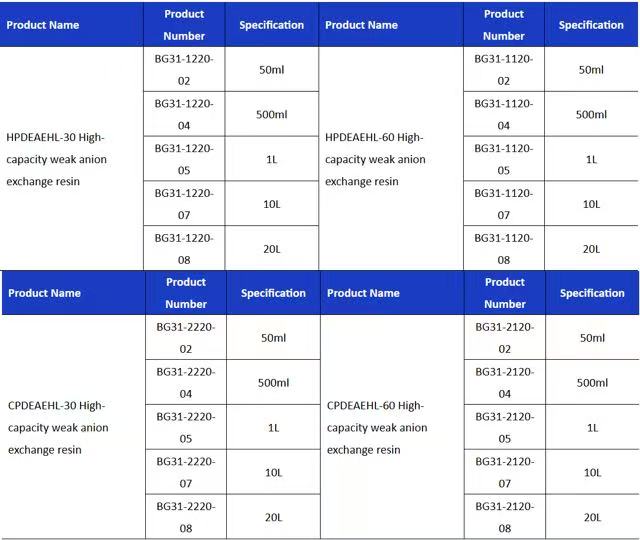
bio-equip.cn
Duoning Biotech is a leading one-stop bioprocess solutions provider from China, committed to offering products and services required for the discovery, development and commercialization production of biologics, including reagents, consumables, instruments, equipment, and services. Leveraging our integrated bioprocess system, we empower our customers to achieve effective, reliable, lower-cost and higher-quality biologics manufacturing processes.
 中文
中文