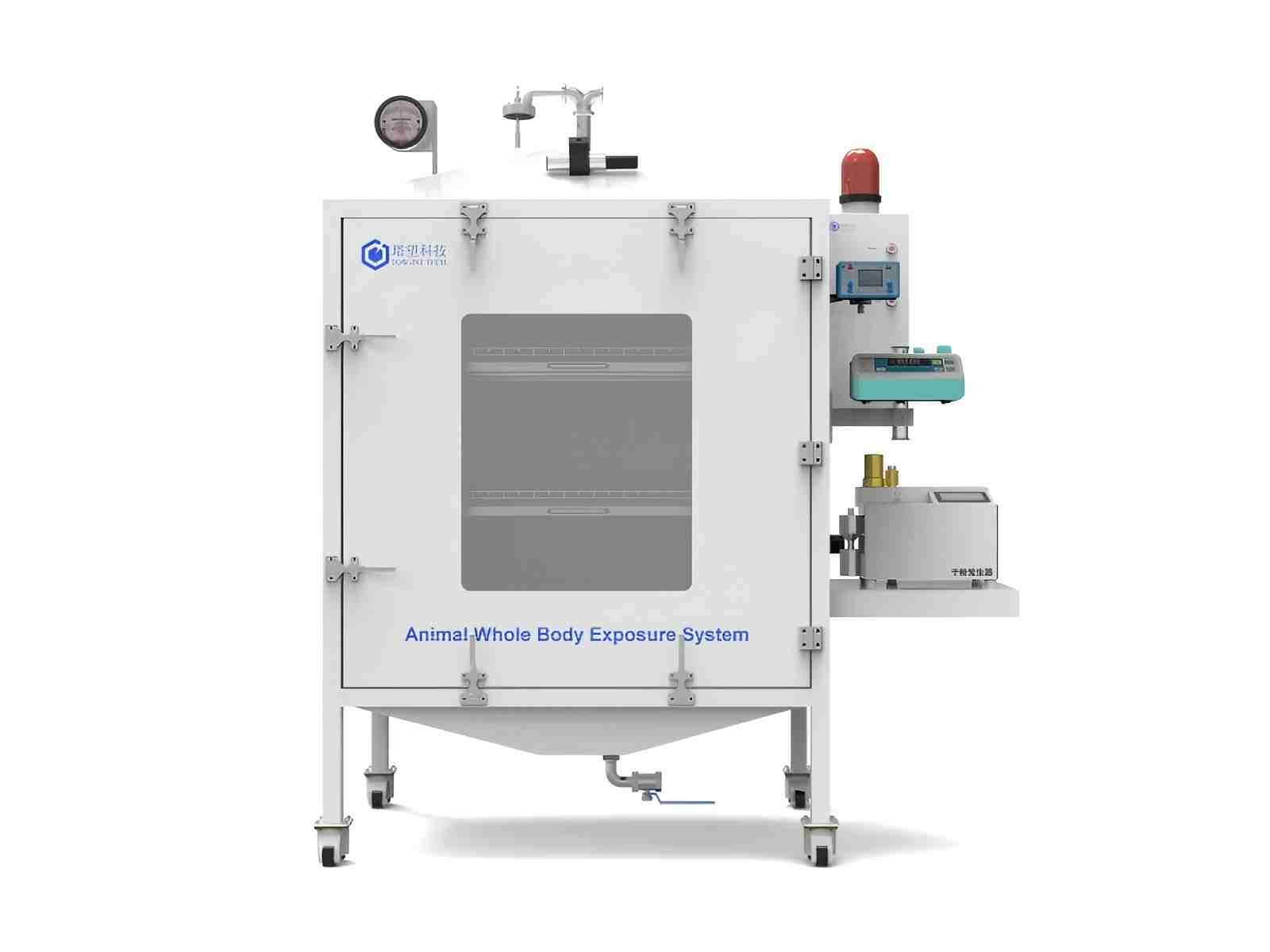
Detailed Introduction (WBE)
The Whole-Body Exposure System is a commonly used experimental apparatus in toxicology, pharmacology, and environmental health sciences. It is designed to expose laboratory animals (such as mice, rats, guinea pigs, etc.) to controlled concentrations of test substances in gaseous, vapor, or aerosol form through natural respiratory pathways. Unlike the Nose-only Exposure System, which restricts exposure to the respiratory tract, the Whole-Body Exposure System allows the animals’ entire bodies (including skin and fur) to be exposed to the test environment.
1. Simulating Realistic Exposure Scenarios:
The Whole-Body Exposure System more accurately simulates real-world exposure conditions, such as air pollution, chemical spills, or aerosolized drug delivery. It enables the study of how pollutants enter the body through multiple pathways such as inhalation and dermal contact.
2. Comprehensive Analysis of Multiple Exposure Routes:
Inhaled substances can affect not only the respiratory system but also enter the bloodstream and reach other target organs (e.g., cardiovascular system, nervous system, liver, kidneys). Whole-body exposure provides a more complete assessment of the systemic toxicity of test substances.
Product Features
1. Multi-Substance Compatibility:
Compatible with a wide range of test materials, including PM2.5 particles, cigarette smoke, VOC aerosolized organic solvents, liquid aerosol mist, methane, dust, nanoparticles, pollen, etc., meeting diverse research requirements.
2. Environmental Parameter Control and Monitoring:
Equipped with an advanced control system to monitor and display temperature, humidity, pressure, oxygen concentration, carbon dioxide concentration, and drug concentration in real-time. The gas flow control system ensures accurate and stable exposure concentrations.
3. Data Recording and Traceability:
Records a variety of experimental data including environmental parameters, exposure duration, and animal reactions, enabling researchers to review and analyze at any time. These data are essential for evaluating results, identifying trends, and informing future studies.
4. Exhaust Gas Treatment:
Features a high-efficiency exhaust treatment system that filters and purifies harmful substances in the exhaust, reducing them to safe levels to protect laboratory personnel and the environment.
5. SUS304 Stainless Steel Construction:
The chamber is constructed from SUS304 stainless steel, offering excellent sealing and corrosion resistance to prevent leakage of toxic gases.
6. Lighting Control:
Equipped with built-in LED lights that can be manually switched on/off. Lights improve visibility during experiments for better observation of animal behavior and responses. Lights can be turned off to simulate specific environments (e.g., circadian rhythm studies).
7. Ultraviolet Sterilization:
Built-in UV lights can be activated after experiments to sterilize the interior using powerful UV germicidal effects. This effectively eliminates residual pathogens and microorganisms, preventing cross-contamination.
8. Video Monitoring:
Supports real-time observation and playback. Users can monitor animal status, record behavior, and abnormal reactions during exposure, capturing subtle physiological changes and providing visual support for data analysis. This ensures experiment traceability and detail retention.
9. Alarm Indicator:
Allows setting of alarm parameters (e.g., exposure concentration thresholds, abnormal temperature/humidity). If parameters exceed preset values, the alarm light flashes and a buzzer alerts staff to intervene promptly.
10. Spraying Systme:
After the experiment, connect to a water source to activate the spray system for internal rinsing. It helps clean residue and animal waste efficiently, reducing manual cleaning efforts.
Stainless Steel Mesh Exposure Cage

Applications
1. Core Tool in Toxicology Research:
- Inhalation Toxicity Assessment: Evaluate the acute, sub-chronic, and chronic toxicity of chemicals, drugs, nanoparticles, industrial materials, and air pollutants through inhalation (including lethality, organ damage, carcinogenicity, etc.).
- Dose-Response Relationship: Precisely study the relationship between exposure levels and toxic effects by controlling concentration and duration. Provides key data for setting safety limits (e.g., occupational exposure limits, air quality standards).
- Mechanism of Action Studies: Investigate how pollutants enter and behave within the body—absorption, distribution, metabolism, and excretion (ADME)—as well as toxicity mechanisms such as inflammation, oxidative stress, and genotoxicity.
2. Health Effects of Air Pollution:
- Research the impact of urban air pollutants (e.g., vehicle emissions, industrial discharge), indoor pollutants (e.g., secondhand smoke, cooking fumes, formaldehyde), and harmful gases (e.g., ammonia, hydrogen sulfide) on respiratory diseases (asthma, COPD), cardiovascular conditions, and neurodegenerative disorders.
3. Occupational and Environmental Health Risk Assessment:
- Evaluate risks posed by chemical exposure in specific workplaces (e.g., chemical plants, mining sites, dusty environments).
- Assess potential health risks of environmental pollutants to the general population, especially vulnerable groups such as children and the elderly.
4. Realistic Simulation of Group Exposure Scenarios:
- Animals can move relatively freely within the chamber, and behaviors (e.g., grooming) may influence exposure routes (e.g., dermal contact, oral ingestion), better simulating real-world, multi-route exposure scenarios.
5. High Efficiency Compared to Individual Exposure:
- A single exposure chamber can accommodate multiple animals simultaneously, increasing experimental efficiency. Particularly suitable for chronic studies requiring large sample sizes.
Configuration
| Name |
Model |
Description |
Unit |
| High-Throughput Whole-Body Animal Exposure System |
WBE-850-LD |
- Standard with both liquid and dry powder aerosol generators
- Holds 9 exposure cages
- External dimensions(W×D×H):1600x800x1800mm
- Approx. weight::200kg
|
set |
*Our company can provide customized services according to customers' special applications, requirements, as well as experimental services. Please kindly contact us for more information.
bio-equip.cn
TOW-Int, as a high-tech enterprise focusing on the research and development, production and sales of animal experimental equipment and cell research instruments, has always been committed to providing customers with cutting-edge, efficient and stable scientific research solutions.The company is committed to breaking technical barriers, and providing accurate solutions for global customers.
Tow-Int offers a wide range of products, including:
1. Metabolic science experimental equipment,
2. Respiratory study equipment,
3. Laboratory animal hyperbaric and hypobaric chamber,
4. Incubators for cellular study,
5. Animal inhalation and exposure systems.
We are opening for global collaborations, if you want to become our distribution partner, please kindly contact us for more information.
|
 中文
中文