Introduction:
Cardiac optical mapping has become an important technique to investigate the mechanisms of cardiacarrhythmias. This technology utilizes fluorescence-based imaging to study the electrical properties ofmulticellular cardiac preparations. its use is well-suited to study a variety of biological samples, includingbut not limited to isolated hearts, intact cardiac tissue preparations, muscle slice, and monolayers ofpluripotent stem-cell derived or neonatal cardiac myocytes. Optical mapping is assisted with the useof voltage and/or calcium-sensitive dyes while using imaging systems to record electrical activity andcalcium transients from the surface of the heart. Due to its potential to generate high spatio-temporaresolution information on electrophysiological properties, optical mapping is a popular experimentaltechnique that has been used to interrogate the fundamental mechanisms governing the electricalstability of the heart in health and disease.
Applicable samples:
isolated heart, atrial tissue, ventricular tissue, sinoatrial node, atrioventricularnode, Purkinje fibres, myocardial sections, cardiomyocyte layers (containing iPsC-cardiomyocyte layersprimary cell layers), tissues of the gastrointestinal tract, gallbladder, and uterine smooth muscle.
Optical Mapping System:
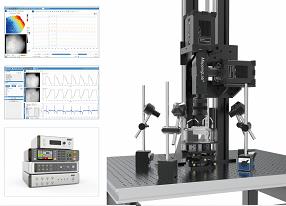
MappingLab Ltd provides standard OMS-PCIE-1001, OMS-PCIE-1002 and OMS-PClE-2002 system as wellas tailor-made systems. Dual signal optical mapping systems enable users to record cardiac membranepotential and calcium imaging simu ltaneously. Our latest optical mapping system is equipped with th eback lluminated scientific cMOs cameras with 95% quantum efficiency (QE) and pixel size of 6.5 um x 6.5um to 1 1 um x 11 um. lt has a high speed and low noise acquisition with a dynamic range up to 50,000:1(94dB). The optical axis can be constructed either vertically or horizontally. There are various l/0 connectorsfor helping researchers to set up the communication system. The software of the optical mapping systemalso has an advanced intuitive user interface. A 8-channel TTL controller is designed for synchronizingdevices such as camera, LED light controller, stimulator, ECG, MAP, pressure and temperature probewith the optical mapping system. The OMapRecord/Scope is an advanced data acquisition and analysissoftware which has a user-friendly intuitive interface and highly efficient data management.
bio-equip.cn MappingLab is a leading enterprise specializing in the R&D of electrophysiological mapping scientific research equipment, co-founded by world-renowned, highly experienced scientists from the University of Oxford and the University of Manchester in the United Kingdom. PEVI Instruments Co. Ltd, Henan serves as MappingLab's translational entity in China, holding the registered trademark of MappingLab for the Chinese market. In late 2023, the company successfully established a localized production line for MappingLab in China.
Our mission is to provide the global community of electrophysiological researchers with the highest-quality mapping systems, and to address the critical challenges in electrophysiological detection across key areas including the fundamental research on the mechanisms of heart diseases, preclinical cardiac safety evaluation of pharmaceuticals, and the electrophysiological testing of induced pluripotent stem cell-derived cardiomyocytes (iPSC-CMs) and other differentiated cells.
To date, leveraging our robust product advantages, comprehensive professional technical support, extensive practical experience, and a commitment to rigorous customer service, our core products—including Electrical Mapping systems and Optical mapping systems—have been widely adopted by research institutions worldwide. We have forged strategic collaborations with the most esteemed experts in the global electrophysiological research field and established a strong network of authorized equipment distributors.
Additionally, we maintain close academic exchanges with a roster of world-class universities and research institutions, such as the University of Oxford, the University of Manchester, Harvard University, Peking University, the University of Toronto, and the University of Technology Sydney.
At MappingLab, we are unwaveringly dedicated to designing and developing highly automated instruments for researchers across the globe. We uphold a customer-centric approach by empowering .
|
 中文
中文