Introduction:
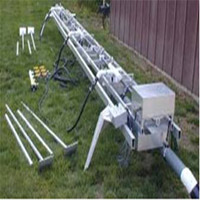
The artificial rainfall simulator generates raindrops through a rapid oscillation mechanism and employs a vertically downward pressure-spray design, endowing the droplets with high kinetic energy and strong resistance to wind interference. Compared to conventional field-based simulation systems, this technology ensures more stable droplet trajectories and minimal deviation caused by natural wind, enabling accurate simulation of natural precipitation with significant water erosion potential. This system provides controllable experimental conditions for studying surface erosion processes. Researchers can systematically analyze the mechanisms by which factors such as slope gradient, surface cover, and soil texture influence sheet erosion (e.g., topsoil loss) and rill erosion (e.g., gully development). The resulting quantified soil and water loss data support the scientific design of ecological engineering projects and soil conservation planning.
Operating Principle:
The artificial rainfall generator operates on an oscillation-based principle. Its specialized nozzle design allows precise control over raindrop diameter and rainfall intensity. System specifications are as follows: nozzle spacing of 1.35 m, installation height of 2.5 m above ground. Rainfall intensity is regulated jointly by nozzle orifice size and the hydraulic pressure system, with an adjustable range of 6.5–130 mm/h. (Note: There is a nonlinear relationship between pressure and rainfall amount—excessively high pressure may increase ejection velocity but reduce effective coverage area, thereby decreasing actual rainfall per unit time.)
Main System Components
- Aluminum alloy frame
- Touchscreen-controlled operating system
- Adjustable support columns
- Specialized spray nozzles
- Dedicated water supply system
- Pressure regulation unit
Technical Specifications:
|
No.
|
Model
|
Rainfall Area
|
Rainfall Intensity Range
|
Operating Model
|
Operation Interface
|
Operating Temperature
|
Installation Slope
|
|
1
|
DJ-2500
|
1.33 × 1.5 m
|
Standard adjustment intensity
6.5 – 130 mm/h
|
Human-machine interface operation, dual-mode multi-level adjustment. Customizable rainfall intensity mode allows arbitrary setting according to experimental requirements.
|
65,536-color TFT LCD touchscreen, 7-inch display
|
1 – 50 °C
|
< 15°
|
|
2
|
DJ-2501
|
2.0 × 1.5 m
|
|
3
|
DJ-2502
|
4.5 × 1.5 m
|
bio-equip.cn
Dianjiang Technology (www.Dianjiangtech.cn) has been dedicated to the research, development, sales, and service of scientific research and application systems and instruments related to ecological environment and modern agriculture since 2001. Headquartered in Shanghai, the company has established regional offices in Hong Kong, Beijing, Kunming, Hefei, and Xi'an to promptly respond to customer needs. The company has always been committed to providing users with more advanced technologies and instruments, as well as superior services, covering fields such as soil science, plant science, environmental meteorology, hydrology and water quality, marine science, zoology, entomology, and modern agriculture.
Dianjiang Technology consistently adheres to the principles of integrity, professionalism, efficiency, and gratitude, providing our valued customers with comprehensive quality services including industry updates, project design, solution consultation, product selection, professional procurement, installation training, and ongoing maintenance. The company has also participated in numerous national and provincial/ministerial-level major scientific research projects, providing technical support for initiatives such as the Ministry of Education's "211" and "985" university construction projects, the Ministry of Water Resources' "948" project, the Ministry of Agriculture's "Discipline Cluster" program, the Chinese Ecosystem Research Network (CERN), and the Chinese Forest Ecosystem Research Network (CFERN). The company has earned an excellent reputation through its quality services.
Featured Projects:
Ancient and Famous Tree Detection
Soil Lysimeter and Evapotranspiration Monitoring
UAV Remote Sensing
Carbon Source and Sink Monitoring
 中文
中文